 listicle
Best Workwear Suppliers 2026: Norfolk Guide
Table of Contents
- What to Look for in a Workwear Supplier
- Top Workwear Suppliers for Norfolk Businesses
- Workwear East: Local Embroidery and DTF Printing
- EPT Workwear: Comprehensive Safetywear and Customisation
- Workwear (East Anglia) Ltd: Local Range with Print Services
- National Workwear: Managed Solutions and Heat Press
- Cintas Uniform Services: Rental and Purchase Programs
- Union Overall Company: Handcrafted Heritage Workwear
- Custom Embroidery Services: Durability and Quality
- Workwear Safety Standards UK: What You Need to Know
- How to Choose a Workwear Supplier: Key Considerations
- Turnaround Times and Bulk Order Capabilities
- Conclusion
Last Updated: August 11, 2026
What to Look for in a Workwear Supplier
Finding the right workwear supplier means understanding what separates a vendor that simply ships items from one that becomes a genuine business partner. The best workwear suppliers don't just stock inventory, they understand durability, brand consistency, and the specific demands of your industry.
When evaluating workwear suppliers, focus on three core areas: customisation capabilities, quality standards, and turnaround reliability. A supplier worth partnering with will offer multiple decoration methods (embroidery, DTF printing, screen printing) rather than forcing you into a single approach. They should be transparent about fabric composition, stitch density, and thread specifications, not vague marketing language. Turnaround times matter enormously; a supplier who promises three weeks but delivers in five costs you more than the one charging slightly higher rates upfront.
The companies listed below represent strong options for businesses. Each brings distinct strengths: some excel at bulk ordering and managed solutions, others specialise in heritage craftsmanship or rapid customisation. The key is matching your operational needs to their actual capabilities.
Top Workwear Suppliers for Norfolk Businesses
1. Workwear East: Local Embroidery and DTF Printing
Workwear East stands as a strong choice for businesses seeking custom workwear with genuine local accountability. Based in Thetford, they specialise in advanced embroidery and DTF (Direct-to-Film) printing, two techniques that deliver durability and visual impact.

Their advanced embroidery machines handle intricate, multi-colour designs. Versatile DTF printing applies detailed, full-colour images on various materials. For larger orders, their cost-effective screen printing delivers vibrant, long-lasting results.
What makes them different: proximity. When issues arise (sizing problems, colour matching concerns, rush orders), you're working with a local team who understands your business context. They provide access to their online ordering portal, simplifying reorders across multiple departments and staff sizes. This matters more than it sounds, managing 50 staff across different sizes becomes a genuine headache without proper systems.
The durability question surfaces repeatedly from prospects who've experienced logos cracking or peeling after a few washes. Workwear East addresses this through proper stabiliser selection, appropriate thread tension, and fabric pre-treatment. Their embroidered garments maintain integrity through regular industrial washing because they treat the process as precision work, not volume production.
For a quote tailored to your specific requirements, whether you need 15 branded polo shirts or 200 mixed items across departments, email info@workweareast for a quote. Their team will discuss your exact use case, fabric preferences, and timeline before providing pricing.
2. EPT Workwear: Comprehensive Safetywear and Customisation
EPT Workwear operates from Leicester but serves the full UK market with a focus that extends beyond standard uniforms into proper safetywear and PPE. Their range spans workwear, uniforms, flame-resistant clothing, and safety footwear, making them valuable for industries where compliance matters as much as branding.
They offer embroidery and printing customisation, provide samples for sizing verification, and assist with artwork creation. Their reputation centres on quick turnaround times and responsive customer service. Construction firms, nurseries, and community service organisations use them regularly, suggesting they understand sector-specific requirements beyond generic corporate uniforms.
The trade-off: they're not local. Turnaround times are reasonable, but physical samples require posting. For businesses needing rapid iteration or same-week adjustments, this distance creates friction that Workwear East's local presence eliminates.
3. Workwear (East Anglia) Ltd: Local Range with Print Services
Operating locally within East Anglia, Workwear (East Anglia) Ltd combines workwear with country wear and men's fashion, a positioning that appeals to businesses wanting professional appearance without the industrial aesthetic. They offer embroidery and print services alongside their product range.
Their advantage lies in local knowledge and diverse product selection. Their disadvantage: limited online transparency regarding specific products, pricing, and service capabilities. The website suggests they're still developing e-commerce functionality, which may complicate ordering for teams preferring digital management.
4. National Workwear: Managed Solutions and Heat Press
National Workwear positions itself as a managed workwear solution provider, meaning they handle the complexity of outfitting crews rather than simply selling garments. They offer in-house customisation through embroidery, screen printing, and heat press application.
Their heat press capability matters for smaller quantities and specialty fabrics like hi-vis apparel, where embroidery density might compromise visibility or durability. For businesses wanting to outsource the entire workwear management process, procurement, customisation, reordering, their managed approach eliminates internal coordination overhead.
The catch: they operate nationally rather than locally, and pricing requires direct consultation.
5. Cintas Uniform Services: Rental and Purchase Programs
Cintas operates a fundamentally different business model: uniform rental with included laundering, repairs, and maintenance. They also offer direct purchase options for businesses preferring ownership.
This model suits large organisations with consistent uniform needs and the infrastructure to manage laundry logistics. For smaller teams or businesses wanting branded items employees take home, the rental model adds complexity. Their strength is professional management; their limitation is inflexibility for customisation timelines.
6. Union Overall Company: Handcrafted Heritage Workwear
Union Overall Company manufactures garments in their Norfolk shop, drawing from vintage workwear and military aesthetics. Every piece is designed, cut, and sewn by hand, representing true craftsmanship in an industry dominated by industrial production.
This isn't a supplier for teams needing 50 identical polo shirts. They're the choice for businesses valuing heritage, durability, and unique aesthetic. Their garments improve with age, developing character that standard workwear never achieves. Pricing reflects handcrafted production, making them premium positioning rather than cost-effective scaling.
Custom Embroidery Services: Durability and Quality
Custom embroidery separates professional workwear from commodity apparel. The difference isn't aesthetic, it's longevity. Properly executed embroidery withstands industrial washes without degradation, while poorly executed embroidery cracks, peels, or frays within weeks.
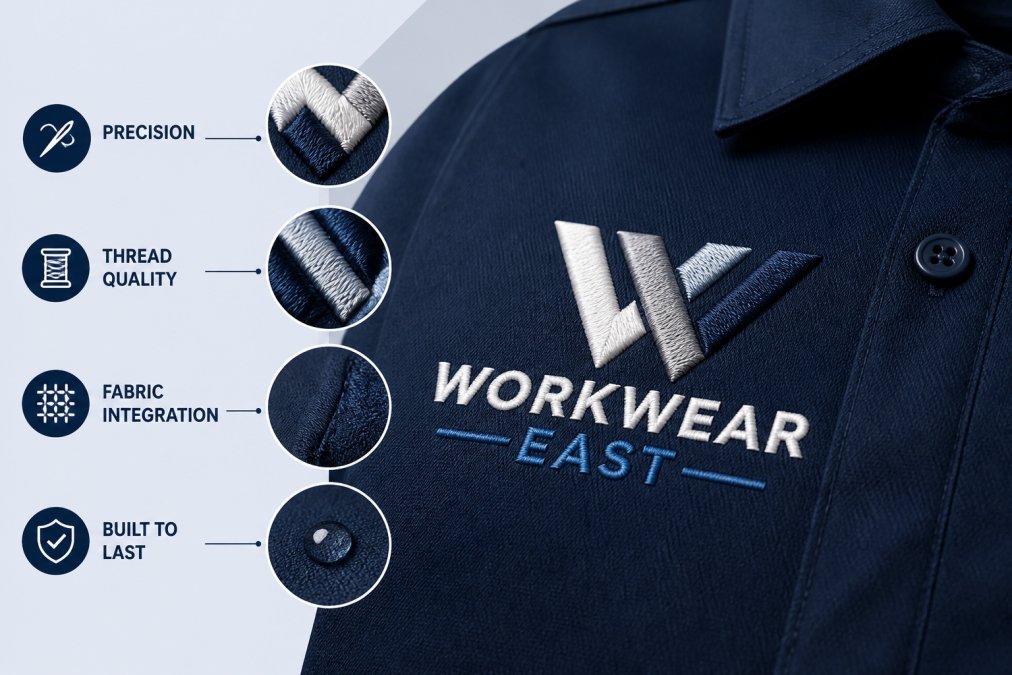
The technical factors determining durability are thread density (measured in stitches per inch), stabiliser selection (the backing that prevents puckering), and machine tension calibration. A supplier claiming "professional embroidery" without specifying these details is making marketing noise, not engineering commitments.
Workwear East's embroidery process accounts for fabric weight and weave. Lightweight cotton requires different stabiliser and tension than heavy-duty workwear fabrics. This precision matters because improper settings create stress points where embroidery fails under washing and wear.
The question most prospects ask: "How do I know the embroidery won't crack like my last batch?" The answer lies in three specifics. First, request thread samples matching your colour palette, colour fastness varies between thread manufacturers, and inferior threads fade or bleed. Second, discuss stabiliser type with your supplier; water-soluble stabilisers work differently than permanent ones, affecting final garment feel and durability. Third, ask about stitch count and density, a logo stitched at 3,000 stitches per square inch holds differently than one at 1,500.
Workwear East uses high-spec embroidery machines and operator training that prevents the common mistakes: excessive density causing puckering, insufficient density causing unravelling, and improper hoop tension creating uneven stitching.
Workwear Safety Standards UK: What You Need to Know
Safety compliance isn't optional for certain industries. Construction, manufacturing, and utilities sectors operate under specific standards governing workwear specifications, visibility requirements, and protective properties.
The Health and Safety at Work etc. Act 1974 establishes the legal framework requiring employers to provide appropriate protective equipment. For workwear, this means understanding relevant standards like EN ISO 20471 (high-visibility clothing), EN 11611 (protective clothing for welding), and EN 14404 (knee protection).
Hi-vis workwear must meet EN ISO 20471 standards, which specify minimum retroreflective material coverage and fluorescent colour requirements. A supplier claiming "hi-vis compliant" should provide documentation confirming fabric and tape specifications. Generic hi-vis garments from discount suppliers often fail compliance testing.
For construction and trade work, suppliers like EPT Workwear who specialise in safetywear understand these requirements. They can advise on appropriate fabric treatments, seam specifications, and certification documentation.
The practical implication: don't assume branded workwear is safety-compliant. Verify with your supplier that customised garments maintain required safety properties. Embroidery, printing, and logo placement can compromise visibility or protective ratings if executed improperly.
How to Choose a Workwear Supplier: Key Considerations
Selecting the right workwear supplier involves evaluating five critical dimensions: customisation flexibility, quality consistency, turnaround capability, pricing transparency, and local accessibility.
Customisation Flexibility. Does the supplier offer multiple decoration methods (embroidery, DTF, screen printing), or do they force you into a single approach? Different garment types and order sizes benefit from different techniques. A supplier offering all three provides flexibility as your needs evolve.
Quality Consistency. Request samples with your actual logo applied to your preferred garment. Don't accept generic samples, quality varies dramatically between fabric weights, colours, and decoration methods. Examine stitch density, colour matching, and print durability. Ask about their quality assurance process and what happens if samples fail your standards.
Turnaround Capability. Understand their standard lead times and rush order options. Can they handle a 40-shirt order in three weeks without compromising quality? Do they charge premium rates for expedited delivery? What's their track record on meeting stated deadlines?
Pricing Transparency. Avoid suppliers who require quotes for basic information. Legitimate suppliers provide pricing frameworks based on quantity, garment type, and decoration method. Get multiple quotes and understand what's included: setup fees, artwork revisions, sample costs, delivery charges.
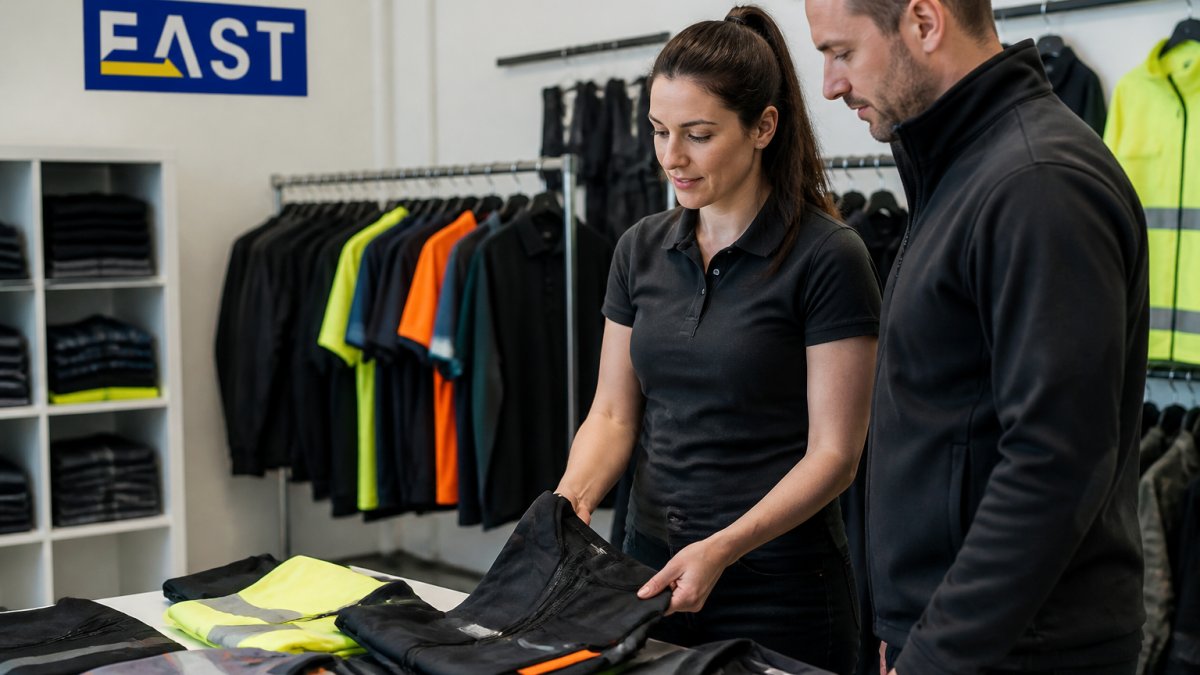
Local Accessibility. For Norfolk businesses, local suppliers like Workwear East offer advantages when problems arise. Can you visit in person? Do they understand your specific industry context? How responsive are they to urgent requests?
Turnaround Times and Bulk Order Capabilities
Turnaround times depend on decoration method, order complexity, and current supplier capacity. Standard embroidery typically requires 5-10 working days from artwork approval. DTF printing operates faster, often 3-5 days. Screen printing for large orders (100+ units) may require 7-14 days due to setup time.
Rush orders are possible but carry premium costs. A supplier offering three-week turnaround standard might handle two-week orders at 20% surcharge, or one-week orders at 50% surcharge. Understand these rates before committing to tight timelines.
Bulk order capabilities matter for businesses managing multiple departments or seasonal restocking. Workwear East's online portal simplifies bulk ordering by allowing different staff members to place orders within approved budgets and specifications. This eliminates the coordination nightmare of managing 50 staff across different sizes and departments.
For construction and trade firms with 15-50 staff, bulk ordering through managed suppliers reduces administrative overhead. Rather than collecting sizing information, managing multiple orders, and tracking delivery, a single supplier relationship with proper systems handles the complexity.
The cost-benefit analysis: paying slightly more per unit for simplified ordering and quality assurance often costs less than managing logistics internally or dealing with sizing issues and delays that create downtime.
| Supplier | Customisation Methods | Local Presence | Turnaround Standard | Best For |
|---|---|---|---|---|
| Workwear East | Embroidery, DTF, Screen Printing | Yes (Thetford) | 5-10 days | Norfolk businesses valuing local service |
| EPT Workwear | Embroidery, Printing | No (Leicester) | 5-10 days | Comprehensive safetywear needs |
| Workwear (East Anglia) Ltd | Embroidery, Print | Yes (East Anglia) | Varies | Local East Anglian sourcing |
| National Workwear | Embroidery, Screen Printing, Heat Press | No (National) | 7-14 days | Managed workwear solutions |
| Cintas Uniform Services | Embroidery, Printing | Multiple locations | Varies | Uniform rental programs |
| Union Overall Company | Handcrafted production | Yes (Norfolk) | 8-12 weeks | Heritage, bespoke workwear |
Conclusion
The best workwear supplier for your Norfolk business depends on your specific requirements, team size, industry sector, customisation complexity, and timeline. Workwear East delivers a strong combination of local accessibility, multiple decoration capabilities, and quality consistency that matters when your team's appearance reflects your brand daily.
For businesses managing multiple staff across different departments and sizes, the online ordering portal and local support eliminate the coordination overhead that makes workwear procurement unnecessarily complex. Their embroidery, DTF printing, and screen printing options provide flexibility as your needs evolve.
Frequently Asked Questions
What should I look for when choosing a workwear supplier?
Prioritise suppliers who offer multiple customisation methods (embroidery, DTF printing, screen printing), demonstrate quality through samples, provide clear turnaround times, and understand your industry's safety standards. Check whether they offer bulk order discounts, have experience with your sector, and provide responsive customer service. Local suppliers often offer faster communication and delivery. Email info@workweareast for a quote to compare options.
How do custom embroidery services ensure durability?
Quality embroidery uses appropriate thread density, stabilisers matched to fabric type, and precise stitch counts to prevent puckering or unravelling. Professional suppliers digitise logos correctly, ensuring the design withstands regular washing and wear. Thread quality and machine calibration are critical, cheaper suppliers often cut corners on stabiliser choice, leading to logos cracking or peeling after a few washes. Ask suppliers about their thread specifications and stabiliser standards before ordering.
What workwear safety standards apply in the UK?
Workwear must comply with the Health and Safety at Work etc. Act 1974 and relevant regulations such as the Personal Protective Equipment (PPE) Regulations 2018 for safety-critical items. Hi-vis clothing must meet EN ISO 20471, and flame-resistant workwear requires EN 11611 or EN 11612 certification. Your supplier should confirm compliance with these standards and provide documentation. Different industries have specific requirements, construction, healthcare, and manufacturing each have distinct standards your workwear must satisfy.
How long does it typically take to receive bulk workwear orders?
Standard turnaround times range from 5 to 15 working days depending on order size, customisation method, and supplier capacity. Embroidery typically takes longer than screen printing for small batches, but screen printing becomes cost-effective only for large orders (100+ units). Rush orders are possible but may incur additional charges. Discuss your timeline early, suppliers like Workwear East can advise on realistic delivery dates based on your specific requirements. Email info@workweareast for a quote with your required delivery date.
Can workwear suppliers handle different sizes and styles for multiple departments?
Yes, most professional suppliers manage multi-size orders and offer a range of styles (polos, t-shirts, jackets, hi-vis, trousers). Many provide online ordering portals where employees can select their sizes, simplifying the process for large teams. Some suppliers offer managed solutions that handle sizing, stock, and reordering automatically. This eliminates the nightmare of manual tracking and prevents sizing errors that cause downtime and frustration.
When you're ready to move forward, visit https://www.workweareast.co.uk/ to explore their full range of workwear bundles, branded polo shirts, hi-vis options, and customisation services. For a quote tailored to your specific requirements, whether you need embroidered corporate uniforms, DTF-printed promotional apparel, or screen-printed bulk orders, email info@workweareast for a quote and discuss your exact timeline and budget with their team.
This article was written using GrandRanker