 listicle
Sustainable Workwear Recycling Programs UK: 2026 Guide
Table of Contents
- Why Workwear Recycling Matters for Your Business
- Understanding Uniform Recycling Schemes
- Workwear Take-Back Schemes: What to Expect
- PPE and Workwear Recycling: Handling Contaminated Garments
- Recycling Embroidered Uniforms: Special Considerations
- Measuring Programme Outcomes and Environmental Impact
- Choosing the Right Workwear Recycling Provider
- Building Durable Workwear That Lasts Longer
- Frequently Asked Questions
Last Updated: October 8, 2026
Why Workwear Recycling Matters for Your Business
Textile waste is one of the UK's fastest-growing waste streams. At Workwear East, we see durable workwear as an investment that shouldn't end up in a skip.
Workwear recycling programmes reduce environmental impact while managing the lifecycle of branded uniforms and PPE, diverting tonnes of material from landfill annually.
The challenge is knowing which workwear recycling programs exist, what they accept, and how to integrate them into supply chain operations. Below, we cover the major schemes, what happens to your garments, and how to measure your impact.
Understanding Uniform Recycling Schemes
How Collection and Take-Back Work
Uniform recycling schemes operate through structured collection and take-back arrangements, collecting used garments from the workplace and sorting them by material type and condition.
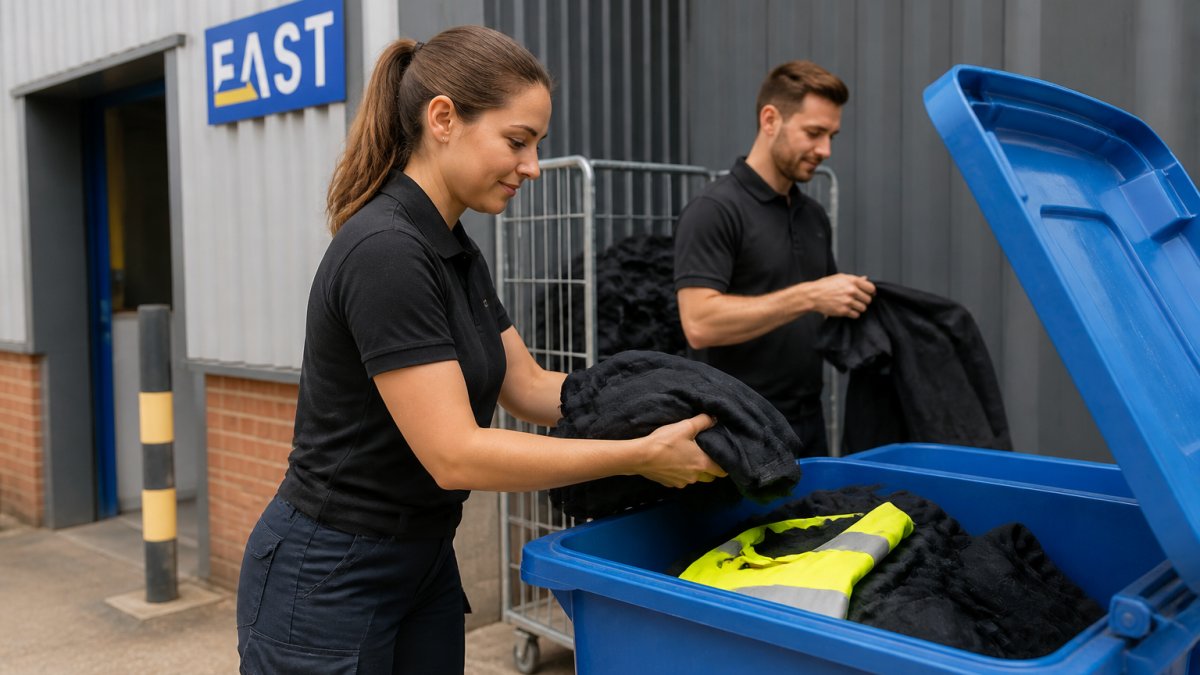
The collection process typically involves:
- On-site collection bins or scheduled pickups at your premises
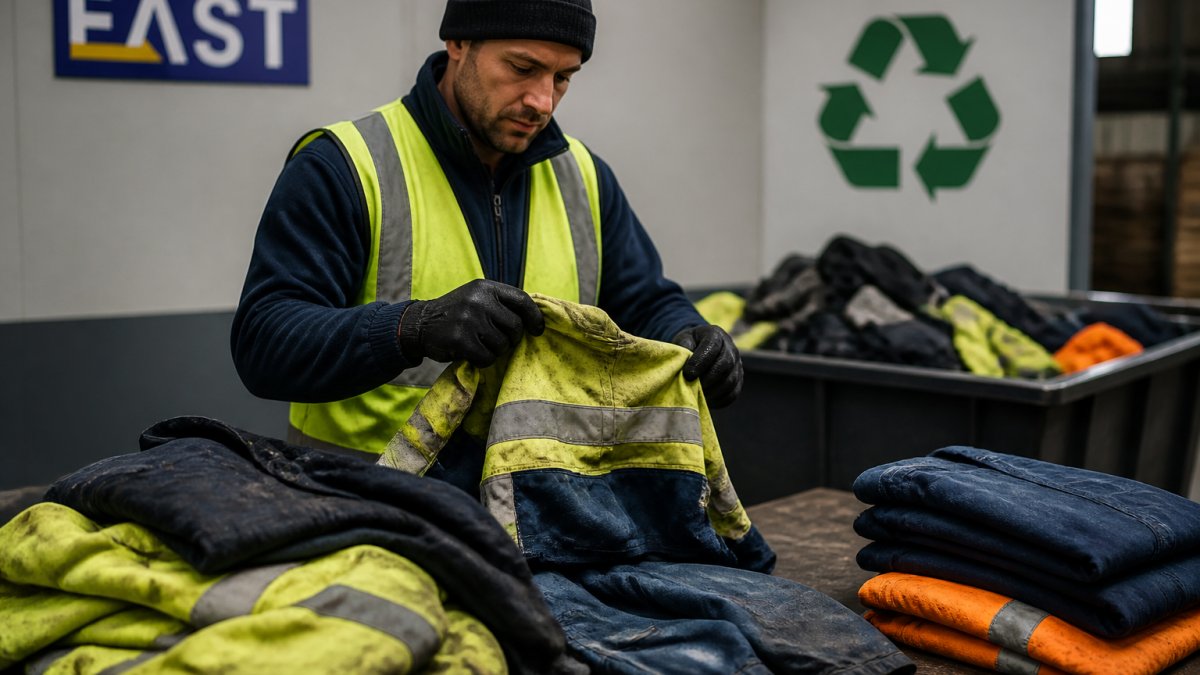
- Sorting by material (polyester, cotton blends, contaminated PPE)
- Transportation to processing facilities
- Documentation of weight and garment counts for reporting
Take-back schemes differ from general textile recycling: they're designed specifically for workwear and uniforms, so processors understand how to handle embroidered logos, industrial dyes, and contaminated materials that standard textile recyclers might reject.
Many schemes require minimum volumes, typically 100-500 kg per collection, so they suit businesses with regular replacement cycles. Smaller organisations may need to batch collections or partner with other businesses to reach minimums.
Material Recovery and Fibre Processing
Once collected, workwear enters fibre recovery. Post-consumer polyester, common in modern workwear blends, can be shredded and regenerated into new fibres for textiles or applications like insulation and automotive components.
Cotton and cotton-blend garments are processed into fibrous materials for wiping cloths, insulation, or lower-grade textiles. Contaminated PPE often undergoes secure destruction rather than material recovery, depending on contamination levels.
Material consistency is key: uniform blends such as 65% polyester, 35% cotton process more efficiently than highly mixed garments.
Workwear Take-Back Schemes: What to Expect
Eligibility and Garment Types Accepted
Not all workwear recycling programmes accept every type of garment. Most schemes welcome:
- Corporate uniforms and branded polo shirts
- Hi-vis and safety workwear (non-contaminated)
- Embroidered or printed apparel
- Workwear made from standard polyester, cotton, or blended fabrics
Schemes typically exclude:
- Heavily contaminated PPE (chemical, paint, or biological hazards)
- Leather or specialist materials
- Garments with metal components that can't be easily removed
- Items with extensive damage or staining beyond standard wear
Before committing to a workwear recycling programme, clarify what your business generates. A construction firm with contaminated safety gear faces different eligibility constraints than an office-based business with clean branded polo shirts. Some programmes offer tiered acceptance, taking lightly contaminated items but requiring secure destruction for heavily soiled pieces.
This distinction affects your overall participation cost and logistics: a scheme accepting 70% of your used workwear is more valuable than one accepting only 30%, even at identical per-unit pricing.
Minimum Volumes and Collection Logistics
Most workwear take-back schemes set minimum collection thresholds of 100 kg to 500 kg per pickup, depending on provider and location.
Collection logistics vary: some schemes provide scheduled pickups at your premises, others require you to arrange transport or drop garments at a designated point, and a few operate drop-off networks through retail partners or industrial waste facilities.
Cost structure depends on volume and collection method. Direct pickup costs more than drop-off but saves staff time and ensures consistent participation.
PPE and Workwear Recycling: Handling Contaminated Garments
Secure Destruction for Branded Items
Branded workwear carries company information, logos, names, and colours.
Secure destruction services handle this concern. Contaminated or sensitive branded garments are shredded in controlled environments and typically incinerated or sent to energy recovery, ensuring no intact or recognisable branded pieces re-enter circulation.
Secure destruction is particularly important for:
- High-visibility branded uniforms (security, hospitality, retail)
- Garments with sensitive company branding or logos
- Items contaminated with hazardous materials
- PPE that has been in direct contact with chemicals or biological hazards
Secure destruction typically costs more than material recovery, but it's justified when brand protection is a priority. Many businesses use a hybrid approach: material recovery for standard workwear, secure destruction for branded or contaminated items.
Processing Different Material Types
Different workwear materials require different processing approaches. Understanding what your uniforms are made from helps you choose the right recycling pathway.
Polyester and polyester blends are the easiest to process, shredded and regenerated into new fibres.
Cotton and cotton blends process into lower-grade fibres for industrial wiping cloths or insulation.
Specialty materials such as nylon, elastane, and moisture-wicking synthetics complicate processing. Some schemes handle them; others don't. If your workwear includes technical fabrics, confirm acceptance before committing.
Contaminated materials require secure destruction rather than material recovery.
Recycling Embroidered Uniforms: Special Considerations
Embroidered logos add value to workwear but complicate recycling: thread, backing materials, and stabilisers don't always separate cleanly from base fabrics during shredding.
Most schemes accept embroidered uniforms, but processors typically remove embroidered sections before fibre processing, reducing recoverable material by 5-15% depending on coverage.
If brand protection is your priority, embroidered uniforms suit secure destruction rather than material recovery, since the embroidery keeps the garment visibly branded throughout processing.
Measuring Programme Outcomes and Environmental Impact
Traceability and Proof of Recycling
One challenge with recycling programmes is proving garments actually were recycled. Without clear documentation, a recycling commitment remains an assumption rather than a verified outcome.
Reputable workwear recycling programmes provide detailed documentation for each collection:
- Weight of garments collected
- Material breakdown (polyester, cotton, contaminated items)
- Processing pathway (material recovery, secure destruction, energy recovery)
- Final destination of recovered materials
This documentation lets you track outcomes across collections and build a picture of your impact over time. Some schemes provide annual reports summarising total volumes and environmental metrics.
Traceability lets you communicate sustainability efforts credibly: rather than claiming "we recycle workwear," you can state "we diverted 2.4 tonnes of branded uniforms from landfill in 2026, with 87% processed for fibre recovery."
Calculating Waste Reduction and Carbon Savings
Environmental impact from workwear recycling comes in two forms: landfill diversion and carbon avoidance. Landfill diversion is simply the weight of garments recycled rather than sent to waste facilities; carbon savings are more complex but equally important.
Recycling textiles into new fibres avoids methane emissions from decomposition, and recycled fibres reduce the need for virgin material production.
To measure your programme's impact:
- Record total weight collected at each pickup
- Request material breakdown from your recycling partner (% sent to fibre recovery vs. secure destruction)
- Calculate landfill diversion: total weight collected minus contaminated/destroyed items
- Estimate carbon savings using industry benchmarks (approximately 3-5 tonnes CO2 saved per tonne of polyester recovered)
Most schemes provide baseline figures for these calculations, and some offer carbon calculators or annual impact reports that do the maths for you.
Choosing the Right Workwear Recycling Provider
Key Questions to Ask Before Committing
Before signing a workwear recycling agreement, ask providers:
Collection and Logistics:
- What are the minimum collection volumes and how frequently can you collect?
- Do you offer on-site pickup, drop-off, or both?
- What's the cost structure, per kilogram, per collection, or annual fee?
- How quickly can you arrange the first collection?
Material Acceptance:
- What types of workwear do you accept (uniforms, PPE, embroidered garments)?
- Do you accept contaminated items, and if so, what level of contamination?
- Are there any materials you won't process (leather, metal components, specialty synthetics)?
Processing and Outcomes:
- What percentage of collected material is sent to fibre recovery versus secure destruction?
- Where does recovered material go, what are the end applications?
- Can you provide documentation of processing for each collection?
- Do you offer annual impact reports or carbon calculations?
Brand Protection:
- How do you handle secure destruction of branded garments?
- Can you guarantee that no intact branded items re-enter circulation?
- What documentation do you provide for secure destruction?
References and Verification:
- Can you provide references from other businesses in similar industries?
- Are you certified or accredited by any textile or sustainability bodies?
- How long have you been operating workwear recycling programmes?
The answers reveal whether a provider delivers genuine recycling outcomes or simply collects garments without clear end-of-life pathways.
Integrating Recycling Into Your Supply Chain
Successful workwear recycling requires integration into procurement and replacement processes. Build it into your workwear lifecycle from the start rather than treating it as an afterthought.
Establish a clear replacement schedule so you know roughly how much workwear needs recycling each year, letting you plan collections, negotiate pricing, and set realistic environmental targets.
Document participation internally, train staff on garment care to extend lifespan, and track collection dates and weights so you can report outcomes to management and stakeholders.
Building Durable Workwear That Lasts Longer
Quality matters: well-made workwear with reinforced seams and durable fabrics withstands repeated washing and daily wear.
At Workwear East, we specialise in durable, custom workwear built for industrial environments and frequent laundering.
When evaluating suppliers, ask about wash durability and expected lifespan.
Proper care extends lifespan too: laundering at appropriate temperatures, avoiding excessive bleach, and repairing minor damage promptly can add months or years to garment life.
Workwear recycling programmes are becoming essential infrastructure for responsible businesses.
The key is choosing a provider offering genuine recycling outcomes, clear documentation, and support for your specific workwear types. To discuss a workwear recycling solution tailored to your business, contact Workwear East at info@workweareast.co.uk for a quote.
Frequently Asked Questions
How can businesses recycle old workwear?
Most workwear recycling programmes operate through collection schemes where your business gathers used uniforms and sends them to a recycling partner. The provider collects garments either on a scheduled basis or on demand, depending on the scheme. Textiles are then sorted by material type, cleaned, and processed into fibres for new products or downcycled into insulation and industrial materials. Contact your workwear supplier or a dedicated textile recycler to establish a take-back programme tailored to your volume and frequency.
Can embroidered or printed workwear be recycled?
Yes, embroidered and printed workwear can be recycled, though the process differs slightly from plain garments. Embroidery threads and printed inks must be separated or tolerated during fibre recovery. Some recycling partners specialise in removing embroidery before processing; others use mechanical or chemical methods that break down all components together. Ask your recycling provider whether they accept embroidered uniforms and what happens to the threads and prints during processing. If your branded garments contain sensitive company information, secure destruction may be preferable to recycling.
What is the difference between reusing and recycling workwear?
Reuse means passing garments to another user or organisation in wearable condition, extending their lifespan without processing. Recycling breaks down worn textiles into fibres or raw materials to create new products. Reuse is preferable environmentally because it requires less energy, but it only works for garments in good condition. Recycling captures value from damaged, stained, or heavily worn items that cannot be reused. A comprehensive programme combines both: reuse sound garments through donation or resale, and recycle the rest to avoid landfill.
What should businesses do to prepare workwear for recycling?
Remove any personal items, clear pockets, and separate garments by material type if your recycling partner requests it. Wash heavily soiled workwear if it contains hazardous residues (oil, chemicals, medical waste). Segregate damaged items, zips, and non-textile components if instructed. Label or document quantities if your programme tracks volumes for reporting. Most recycling schemes accept workwear as-is, but check your provider's specific requirements to avoid delays or rejection. For branded garments with sensitive data, confirm whether they will be securely destroyed or anonymised before recycling.
How do I choose a workwear recycling provider?
Evaluate providers on collection frequency, minimum volumes, geographic coverage, and transparency about end-of-life processes. Request proof of recycling or reuse outcomes, including fibre recovery rates and where materials go. Confirm they handle your garment types (including embroidered or printed items) and any contaminated PPE safely. Ask about costs, collection logistics, and whether they provide reporting on waste diverted from landfill. Check whether they comply with textile industry standards and offer traceability documentation. For a tailored assessment of your business's recycling needs, contact Workwear East at info@workweareast.co.uk for guidance on building a sustainable supply chain.