 listicle
Branded Workwear Thetford: Your 2026 Business Guide
Table of Contents
- Why Branded Workwear Matters for Thetford Businesses
- Embroidery vs Print: Which Branding Method Suits Your Team?
- The Benefits of Branded Uniforms for Staff and Customers
- Workwear Embroidery Best Practices: Getting a Logo That Lasts
- Embroidered Workwear Bundles: Simple Solutions for Small Teams
- Safety Standards and Fabric Choices for Norfolk Industries
- Ordering Branded Workwear in Thetford: Process and Turnaround
- Frequently Asked Questions
Last Updated: October 1, 2026
Why Branded Workwear Matters for Thetford Businesses
Branded workwear is uniform clothing decorated with a company's name, logo or colours, worn by staff during working hours. For businesses in and around Thetford, it does three jobs at once: it identifies your team on site, it projects a professional appearance to customers, and it protects workers when the garment is specified correctly.
This guide from Workwear East covers how to choose between embroidery and print, what fabrics survive Norfolk's industrial environments, and how to order branded workwear without the sizing delays that derail most first orders.
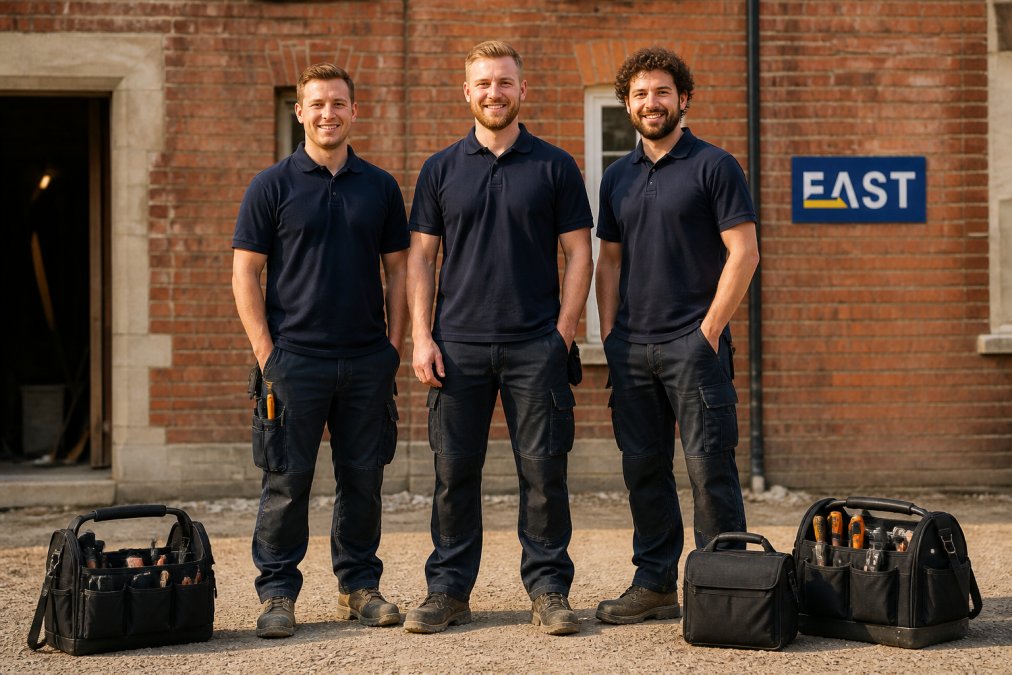
The commercial case is straightforward. A survey by the Federation of Small Businesses found that small firms consistently rank reputation and repeat custom among their top growth drivers, and uniform is one of the few marketing assets a customer sees face to face every single day. Unlike a van livery or a website, it walks into the room with your team.
Here's what most guides get wrong: they treat branded workwear as a marketing purchase. It isn't. It's an operations purchase that happens to market for you. Get the fabric and the fit right and the branding is almost a bonus.
Embroidery vs Print: Which Branding Method Suits Your Team?
The right decoration method depends on three things: your industry, your logo's complexity, and your order size. Embroidery suits trade and industrial teams, DTF and screen printing suit larger orders and detailed full-colour artwork.
| Method | Best For | Durability | Colour Range | Suits |
|---|---|---|---|---|
| Embroidery | Polos, fleeces, jackets, caps | Excellent, outlasts the garment | Up to 12 thread colours | Trade, industrial, corporate |
| DTF printing | Detailed logos, small runs | Good, with correct washing | Unlimited full colour | Events, retail, hospitality |
| Screen printing | Large single-design runs | Very good on flat fabric | One colour per screen | Promotional apparel, bulk tees |
Embroidered Workwear: Durability for Trade and Industrial Teams
Embroidery stitches your logo directly into the fabric using thread. There's no printed layer to crack, peel or fade, which is why it holds up on garments that get washed at high temperatures and worn against abrasive surfaces.
For construction and trade firms, this matters more than anything else. A logo that survives two years of site work costs less over its life than one replaced twice a year.
DTF and Screen Printing: Colour and Cost for Larger Orders
DTF (direct-to-film) printing transfers a printed film onto the garment, which allows gradients, fine detail and photographic logos that embroidery can't reproduce. Screen printing pushes ink through a mesh stencil and becomes cheaper per item as quantities rise.
A common mistake is choosing print for a logo that will sit on a work polo worn five days a week. Print on a high-wear garment is a false economy unless the design genuinely needs full colour.
The Benefits of Branded Uniforms for Staff and Customers
The benefits of branded uniforms split into two audiences, and most businesses only think about one. The customer-facing case is well rehearsed: instant recognition, faster trust, a professional impression at the door. The staff-facing case is where the operational value actually sits, and it is the one that determines whether your uniform programme survives its second year.
For customers, uniform does something a website cannot.
For staff, the benefits are more practical:
- Removes the daily decision. When the uniform is specified, nobody has to choose what to wear or worry whether their own clothes will be ruined on site.
- Signals belonging. A shared uniform does more for team cohesion than most managers expect, particularly on sites where subcontracted labour is mixed in.
- Separates work from personal clothing. Staff stop subsidising the business with their own wardrobe, which matters for retention in trades where clothing takes a beating.
- Makes PPE compliance visible. When everyone wears the same specification, a supervisor can spot a missing hi-vis vest or the wrong class of garment at a glance. That is a safety function, not a branding one.
Workwear Embroidery Best Practices: Getting a Logo That Lasts
Workwear embroidery best practices come down to artwork preparation, placement and thread choice. Most logo failures trace back to the first of those three, not the stitching itself.
- Simplify the artwork. Thin lines under 1mm and text below 5mm tall close up when stitched. Supply a vector file wherever possible.
- Pick the right placement. Left breast is standard for polos and shirts. Back placement suits hi-vis and site wear where the logo needs to be read from a distance.
- Match thread to fabric. Polyester thread holds colour on workwear far better than cotton, particularly on garments washed industrially.
- Back the logo. A backing layer stops the embroidery pulling on stretchy or lightweight fabrics.
- Test one garment first. Approve a single stitched sample before the full run goes ahead.
Embroidered Workwear Bundles: Simple Solutions for Small Teams
Embroidered workwear bundles package the core garments a role needs into one order with branding included. For a small firm, this removes the guesswork about which items to buy and keeps the whole team consistent.
Safety Standards and Fabric Choices for Norfolk Industries
Safety-critical workwear must meet the relevant standard for the hazard, and the standard should be stated on the garment label. Most guides stop at naming hi-vis and move on. The useful detail is which standard applies to which job, and how fabric choice affects whether the garment still meets that standard after a year of industrial washing.
-
BS EN ISO 20471, high-visibility clothing, split into three classes based on the area and placement of reflective material. Class 1 is the minimum for low-risk environments; Class 3 is required where workers are exposed to fast-moving traffic or plant.
-
BS EN ISO 20471 also sets a minimum after-care requirement. A hi-vis garment that has been washed incorrectly can lose its retroreflective performance and no longer meet the class it was certified to. This is why the care label matters as much as the certification label.
-
EN ISO 11612, clothing for protection against heat and flame, relevant to welding, foundry and some food production environments.
-
EN ISO 20471 is not the same as EN 1150, which covers non-professional hi-vis for recreational use and is not suitable for site work.
-
Construction and site work: heavyweight polycotton with reinforced knees and hi-vis Class 2 or 3 where required. Polycotton holds shape better than 100% cotton through repeated industrial washing, but it is less breathable in summer.
-
Hospitality: easy-care polycotton that holds colour through frequent washing, with aprons where food handling applies. Colour retention is the main failure point here, not abrasion.
-
Healthcare: garments that tolerate high-temperature laundering, in lighter weights for all-day wear. The standard to check is the wash temperature the garment is certified for, not just the fabric composition.
-
Logistics and warehousing: hi-vis vests and jackets with back logo placement for vehicle visibility. Vests are cheaper but offer no abrasion protection; jackets last longer but cost more upfront.
Ordering Branded Workwear in Thetford: Process and Turnaround
Ordering branded workwear in Thetford follows five steps: brief, mock-up, sample approval, production, delivery. The mock-up stage is where most projects are won or lost.
- Brief us on roles, headcount and hazards. Tell us who needs what and where they work.
- Approve a visual mock-up. You see your logo on the actual garment before anything is produced.
- Sign off a physical sample. One stitched or printed garment confirms colour and placement.
- Production runs. Embroidery and print are completed in-house.
- Delivery. Bulk to one address, or individual packs per employee.
Frequently Asked Questions
What are the benefits of branded workwear for small businesses?
Branded workwear gives small teams a professional edge that customers notice immediately. When staff wear matching embroidered polo shirts or hi-vis jackets with your logo, it builds trust and makes your business look established. It also helps with staff retention because team members feel part of something. For Thetford businesses, local recognition matters too: a consistent uniform makes your vans and staff instantly identifiable around town. Email info@workweareast for a quote tailored to your team size.
Is embroidery or screen printing better for work uniforms?
It depends on the garment and how long you need the branding to last. Embroidery is the better choice for polos, hoodies, jackets and work trousers because the stitched logo withstands industrial washing and daily wear without cracking. Screen printing suits large orders of t-shirts or promotional items where cost per unit matters most. DTF printing handles detailed, multi-colour logos on fabrics that embroidery cannot easily cover. Most Thetford trade firms choose embroidery for staff uniforms and print for event giveaways.
How do I choose the right fabric for durable workwear?
Look for tightly woven cotton or poly-cotton blends for embroidery, as these hold stitching without puckering. For construction and industrial roles, choose garments with reinforced seams and heavier fabric weights (around 250-300 gsm for trousers). Hi-vis clothing must meet the relevant EN ISO 20471 standard for visibility. If your team works outdoors in Norfolk weather, consider weather-resistant jackets with taped seams. Workwear East can advise on the right base garments for your specific trade.
Can branded workwear help improve staff professionalism?
Yes. When staff wear clean, branded uniforms, they tend to present themselves more professionally and customers respond differently. Embroidered logos on polos and jackets also give a polished appearance that reflects well on your business. Uniforms are not just clothing; they set a standard for how your team approaches their work.