 listicle
Professional Embroidery for Trade Companies
Table of Contents
- What Is Contract Embroidery for Trade Companies?
- Contract Embroidery Services UK: How They Work
- Embroidery Digitisation Services: Preparing Your Design
- Trade Embroidery Turnaround Times and Delivery
- Garment and Fabric Compatibility for Embroidery
- In-House vs. Outsourced Embroidery: A Cost-Benefit Analysis
- Why Professional Embroidery Matters for Your Brand
- Conclusion
Last Updated: August 10, 2026
What Is Contract Embroidery for Trade Companies?
Professional embroidery transforms logos into durable, textured designs using thread stitched directly into fabric. Unlike screen printing, embroidery produces results that last through hundreds of wash cycles without cracking, peeling, or fading.
Trade embroidery services handle B2B operations: businesses needing bulk quantities of branded uniforms, safety apparel, or promotional items with consistent, professional finishes. Whether outfitting 15 construction workers or 200 staff across multiple departments, contract embroidery manages the scale, quality control, and turnaround demands that in-house machines cannot match.
Contract Embroidery Services UK: How They Work
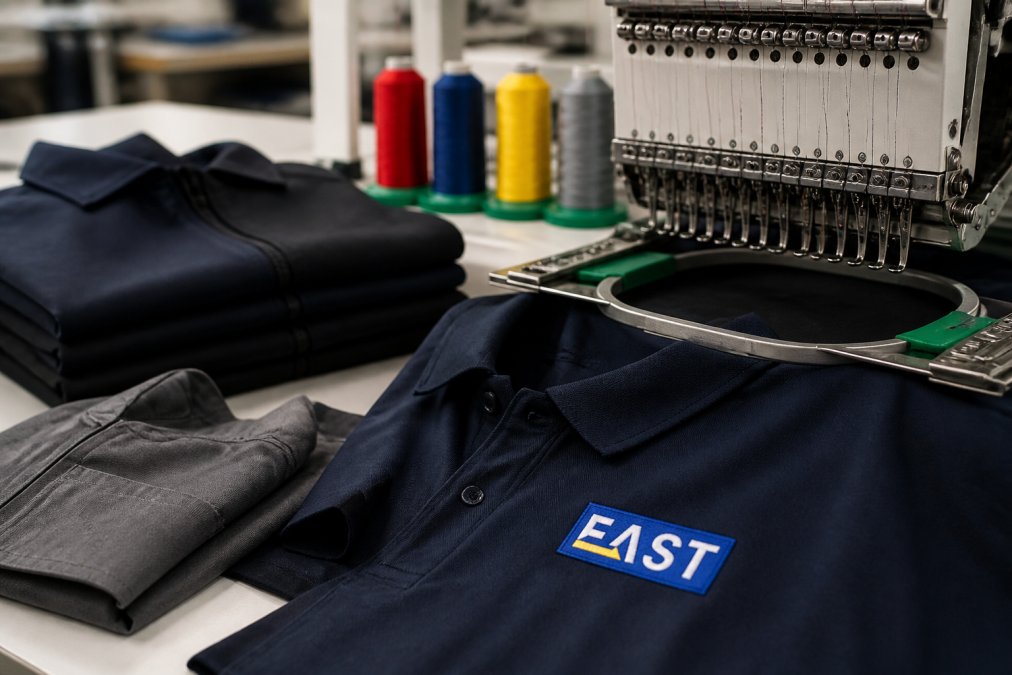
Contract embroidery follows a defined workflow separating design preparation from production. Your artwork begins the journey, typically in PDF, JPEG, or AI format. Professional digitisation converts these files into machine-readable code (DST, EMB, PES formats) that tells the embroidery machine where to stitch, which thread colours to use, and stitch density.
Once digitised, your design moves to production sampling. A reputable service stitches a sample on your actual garment using exact thread colours and machine settings. You approve the sample before bulk production begins, preventing the nightmare scenario of 200 shirts arriving with misaligned logos or mismatched colours.
Production then runs in batches using single-head machines or multi-head setups (up to 15 garments simultaneously). Thread density, stitch count, and machine speed are calibrated for each design. Quality control operators inspect finished garments for loose threads, skipped stitches, and colour consistency before packing.
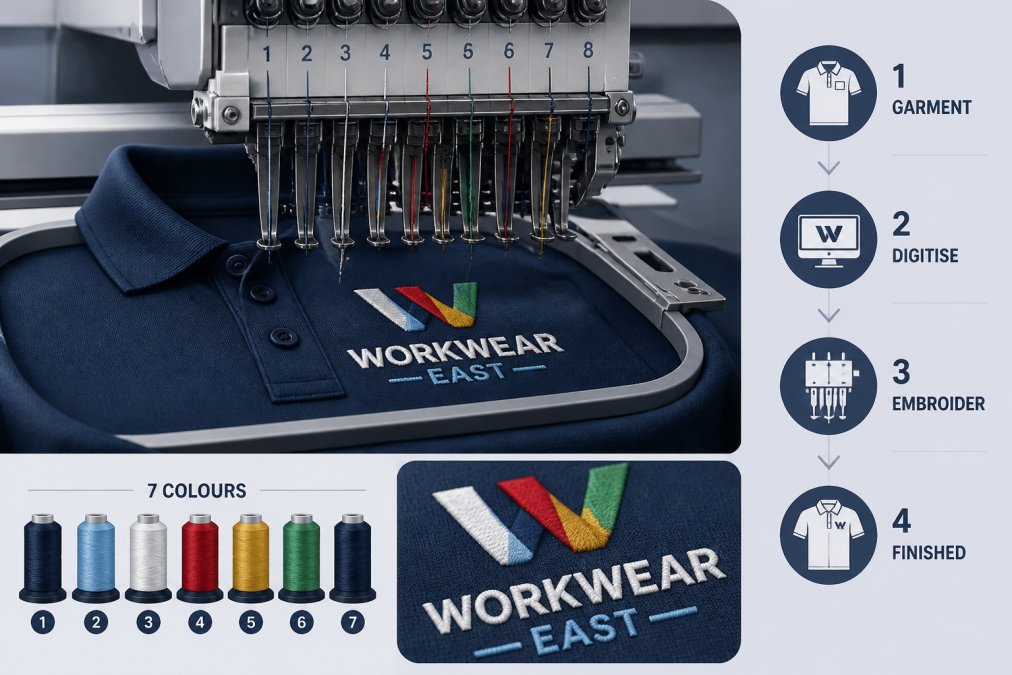
From Logo to Machine: The Embroidery Process
The embroidery process involves five critical stages, each affecting final quality.
Thread selection comes first. Professional services stock hundreds of thread colours: rayon for high sheen, polyester for durability and washability, and specialist threads for workwear enduring bleach and harsh detergents. Polyester threads like Gunold POLY resist bleach, making them essential for hospitality uniforms and healthcare workwear.
Stabiliser selection prevents puckering. Stabilisers are temporary backing materials placed behind fabric during stitching, supporting the fabric and preventing stretching. Cotton stabilisers dissolve in water; tearaway stabilisers are manually removed after stitching.
Hoop setup positions the garment accurately. Embroidery hoops hold fabric taut during stitching. For workwear, operators use hoops sized to the logo area, small hoops for pocket logos, larger hoops for back-of-shirt designs.
Machine speed and tension determine stitch quality. Modern machines run 800-1,000 stitches per minute. Too fast causes thread breakage; too slow produces loose, uneven stitching. Thread tension must match fabric weight and thread type.
Inspection catches defects before shipping. Quality control staff examine stitch density, colour accuracy, thread coverage, and loose ends against the approved sample.
Quality Control and Thread Specifications
Quality hinges on three measurable factors: stitch count, thread density, and colour matching.
Stitch count measures individual stitches forming the design. A small logo contains 5,000-8,000 stitches; a large back-of-shirt design can exceed 50,000. Professional services calculate optimal stitch counts per design to balance quality and efficiency.
Thread density refers to how tightly stitches pack together. Dense stitching creates solid, durable coverage ideal for logos enduring heavy wear. Workwear demands higher density than decorative apparel.
Colour matching uses Pantone standards. Professional services stock threads matched to Pantone specifications. However, embroidery thread colours never match printed colours exactly due to inherent sheen and texture. A professional service shows you colour samples before production.
Cheap threads create visible problems: low-grade polyester threads tangle, break mid-stitch, and fade unevenly. Madeira and Gunold threads cost more but deliver consistent results across thousands of garments.
Embroidery Digitisation Services: Preparing Your Design
Digitisation converts vector artwork or bitmap images into machine code. The digitiser must decide which lines to stitch, how many colours to use, stitch direction, and underlay stitches.
Poor digitisation creates designs that pucker, show gaps, distort logos, cause thread breakage, or waste thread and machine time. Professional digitisation services manually digitise designs, test-stitch them on actual machines, and revise until output matches your approval sample.
File Formats and Print-Ready Artwork Requirements
Embroidery machines read specific file formats: DST (Tajima), EMB (Brother), PES (Brother), and JEF (Janome). A professional service converts your artwork into all necessary formats.
To prepare artwork for digitisation, provide:
- Vector files (AI, EPS, or PDF) whenever possible.
- High-resolution images (300 DPI minimum) if vector files aren't available.
- Colour specifications using Pantone numbers, not RGB or CMYK values.
- Logo size requirements. Specify whether the logo will appear on a pocket (typically 5-7.5 cm), sleeve (7.5-10 cm), or back (15+ cm).
- Simplified artwork. Remove gradients, drop shadows, and fine lines.
Most trade companies send logos as PDFs or JPEGs, formats that digitisers must interpret rather than directly convert. Sending clean vector files eliminates ambiguity and reduces revision cycles.
Common Digitisation Mistakes and How to Avoid Them
The most costly mistake is submitting artwork without consulting the digitiser first. Trade companies often assume their logo will digitise as-is, only to discover during sampling that fine details vanish or colours don't match expectations.
Too many colours create nightmare production. Each colour requires a thread change, stopping the machine and wasting time. Professional digitisers simplify artwork to 4-6 colours maximum.
Ignoring fabric type causes problems. Digitisation for cotton polo shirts differs from digitisation for hi-vis polyester. Tell your digitiser the exact garment type, fabric content, weight, and weave.
Requesting photorealistic designs is unrealistic. Embroidery cannot reproduce photographs. Digitisers must convert photos to simplified, cartoon-like versions.
Unrealistic size expectations waste effort. Fine details vanish below approximately 4 cm. Thin lines break during stitching.
Skipping the sample stage invites disaster. Never approve digitisation without seeing a physical sample stitched on your actual garment.
Trade Embroidery Turnaround Times and Delivery
Turnaround time depends on order size, design complexity, and production capacity.
Standard production typically runs 5-7 working days from approved sample to shipped goods, including digitisation (if needed), sampling, production, quality inspection, and packing. Simple designs on standard garments may achieve 3-day turnaround at premium rates.
Bulk orders (100+ units) may take 10-14 days because production must be scheduled around other orders. However, per-unit cost drops significantly at scale.
The critical variable is the sampling stage. If your sample requires revisions, colour adjustments, stitch density changes, or design repositioning, add 3-5 days per revision cycle.
Bulk Order Capabilities and Lead Times
Professional embroidery services handle bulk orders that would paralyse in-house operations. A single machine produces 10-20 finished garments per hour, depending on design complexity. For 200 shirts, that's 10-20 hours of machine time. A service with multiple machines completes the same order in 1-2 days.
Lead times depend on design complexity, garment type, current workload, and customisation. Simple logos run faster than intricate multi-colour designs. During peak seasons, services book out 2-3 weeks in advance. Plan accordingly and communicate deadlines clearly.
Rush Orders and Expedited Production
Rush orders are possible but expensive. Most services charge premiums for 24-48 hour turnaround. Rush production skips the standard sampling stage, meaning you accept design quality based on digital preview rather than physical sample.
Rush orders require pre-approved digitisation, confirmed garment inventory, simplified designs, and realistic quantities (100+ units). For event-driven orders, plan 3-4 weeks ahead to avoid rush premiums.
Garment and Fabric Compatibility for Embroidery
Not all fabrics embroider equally. Fabric weight, weave, and fibre content determine whether embroidery will hold, pucker, or fail.
Cotton fabrics (100% cotton or cotton-blend shirts, trousers, and aprons) are ideal for embroidery. Cotton stabilises well, accepts stitches cleanly, and resists puckering.
Polyester fabrics (hi-vis vests, safety trousers, synthetic blends) require higher thread tension and specialist stabilisers. Polyester's slickness causes stitches to slip; incorrect settings produce loose, uneven designs.
Knit fabrics (jersey, interlock, rib knits) are problematic. Knits stretch, causing stitches to distort. Most trade companies avoid embroidery on knits, choosing screen printing or DTF instead.
Heavyweight fabrics (denim, canvas, workwear twill) require industrial-grade machines and heavy-duty thread.
Delicate fabrics (silk, linen, lightweight cotton) risk damage from needle penetration and require precise machine settings.
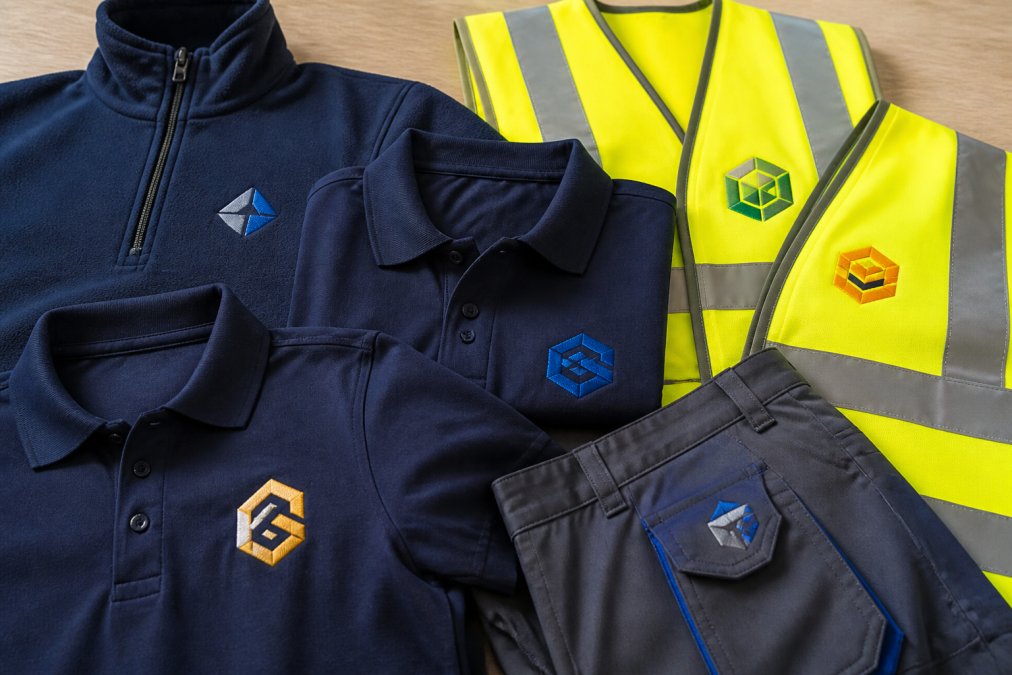
Workwear and Promotional Clothing Solutions
Professional embroidery specialises in workwear, garments designed for durability and professional appearance. Common applications include:
- Corporate uniforms: Polo shirts, work shirts, and branded apparel for staff-facing roles.
- Safety apparel: Hi-vis vests and jackets with company logos and employee names.
- Trade-specific clothing: Construction workers need branded t-shirts and hoodies surviving site conditions.
- Promotional items: Event merchandise, conference giveaways, and branded apparel for client gifts.
Workwear East specialises in durable, custom apparel for trade companies across Norfolk. Our advanced embroidery machines handle intricate, multi-colour designs on everything from polo shirts to hi-vis vests, delivering consistent, professional results designed to withstand daily wear and repeated washing.
Embroidery's advantage over screen printing for workwear is durability. Screen-printed logos crack and peel after 20-30 washes. Embroidered logos last hundreds of washes without degradation. For uniforms worn daily, embroidery's longevity justifies the higher upfront cost.
In-House vs. Outsourced Embroidery: A Cost-Benefit Analysis
The decision to outsource or invest in in-house machines hinges on volume, consistency, and hidden costs.
In-house embroidery makes sense only for trade companies with consistent, high-volume demand (1,000+ embroidered garments monthly). A commercial machine costs significant upfront investment. Add operator training, software, thread inventory, and maintenance; total first-year investment is substantial.
For a construction firm with 15 staff needing new branded uniforms once per year, in-house embroidery is wasteful. The machine sits idle most of the time.
Outsourced embroidery suits most trade companies. You pay per garment, avoiding capital investment. Professional services handle digitisation, sampling, quality control, and bulk production. Turnaround is faster because dedicated machines run continuously. You also avoid training, software licensing, and maintenance headaches.
Per-garment cost of outsourced embroidery is lower than in-house for small-to-medium orders (under 500 units annually).
When Outsourcing Makes Financial Sense
Outsourcing is financially sensible when:
- Your embroidery demand is sporadic (annual uniforms, seasonal promotional items)
- Order quantities are small (under 200 units per order)
- Designs vary frequently
- You lack technical expertise in digitisation or machine operation
- Turnaround speed matters
- Quality consistency is critical
The hidden costs of in-house embroidery often exceed per-garment savings. Machine downtime, operator errors, failed designs, and thread waste accumulate. Professional services absorb these costs, delivering guaranteed quality.
Sustainability and Eco-Friendly Thread Options
Sustainability in embroidery focuses on thread choice and waste reduction. Professional services increasingly stock certified sustainable threads. Gunold POLY carries Oeko-Tex Standard 100 certification, meaning threads are tested for harmful substances and produced under controlled environmental standards.
The most impactful sustainability choice is outsourcing itself. In-house machines generate thread waste through failed stitches, colour changes, and test runs. Professional services optimise production, minimising waste through efficient digitisation and batch processing.
For trade companies committed to sustainability, discuss thread options with your embroidery service. Most can accommodate requests for certified sustainable threads.
Why Professional Embroidery Matters for Your Brand
Embroidered branding signals quality and professionalism. When your construction crew, hospitality staff, or event team wears embroidered uniforms, clients perceive durability and attention to detail. Screen-printed logos fade; embroidered logos endure.
Professional embroidery differentiates your brand in competitive markets. A trade company with crisp, consistent embroidered uniforms looks more established than one with faded screen prints. This perception translates to client confidence and employee pride.
The durability argument is practical. Uniforms embroidered with quality threads survive 100+ wash cycles without visible degradation. Workwear lasts longer, reducing replacement costs over time.
Consistency matters too. Professional services ensure every garment matches the approved sample. Colour, stitch density, logo placement, all remain consistent across 50, 200, or 500 units.
For trade companies in Norfolk and beyond, professional embroidery from Workwear East combines durability, consistency, and cost-effectiveness. We handle digitisation, sampling, and production so you focus on running your business.
Professional embroidery for trade companies transforms branded workwear into durable, professional assets that outlast cheaper decoration methods. The process demands precision, from digitisation through production, but outsourcing to specialists eliminates capital investment, technical complexity, and quality risks of in-house machines.
For most trade companies, outsourced embroidery delivers better value than in-house operations. You avoid machine investment, operator training, and maintenance costs whilst gaining faster turnaround, guaranteed quality, and scalability for bulk orders.
Ready to upgrade your team's uniforms? Contact Workwear East for professional embroidery solutions tailored to trade companies across Norfolk. Email info@workweareast for a quote, or visit workweareast.co.uk to explore our range of embroidered workwear and promotional clothing options. Our team will guide you through digitisation, sampling, and production to ensure your brand looks its best.
| Consideration | In-House | Outsourced |
|---|---|---|
| Initial Investment | Significant | None |
| Turnaround Time | 2-3 weeks | 5-7 days |
| Quality Consistency | Variable | Guaranteed |
| Scalability | Limited | Unlimited |
| Best For | 1,500+ annual units | Under 1,000 annual units |
Frequently Asked Questions
What file formats do you accept for professional embroidery?
Professional embroidery requires print-ready artwork in vector formats such as EPS, AI, or PDF. For digitisation, we work from high-resolution images (300 DPI minimum) as JPG or PNG. Common embroidery machine formats include DST, EMB, and PES. When you email info@workweareast for a quote, send your logo in vector format if possible, this ensures the cleanest digitisation and best stitch results on your finished garment.
How long does embroidery digitisation typically take?
Embroidery digitisation services usually take 4 to 12 hours for standard designs, depending on complexity. Simple logos with few colours digitise faster than intricate multi-colour artwork with fine detail. For trade embroidery turnaround times on full orders, allow 5-10 working days from approved proof to delivery, though rush options are available. Contact info@workweareast to discuss your specific timeline and confirm lead times for your project.
What's the difference between contract embroidery and retail embroidery?
Contract embroidery services are B2B offerings where trade companies like print shops and promotional suppliers outsource bulk embroidery work. Retail embroidery is typically single-item personalisation. Contract embroidery operates on trade rates, requires minimum order quantities, and focuses on scalability and consistency across hundreds of garments. Professional embroidery for trade companies is designed to handle high-spec bulk orders with strict quality assurance and faster turnaround.
How durable is embroidered workwear after repeated washing?
High-quality embroidered workwear withstands hundreds of washes when produced with proper thread density, stabilisers, and quality polyester or rayon threads. Gunold POLY polyester thread is particularly resistant to chlorine and harsh detergents, making it ideal for industrial workwear. Madeira rayon threads offer durability with exceptional sheen. Proper care, washing in warm water and avoiding bleach, extends the lifespan significantly. Professional embroidery machines achieve tight, secure stitching that resists peeling and cracking.
Can you handle rush orders for branded uniforms without compromising quality?
Yes, professional embroidery services can expedite production for rush orders, typically delivering 40 polo shirts or similar quantities within 3 weeks. Quality remains consistent because commercial embroidery machines maintain the same thread tension, stitch count, and digitisation standards regardless of speed. However, rush orders may incur additional charges. Email info@workweareast with your deadline and quantity to confirm availability and get an accurate quote for your urgent project.
This article was written using GrandRanker