 ultimate-guide
Branded Workwear Norfolk: Custom Uniforms for Teams
Table of Contents
- Why Branded Workwear Norfolk Businesses Rely On Makes a Difference
- Custom Embroidered Workwear: Durability That Survives the Wash
- DTF Printing vs Screen Printing: Which Decoration Method Fits Your Order?
- Benefits of Branded Uniforms: Compliance, Identity and Retention
- Workwear That Meets Safety Standards: Hi-Vis, PPE and Safety Footwear
- Bulk Orders, Fast Turnaround and Uniform Management Without the Chaos
- Caring for Your Branded Workwear: Fabric Technology and Longevity
- Frequently Asked Questions
Last Updated: September 12, 2026
Why Branded Workwear Norfolk Businesses Rely On Makes a Difference
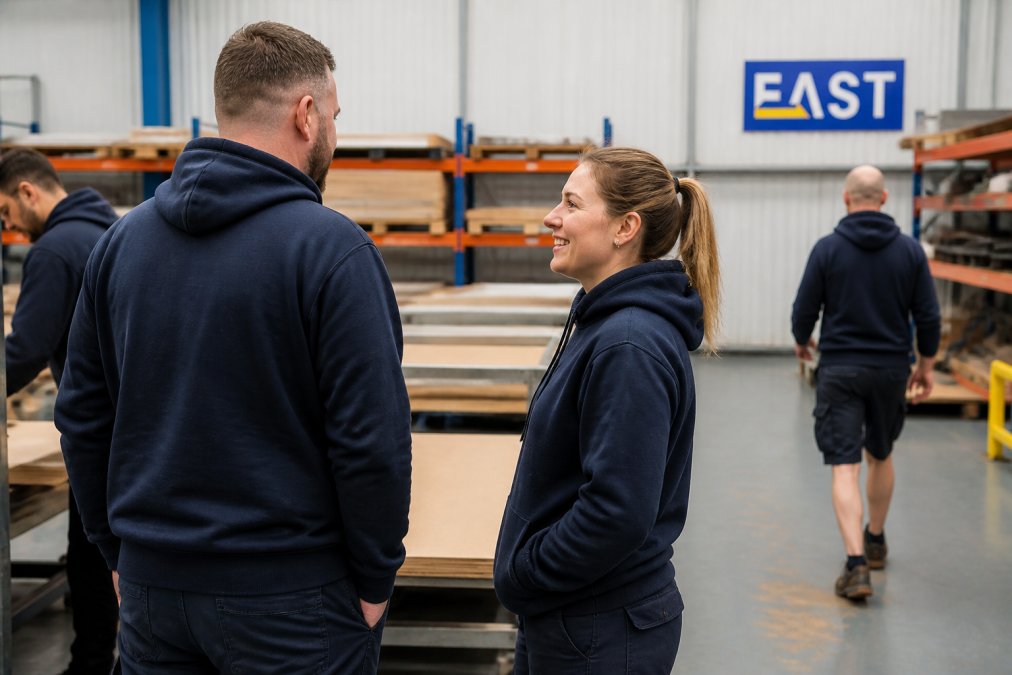
Branded workwear Norfolk teams wear every day does more than label a workforce. It signals competence before a word is spoken and protects staff where a loose shirt or flimsy boot becomes a liability. This guide covers how Norfolk firms choose garments, decoration methods and safety kit that hold up to real working conditions.
The commercial case is straightforward: a uniform removes the daily question of what to wear, presents a consistent face to customers, and gives managers one supplier instead of a dozen.
The Business Case for Uniforms
A branded uniform is a set of garments carrying a company's name, logo or colours, issued to staff for use during working hours. The value sits in three places: identity, safety and retention.
On identity, customers recognise a consistent presence, the person stepping out of the van matches the brand they called. That matters most in trades where trust is decided in the first thirty seconds.
On retention, staff issued proper kit tend to stay longer, and replacing a trained operative costs far more than a set of embroidered polos.
Custom Embroidered Workwear: Durability That Survives the Wash
Custom embroidered workwear is the most durable decoration option for garments washed weekly. Stitched thread does not crack, peel or fade like surface prints, which is why trade and industrial teams default to it.
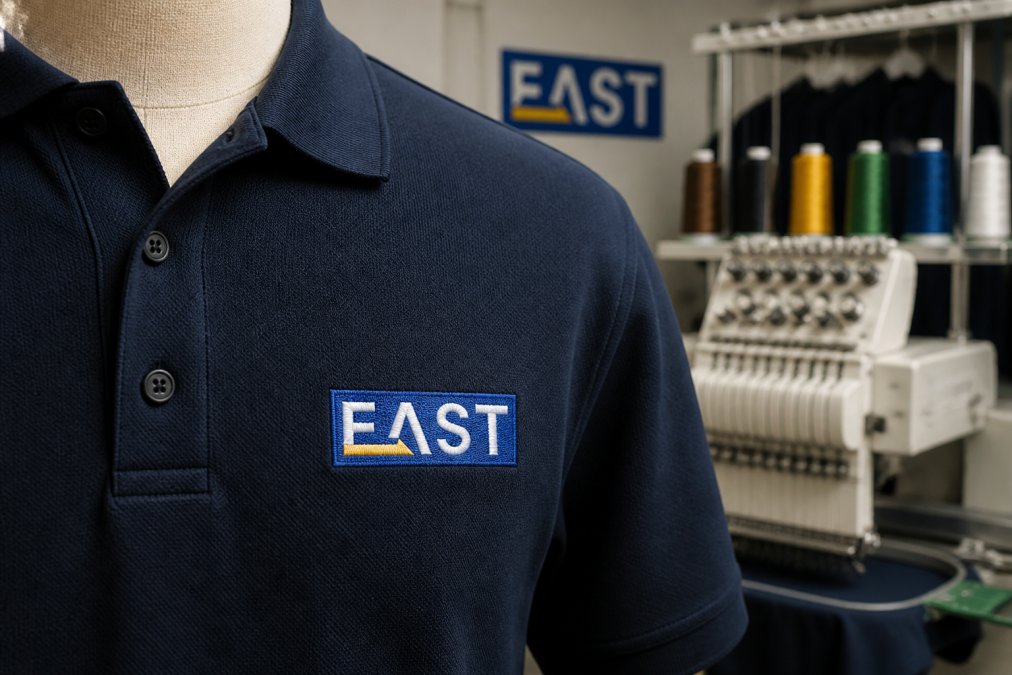
Embroidered logos outlast the garment in most cases. If the shirt eventually wears through at the collar, the stitching is usually still intact.
Where embroidery falls short is fine detail. Very small text, gradients and photographic images do not translate well to thread, so those jobs belong with print.
Embroidery Digitising and Logo Placement
Digitising converts your logo into a stitch file the machine follows. It is a one-off cost per design, and a good file separates a sharp logo from a lumpy one.
Placement rules that matter in practice:
- Left chest sits roughly 18-20 cm down from the shoulder seam on most polos and jackets
- Back prints need to clear the yoke seam or the logo sits crooked
- Sleeve logos work on long-sleeve garments but crowd short sleeves
- Keep at least 2 cm between the logo edge and any pocket or zip
Send your logo as a vector file where possible. A low-resolution JPEG limits how clean the final stitch can be.
DTF Printing vs Screen Printing: Which Decoration Method Fits Your Order?
The right choice depends on order size, design complexity and fabric. DTF suits detailed, full-colour designs on small to medium runs; screen printing wins on large runs of simple designs where unit cost matters; embroidery remains the default for logos on polos, jackets and fleece because stitched thread outlasts the garment.
DTF printing prints a design onto transfer film, dusts it with adhesive powder, then heat-presses it onto the garment. It handles gradients, photographs and multi-colour artwork without per-colour setup charges.
Screen printing pushes ink through a mesh screen, one per colour. Setup takes time, but once running, the per-unit cost drops sharply on big orders.
| Method | Best For | Order Size | Detail Level | Fabric Range |
|---|---|---|---|---|
| Embroidery | Logos on polos, jackets, fleece | Any size | Medium (bold shapes) | Wovens, knits, fleece |
| DTF printing | Full-colour, photographic designs | Small to medium | High | Cotton, poly, blends |
| Screen printing | Simple, bold designs | Large runs | Low to medium | Cotton, poly |
| Heat press vinyl | Names, numbers, single colours | Any size | Low | Most fabrics |
A Decision Framework You Can Apply Before You Order
Work through these four questions in order, the first clear answer usually settles the method.
1. How many colours are in the logo? One or two colours on a large run points to screen printing; four or more, or any gradient or photographic element, points to DTF or embroidery. Screen printing's cost advantage erodes once you pay for a screen per colour.
2. How many garments are you ordering? Small runs, say under fifty, rarely justify screen printing setup, so DTF and embroidery are the sensible default. Above a few hundred units of a simple design, screen printing usually wins on unit cost.
3. How detailed is the artwork? Fine text and small logos belong with embroidery only if the shapes are bold enough to stitch cleanly; very small text and photographic images belong with DTF. Screen printing handles bold shapes well but struggles with fine detail.
4. How long does the garment need to last? Embroidery is the most durable and survives repeated industrial washing. DTF is durable when pressed correctly but can lift at the edges if settings are wrong. Screen printing is durable on cotton but can crack on stretch fabrics. Heat press vinyl is least durable and best for names and numbers that will be replaced.
The Trade-Offs in Plain Terms
A common mistake is choosing screen printing for a five-colour logo on a thirty-shirt order, the per-colour setup makes it the wrong call, and DTF delivers the same result without the overhead. The reverse mistake is choosing DTF for a thousand single-colour shirts where screen printing would be cheaper per unit.
Embroidery is often overlooked beyond logos, but it is the right answer whenever a garment will be washed weekly for years and the logo is a bold shape. It costs more per unit than DTF at low volume, but the decoration typically outlasts the garment, which changes the cost-per-year calculation in its favour.
If you are unsure which method suits your logo and order size, our team can advise before you commit. Email info@workweareast with your artwork and quantities for a quote, or browse our branded polo shirts to see the garments most teams start with.
Benefits of Branded Uniforms: Compliance, Identity and Retention
Branded uniforms deliver three returns at once: they meet workplace safety expectations, build a recognisable corporate identity, and give staff a reason to stay. The safety angle is not optional in most trade settings.
Hi-vis clothing, protective equipment and safety footwear are often required by site rules and by the risk assessment your business has a legal duty to carry out. Uniforms that meet those requirements while carrying your logo do both jobs.
On identity, a consistent look across departments builds recognition. Customers spot your team on site without asking.
On retention, kit that fits properly and looks professional tells staff they are valued. That shows up in how long people stay.
Workwear That Meets Safety Standards: Hi-Vis, PPE and Safety Footwear
Workwear that meets safety standards starts with the risk assessment, not the catalogue. Identify the hazards on site, then match garments and protective equipment to them. The standards below are the ones most commonly cited in risk assessments and site rules across the region's main trades.
Matching Standards to the Job
Construction and groundworks. Hi-vis to EN ISO 20471, usually Class 2 for general site work and Class 3 where workers are near fast-moving traffic or on the highway. Safety footwear to EN ISO 20345, typically S3 for toe protection, penetration resistance and water resistance. Head protection to EN 397 where overhead hazards exist.
Food production and catering. No hi-vis requirement, but garments must be suitable for frequent high-temperature washing. Look for whites and tunics that hold colour and shape at 60°C or above, and footwear that is slip-resistant and wipe-clean rather than steel-toe. Where knives are used, cut-resistant gloves to EN 388 matter more than toe caps.
Warehousing and logistics. Hi-vis to EN ISO 20471 Class 2 is standard. Footwear to EN ISO 20345 S1 or S3 depending on whether floors are wet. Where vehicles and pedestrians share space, the risk assessment usually pushes the hi-vis class up rather than down.
Agriculture and outdoor trades. Waterproof and breathable outerwear, hi-vis where machinery or vehicles operate, and footwear to EN ISO 20345 with ankle support for uneven ground. Chainsaw work brings its own standard, EN ISO 11393, which is separate from general PPE.
Engineering and fabrication. Flame-retardant clothing to EN ISO 11612 where hot work or molten metal is present, plus EN ISO 20471 hi-vis if the work is near vehicles. Welding adds EN ISO 11611 for the specific welding garments.
How to Verify a Garment's Rating
Every compliant garment carries a label or marking showing the standard it meets and the performance level within that standard. Ask your supplier for the certification and check three things:
- The standard number matches the hazard you are managing (EN ISO 20471 for hi-vis, EN ISO 20345 for safety footwear, EN ISO 11612 for flame-retardant clothing).
- The performance level is appropriate, Class 2 hi-vis is not the same as Class 3, and S1 footwear is not the same as S3.
- The certification is current and covers the specific garment, not just the brand's general range.
If a supplier cannot produce the certification, or answers vaguely when asked which standard a garment meets, that is the signal to look elsewhere. The Health and Safety Executive guidance on PPE at work sets out the employer's duties on providing, maintaining and replacing protective equipment. The British Standards Institution publishes the standards themselves, so you can check a garment's rating against the hazard you are managing.
Where Branding Fits Without Compromising Safety
Hi-vis garments have specific rules about where logos can sit. Adding a large dark logo across the back of a hi-vis vest can reduce the visible fluorescent area below the threshold for its class, which effectively downgrades the garment. The safe approach is to keep branding small and placed on the non-reflective areas, and to ask the supplier to confirm the garment still meets its class after decoration.
Safety footwear is rarely branded, most decoration on boots and shoes does not survive the working environment, so the branding effort usually goes on the upper-body garments and the hi-vis outer layer.
Our Hi-Vis range covers the garments most trade teams need, and we can talk through ratings, classes and decoration placement before you order. For a quote tailored to your risk assessment, email info@workweareast.
Bulk Orders, Fast Turnaround and Uniform Management Without the Chaos
Bulk orders and fast turnaround are not opposites if the supplier plans for them. Delays usually come from missing sizes, unclear artwork or a supplier who takes the order before checking stock.
Sizing is the single biggest cause of wasted money: staff guess, the garment arrives wrong, and the reorder costs more than the original.
Ask for a fit kit or size set before committing a large order, a little time upfront saves a fortune in returns.
For teams spread across departments, a workwear portal lets managers allocate garments and staff order their own sizes within set limits. That removes the spreadsheet and the email chains.
On turnaround, a realistic promise beats a fast one that slips. Ask for the lead time for your order size and decoration method, and get it in writing.
Caring for Your Branded Workwear: Fabric Technology and Longevity
How you wash branded workwear decides how long it lasts. Most premature failures come from heat, not from wear.
Wash embroidered and printed garments inside out at 30°C or lower. High temperatures break down DTF adhesives and shrink cotton blends. Skip the tumble dryer where you can; line drying keeps prints flat and stitching tight.
Fabric choice matters too. Poly-cotton blends hold their shape and colour better than pure cotton under frequent industrial washing. Moisture-wicking fabrics suit outdoor and high-activity roles.
Keep a simple log of when each garment was issued. Rotating stock and replacing worn items on a schedule stops a customer seeing a threadbare logo.
For a full programme, our workwear bundles group the garments most teams need, and our branded polo shirts are the workhorse of most uniform orders.
Frequently Asked Questions
What are the benefits of using embroidered workwear for staff?
Embroidered logos are stitched directly into the fabric, so they resist cracking and peeling far better than printed transfers. For teams wearing the same garments several days a week, embroidery keeps the brand looking sharp for the life of the garment. It also suits polos, hoodies, jackets and fleeces, and works well for multi-colour logos. Many Norfolk businesses choose embroidery for customer-facing staff because it reads as a permanent, professional finish rather than a temporary print.
Is DTF printing better than screen printing for work uniforms?
It depends on the order. DTF printing handles full-colour designs and fine detail on small runs without the setup costs of screen printing, which makes it ideal for samples, one-off team shirts or complex artwork. Screen printing becomes more cost-effective once you pass roughly 50 identical garments, because the setup cost is spread across the run. For a 40-shirt order with a detailed logo, DTF is usually the practical choice; for 200 single-colour hi-vis vests, screen printing wins on value.
How do I choose the right fabric for custom workwear?
Match the fabric to the job, not the other way round. Polycotton blends (around 65% polyester, 35% cotton) handle frequent industrial washing and hold colour well, which suits trade and warehouse teams. Heavier cotton-rich fabrics feel softer for office and retail uniforms. For outdoor or cold-store work, look for fleece-backed or softshell options. Always check the wash care label before decorating, as some finishes affect how well embroidery or DTF prints adhere.
Can you handle bulk orders with different sizes across departments?
Yes. Most Norfolk employers order a mix of sizes across several departments, and the simplest approach is to collect a size list per team before ordering. Workwear East can set up a workwear portal so managers order replacement garments on demand, which avoids over-ordering and keeps sizing consistent. For a first bulk order, request a size set to try before committing, especially with safety footwear where fit affects comfort on long shifts.
Building a uniform programme that holds up takes the right garments, the right decoration and a supplier who checks the details before the order ships. Workwear East handles embroidery, DTF printing and screen printing from Thetford, with durable fabrics and consistent results across every order. Get a quote by emailing info@workweareast for your team's branded workwear, and we will match the decoration method and safety ratings to the job.