 Ultimate guide
Custom Branded Clothing: A Practical Guide for UK Businesses
Quick Summary
Custom branded clothing is garment decoration that carries your company identity, such as logos and names, on workwear, polos, hoodies, jackets and hats. UK businesses use it for daily uniforms, event apparel and corporate clothing worn on client visits.
- Match the garment to the working environment before choosing the logo design.
- Embroidery is the most durable decoration for daily-wear workwear because the thread sits within the fabric.
- Compare total cost of ownership by dividing the full order cost by expected months of wear.
- Build a shared core kit across departments, adding small role-specific variations for identification.
- Request a sample to test fit, colour and decoration before approving the full order.
Table of Contents
- What Custom Branded Clothing Covers for UK Businesses
- Choosing Garments: T-Shirts, Polos, Hoodies, Jackets and Hats
- Screen Printing vs Embroidery: Which Decoration Method Suits Your Team
- Why Embroidered Workwear Holds Up Best for Daily Use
- Planning a Corporate Uniform Design That Works Across Departments
- Pricing, Minimum Orders and Total Cost of Ownership
- Ordering Your First Branded Workwear Batch With Workwear East
- Frequently Asked Questions
What Custom Branded Clothing Covers for UK Businesses
Last Updated: November 6, 2026
Custom branded clothing is garment decoration that carries your company identity: logos, names, and sometimes full-colour artwork applied to workwear, polos, hoodies, jackets, and hats. For UK businesses, it covers uniforms worn every shift, promotional apparel handed out at events, and corporate clothing worn on client visits. Workwear East supplies embroidered and printed garments for all three uses, and this guide explains how to plan a branded clothing programme from garment choice through to ordering.
The core decisions are the same whatever the end use: which garment suits the job, how the logo will be applied, how the order is quantified, and the total cost across the life of the garments. Get those four right and the rest is straightforward; get them wrong and you end up replacing uniforms that peel, fade, or fit badly within months.
This guide covers the practical side of custom branded clothing in the order a buyer typically works through it: garment selection, decoration methods, corporate uniform design across departments, pricing and minimum orders, and a step-by-step ordering process.
Choosing Garments: T-Shirts, Polos, Hoodies, Jackets and Hats
The garment you choose sets the tone for the whole programme. A t-shirt suits warehouse staff and event marshals, a polo suits customer-facing teams and site managers, a hoodie works for outdoor or cooler environments, a jacket covers the most exposed roles, and a hat completes a kit without adding much cost.
When advising a business on garments, start with the working environment rather than the logo. Ask what the wearer does, where they do it, and how often the garment will be washed. A polo worn in a cold yard will feel wrong within a week, and a heavyweight hoodie in a hot kitchen will be ignored. If polos suit your team, see our embroidered polo shirts in Thetford for fabric and logo care guidance. Matching the garment to the job is the fastest way to make a uniform stick.
- T-shirts: Best for warehouse, events, and high-turnover teams. Choose a heavier cotton or cotton-polyester blend if the shirts will be worn daily.
- Polo shirts: The most versatile choice for front-of-house and supervisory staff. An embroidered chest logo looks professional and holds up to repeated washing.
- Hoodies and sweatshirts: Useful for outdoor crews and teams who need warmth without a full jacket. Check the weight and fleece lining against the working temperature.
- Jackets: Suit site, delivery, and field roles. Water-resistant shells and padded options cover different weather, and a jacket is worth the higher spend when staff work outside all year.
- Hats: Low cost and high visibility. A simple embroidered cap or beanie adds brand presence across a team at very little extra cost.
Colour matters as much as style. Choose a base colour that fits your existing brand palette and check it against the logo colours before ordering. Dark garments hide dirt in trades, while lighter garments can look smarter in client-facing roles. Keep the palette limited, because a team in five different colours looks disorganised even when every garment is good quality.
Screen Printing vs Embroidery: Which Decoration Method Suits Your Team
Decoration method is the choice most buyers find confusing, so it helps to understand what each method does well, what it costs to set up, and where it fails. The three you are most likely to be offered are embroidery, screen printing, and direct-to-film (DTF) or direct-to-garment (DTG) printing. Each behaves differently on different fabrics, at different order sizes, and under different wash cycles.
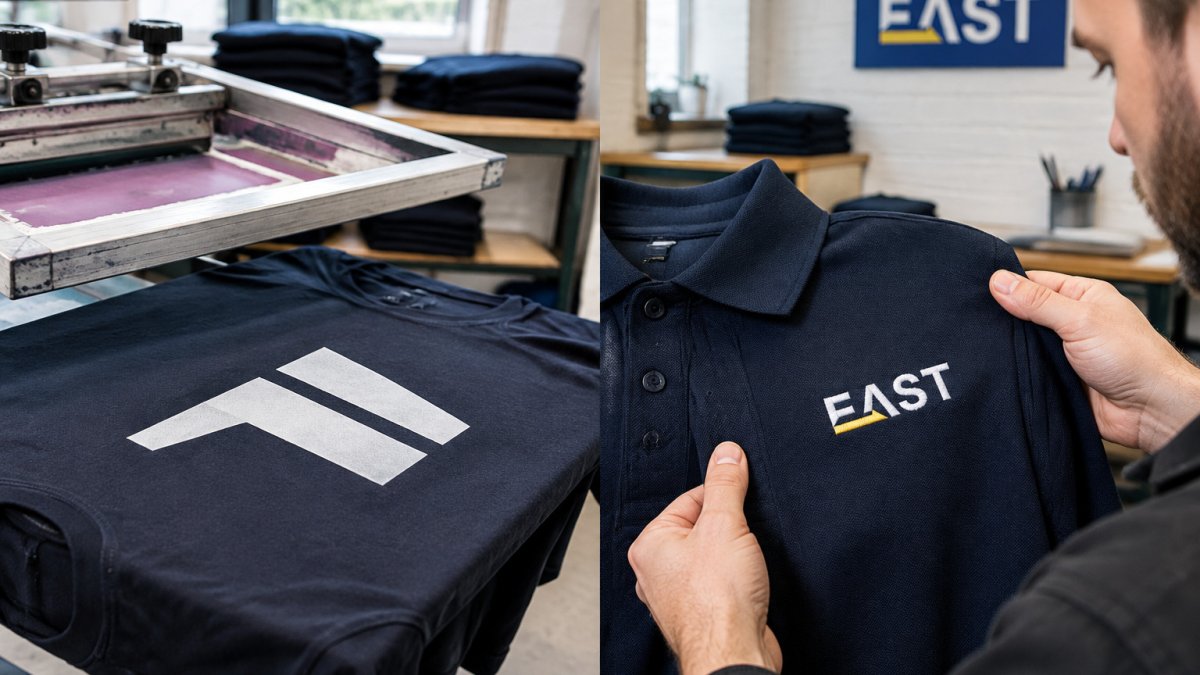
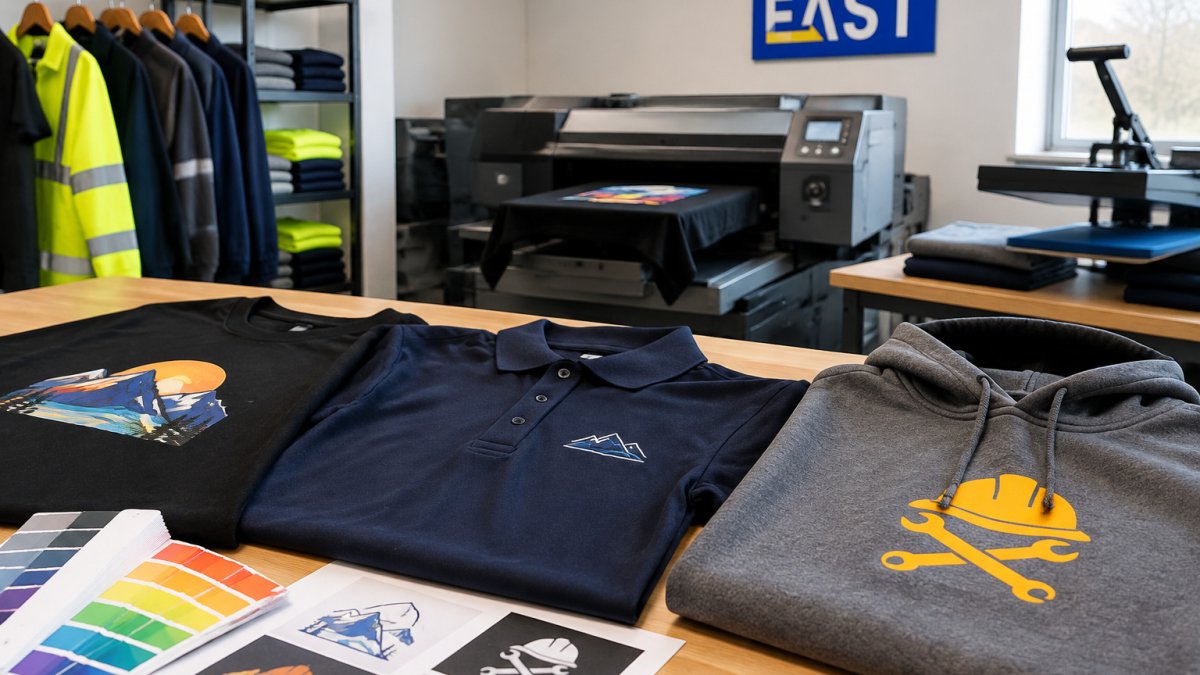
Embroidery stitches thread into the fabric. A digitised file tells the machine where each stitch goes, and the logo is built up in layers of thread. Because the thread sits in the garment rather than on top of it, embroidery does not crack or peel. It is the most durable option for daily-wear workwear and looks premium at close range. The trade-offs: very fine detail, small text, and gradients do not stitch cleanly, and digitising is a one-off setup cost charged before the first garment is run.
A simple way to decide:
| Method | Best for | Setup cost driver | Durability in daily wear | Fabric notes |
|---|---|---|---|---|
| Embroidery | Uniforms, workwear, polos, caps | One-off digitising per logo | High | Structured fabrics; avoid very stretchy or lightweight |
| Screen printing | Large runs, simple logos, event apparel | One screen per colour | Good if cured correctly | Cotton and cotton-rich blends |
| DTF / DTG | Detailed or multi-colour artwork, small runs | No per-colour screen; film or pre-treatment | Good, test first | Check heat tolerance and wash care |
If your team wears the garments every day, embroidery is usually the safer long-term choice. For a large event crowd with a simple design, screen printing can suit the run. Ask your supplier which method fits your artwork and quantity.
Why Embroidered Workwear Holds Up Best for Daily Use
Workwear is judged on how it looks after months of use, not on the day it arrives. Embroidery holds up better than most alternatives because the thread is worked into the garment itself, there is no film or ink layer to crack, so the logo keeps its crispness through repeated washing and rough handling.
Consider how a uniform is actually used: pulled on and off, rubbed against equipment, washed at high temperatures, and tumble dried. A printed logo stretches and wears with each cycle, while an embroidered logo keeps its shape. For a business that needs a team to look professional for a year or more, that difference matters.
Embroidery also looks more premium at close range. Clients and visitors notice garment quality when standing next to the wearer, and a stitched logo reads as considered rather than applied, part of the service for customer-facing staff.
The trade-off is design complexity.
Planning a Corporate Uniform Design That Works Across Departments
A uniform that looks coherent across a business with several departments needs a shared system rather than a separate design for each team. The aim is one recognisable brand identity with small, deliberate variations that identify roles.
Start by setting a core kit every employee wears: the same logo, base colour, and garment family. Then add role-specific pieces, a supervisor might wear a different colour polo or a badge, while a field engineer wears a jacket that matches the kit but suits outdoor work. This keeps the brand consistent while letting people see who does what.
Sizing is where multi-department programmes often go wrong. Staff across roles need a range of sizes and fits, and a single unisex cut will not suit everyone. Collect sizes through a simple form at the start of the order, and plan for a spread covering men's, women's, and extended sizes so nobody is left with a garment that does not fit.
Reorders are easier when the design is documented. Keep a record of the garment style, colour code, logo file, and decoration method for each kit, so a new starter or a replacement order can be matched exactly to the original. This prevents the common problem of a reorder arriving in a slightly different shade from the first batch.
Pricing, Minimum Orders and Total Cost of Ownership
Price depends on quantity, garment type, decoration method, delivery timing, and the complexity of the artwork. Because these variables interact, the best way to know the cost of your order is to request a quote with your specification. Please email info@workweareast.co.uk for a quote tailored to your team and timescale.
What most buyers miss is that the headline price per garment is rarely the whole cost. A useful quote breaks the order into four elements: garment cost, decoration cost, setup or origination cost, and delivery. Ask for each to be shown separately so you can compare like with like.
If you need a small first order to test fit and finish before scaling up, ask your supplier which options allow that and what the minimum is.
Total cost of ownership is the figure that matters most for workwear. Divide the total order cost by the number of months you expect the garments to be worn. An embroidered garment that lasts two years at a higher unit price can cost less per month than a cheaper printed garment needing replacement after a few months.
VAT, delivery, and timing can all affect the final figure, so confirm these when you request a quote. Email info@workweareast.co.uk with your garment list, quantities, and logo details to receive one, and visit https://www.workweareast.co.uk/ to explore the full range.
Ordering Your First Branded Workwear Batch With Workwear East
A structured ordering process prevents most of the errors that cause delays and sizing problems. Work through these steps in order.
- Define the programme. List the roles, the number of staff in each, and the garments each role needs. Note seasonal requirements, such as jackets for winter crews.
- Choose garments and colours. Select styles that match the working environment, then confirm the base colour against your brand palette.
- Pick a decoration method. Discuss with the Workwear East team which method suits your design and wear conditions.
- Prepare your artwork. Supply your logo in a clean vector format where possible, and confirm the size and position for each decoration area.
- Collect sizes. Send staff a simple size form and allow enough time for responses before ordering.
- Request a sample. Test fit, colour, and decoration on a sample garment before a full order.
- Approve and order. Once the sample is signed off, confirm quantities and delivery date.
Lead times depend on quantity and timing, so build in margin before you need uniforms on site. Ordering early for a start date or event leaves room to fix any issues at the sample stage.
For your first batch, start with a manageable number of staff so you can check the fit, finish, and ordering process before committing to a full programme. Email info@workweareast.co.uk to request a quote and sample, and visit https://www.workweareast.co.uk/ to explore the full range of workwear, polos, and workwear bundles available.
Custom branded clothing is an investment in how your team looks and how your business is seen, and it works best when the garment, decoration, and ordering process are planned together. Workwear East supplies embroidered and printed workwear for businesses across Norfolk and beyond, with the durability and consistency that daily wear demands. For a quote tailored to your team, email info@workweareast.co.uk, or visit https://www.workweareast.co.uk/ to browse the range and start your next order.
Frequently Asked Questions
What are the benefits of custom branded clothing for small businesses?
Custom branded clothing gives small businesses a consistent, professional appearance on site, at events and in front of customers. Staff wearing the same garments with a company logo are easy to identify, which supports trust and safety on busy sites. It also acts as low-cost, repeat exposure for your brand every time a team member is seen in public. For a small team, a limited garment range with one or two decoration methods keeps ordering simple and helps the workwear last longer between replacements.
What is the difference between embroidery and DTF printing for workwear?
Embroidery stitches the logo into the fabric using thread, so it stays sharp through repeated washing and rough use and suits hard-wearing garments such as polos, jackets and hats. DTF (direct-to-film) printing transfers a full-colour design onto the garment and suits detailed artwork. The right choice depends on the artwork and the garment. Email info@workweareast.co.uk for advice on your options.
How do I choose the right fabric for custom branded workwear?
Match the fabric to the job, and ask the Workwear East team for advice on which garments suit your working conditions. Check the care label so the garment will survive the wash cycle your team uses.
What is the typical turnaround time for custom branded apparel orders?
Turnaround depends on the quantity, the garment and decoration method, and the delivery date you need. Pricing and timing vary with these factors, so Workwear East does not publish fixed lead times here. For a clear timeline, including any rush requirements for an event, email info@workweareast.co.uk for a quote and visit https://www.workweareast.co.uk/ for current options.