 ultimate-guide
Care Home Uniforms: A 2026 UK Procurement Guide
Table of Contents
- What Care Home Staff Actually Wear: Tunics, Scrubs and More
- Care Home Uniform Colour Coding Explained
- Infection Control Uniform Standards Every Manager Should Know
- Fabric, Comfort and Mobility: What to Look For
- Embroidered Workwear for Care Homes: Branding That Lasts
- Dressing Every Role: HCAs, Nurses and Support Workers
- A Procurement Checklist for Care Home Managers
- Frequently Asked Questions
Last Updated: September 22, 2026
What Care Home Staff Actually Wear: Tunics, Scrubs and More
Care home uniforms are the working garments issued to care staff, in most homes a tunic or scrub set rather than a traditional nurse's dress. The choice comes down to the clinical demands of the role, the laundry setup on site, and how much freedom staff need to move. This guide from Workwear East covers what to buy, how to specify it, and where procurement goes wrong.

Clinical Attire vs Everyday Care Wear
Clinical attire is worn where there is a defined infection risk or clinical task: dressing changes, catheter care, medication rounds, specimen handling. Everyday care wear covers the rest of the shift: personal care, mealtimes, activities, moving and handling.
The sensible split:
- Nursing and clinical leads: tunics in fluid-resistant fabric, close-fitting cuffs, minimal pockets
- Healthcare assistants and support workers: tunics or scrub tops in a durable poly-cotton blend
- Activities, catering and domestic staff: lighter tunics or polo-based uniforms, clearly differentiated by colour
Care Home Uniform Colour Coding Explained
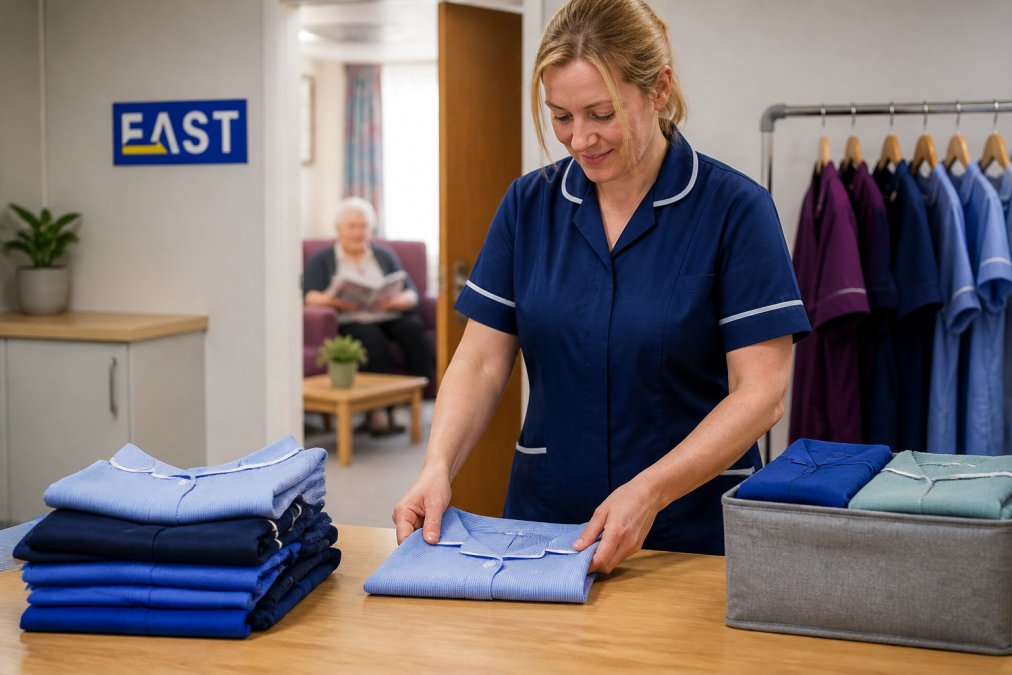
Care home uniform colour coding assigns each job role a distinct garment colour so residents, visitors and staff can identify who does what at a glance. It is not a legal requirement, but it is close to universal in larger homes, and inspectors increasingly treat a coherent scheme as evidence of a well-run service.
A typical scheme runs like this:
| Colour | Role | Why it works |
|---|---|---|
| Navy | Registered nurses and clinical leads | Reads as clinical without the harshness of white |
| Teal or green | Healthcare assistants | Distinct from nursing, calm on the eye |
| Burgundy | Senior carers and shift leads | Signals authority, easy to spot across a room |
| Grey | Domestic and housekeeping | Clearly non-clinical, avoids resident confusion |
| Black or charcoal | Catering and kitchen | Hides stains, separates food handling from care |
Making the Scheme Stick
A colour scheme fails for three predictable reasons: agency staff arrive in their own colours, new starters get whatever is in the stock cupboard, and managers avoid the confrontation. Each has a fix.
- Agency and bank staff. Write a colour expectation into the agency contract. If the agency cannot supply the right colour, issue a coloured tabard or apron at reception so the role is still visually identifiable.
- New starters. Hold a small buffer of plain garments in the two or three most common colours, so nobody spends their first fortnight in the wrong shade while an embroidered order is processed.
- Enforcement. Put the scheme in the staff handbook, reference it at induction, and make it a line in the supervision template. A policy that is never mentioned again is not a policy.
Colour Coding and Dementia-Friendly Design
For homes with residents living with dementia, colour choice carries more weight than aesthetics. High-contrast, saturated colours are easier to distinguish than pastels, and mid-tone navy, teal and burgundy are more legible to a resident with reduced contrast sensitivity than pale blues and greys. Avoid schemes where two roles sit in similar tones, a carer in pale blue and a nurse in pale green will blur together for many residents.
Writing the Scheme into the Uniform Policy
A workable policy covers five things: the colour assigned to each role, who issues garments, what happens when a garment is lost or damaged, how agency staff are handled, and the review date. Keep it to a single page.
Infection Control Uniform Standards Every Manager Should Know
Infection control uniform standards are the laundering, fabric and handling rules that reduce the risk of garments carrying pathogens between residents, a policy built around wash temperature, separation of clean and dirty garments, and fabric that can take the heat.
Laundry Protocols and the 60°C Wash
The NHS England guidance on uniform and workwear laundering sets out the expected standard: uniforms should be washed separately from domestic laundry, at the highest temperature the fabric will tolerate, and never taken home in the same bag as everyday clothing.
A workable protocol for a residential home:
- Staff change out of uniform before leaving the building, or bag it separately
- Soiled uniforms are bagged at the point of removal, not carried loose
- On-site laundry runs a dedicated uniform cycle at 60°C minimum
- Clean uniforms are stored covered, away from the laundry area
- Fabric softener is banned, it coats the fibres and reduces absorbency
- Tumble drying is set to the fabric's stated maximum, not the machine's default
The Mechanics Most Guides Skip
Temperature is the headline, but four other variables decide whether a wash actually disinfects.
Cross-Contamination Prevention
The Health and Safety Executive's guidance on controlling infection risks at work is worth reading alongside any uniform policy, particularly on the handling of contaminated clothing.
Specifying Fabric to Survive the Cycle
A uniform that cannot take 60°C is not fit for a care setting, however comfortable it feels on day one. Ask for the fabric's stated maximum wash temperature in writing, and test a sample garment through twenty cycles before committing to a bulk order. A high-cotton poly-cotton blend feels softer but shrinks and fades faster; a higher polyester content holds colour and shape but feels warmer on a long shift.
Fabric, Comfort and Mobility: What to Look For
Fabric choice decides how long a uniform lasts and how willing staff are to wear it. The best-performing care uniforms use a poly-cotton blend with a small amount of elastane, giving enough stretch to survive a shift of bending, lifting and crouching.
What to specify:
- Breathable material with moisture-wicking properties, so staff working in warm corridors stay comfortable
- Stretch panels at the shoulder and underarm, the two places that tear first
- Fluid-resistant finish on clinical roles, not on every garment
- Anti-microbial treatment where the fabric will be worn against skin for long shifts
- Ergonomic design in the sleeve and hem, so the garment does not ride up during manual handling
Embroidered Workwear for Care Homes: Branding That Lasts
Embroidered workwear for care homes is the most durable way to put a home's name and logo on staff clothing. Stitched logos do not crack, peel or fade in the wash, which matters when every garment goes through a hot cycle several times a week. A heat-transfer print on a care tunic starts lifting at the edges within a few dozen 60°C washes; embroidery has no adhesive layer to break down.
Dressing Every Role: HCAs, Nurses and Support Workers
Role-specific uniform planning stops the common situation where everyone is issued the same garment and half the team is uncomfortable. Each role has a different mix of clinical exposure, movement and public-facing time.
A Procurement Checklist for Care Home Managers
Procurement is where care home uniform projects succeed or fail, and the failure mode is almost always sizing and lead time rather than price. Work through this before you order:
- Audit headcount by role and department. Get an accurate number per role before you request anything.
- Collect sizes properly. Use a self-service sizing portal so staff enter their own measurements rather than guessing on a clipboard.
- Order sample garments first. Have three or four staff in different roles wear a sample for a full shift before committing.
- Confirm the wash temperature your laundry actually runs. Specify fabric to match, not the other way round.
- Decide the colour scheme and write it into the uniform policy. Include it in the staff handbook.
- Plan for new starters. Keep a small buffer stock in the most common sizes.
- Set a reorder trigger. Agree in advance at what point you reorder, so you are not caught short.
- Agree lead times in writing. Confirm delivery dates before the order is placed, especially for anything embroidered.
Frequently Asked Questions
What do the different colours on care home uniforms signify?
Colour coding helps residents, visitors and staff tell roles apart at a glance. In many care homes, navy or dark blue tunics indicate registered nurses, while lighter blue or green is worn by healthcare assistants and care workers. Some homes use burgundy or purple for senior carers, and housekeeping or catering teams often wear a distinct colour such as grey or white. There is no single national standard, so each home sets its own palette. The key is consistency: pick a scheme, document it in your uniform policy, and apply it across every shift.
How do care home uniforms support infection control standards?
Uniforms act as a barrier between staff and residents, reducing the spread of bacteria and viruses. Fluid-resistant fabrics, short sleeves and minimal creases make tunics easier to clean, and a 60°C wash kills most pathogens. Staff should change out of uniforms before leaving the building and never wear them on public transport. Uniforms should be washed daily or after every shift in a care environment. Following these infection control uniform standards protects both staff and vulnerable residents, and it is a key part of any CQC inspection.
What fabrics are best suited for daily wear in a care environment?
Look for a poly-cotton blend with a high cotton content for breathability, or a polyester-rich mix for durability and easy-care. Stretch panels under the arms and across the back improve mobility when moving and handling residents. Moisture-wicking finishes keep staff comfortable during long shifts, and anti-microbial treatments add an extra layer of hygiene. Avoid pure cotton if you need fluid resistance, and steer clear of heavy fabrics that restrict movement. Always check the wash care label: industrial laundering at 60°C or above will shorten the life of poorly made garments.
How often should care home uniforms be replaced?
Most quality tunics and scrubs last between 18 months and three years with daily wear and regular 60°C washing. Replace garments when you see fading, thinning fabric, broken zips, stretched necklines or stubborn stains that survive laundering. Embroidery outlasts printed logos, so embroidered workwear for care homes often stays presentable for the full lifespan of the garment. Keep a small stock of spares so you can swap out worn items immediately. Bulk ordering every 12 to 18 months helps you maintain a consistent look across the team.