 ultimate-guide
Company Event T-Shirts: The 2026 UK Guide
Table of Contents
- Why Company Event T-Shirts Do More Than Fill a Goody Bag
- Printing Methods Compared: Screen Print, DTF and Embroidery
- Custom Embroidered Workwear: When Stitching Beats Printing
- DTF Printing for Corporate Apparel: Full-Colour Logos That Survive the Wash
- Choosing Fabrics and Fits for Large Teams
- Budgeting, Bulk Discounts and Turnaround Times
- Sustainable Options and What Happens After the Event
- Frequently Asked Questions
Last Updated: September 25, 2026
Why Company Event T-Shirts Do More Than Fill a Goody Bag
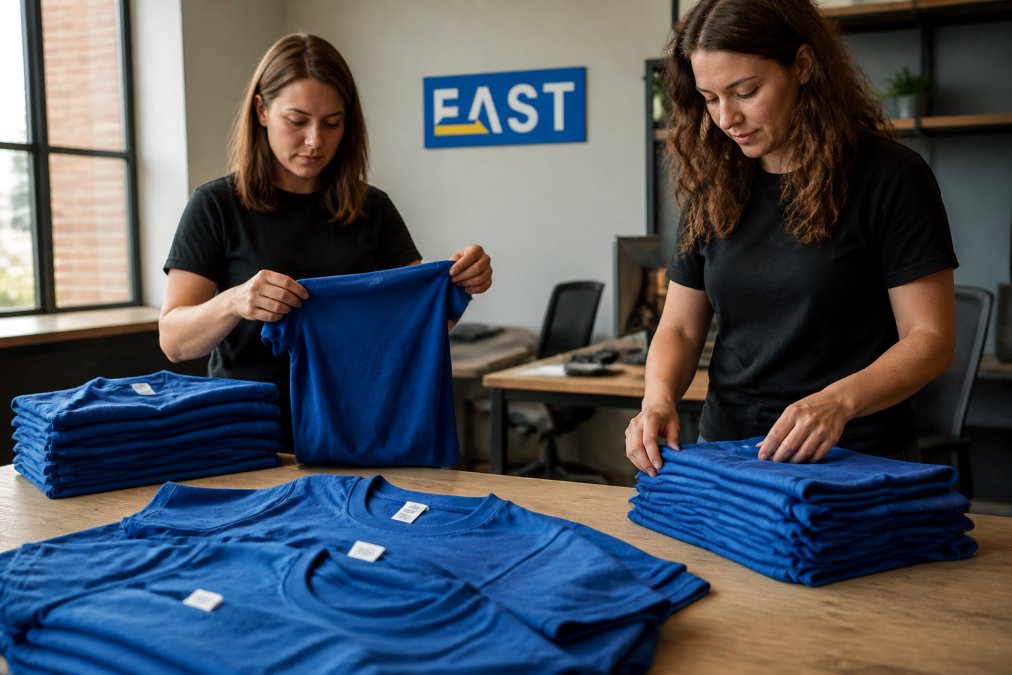
Company event t-shirts are branded garments produced for a specific occasion, a conference, trade show, team away day or product launch. They turn attendees into walking advertising and give staff a shared identity. At Workwear East, we treat them as a procurement decision first and a design project second.
Printing Methods Compared: Screen Print, DTF and Embroidery
Screen print, DTF and embroidery are the three main methods for decorating event t-shirts, each suiting a different combination of order size, design complexity and garment type. Screen printing presses ink through a mesh stencil, DTF transfers a printed film onto the fabric, and embroidery stitches the design into the garment.
Which Method Suits Which Event
| Method | Best For | Order Size | Colour Range |
|---|---|---|---|
| Screen print | Bold, simple logos | Large runs | Limited per screen |
| DTF printing | Detailed, full-colour art | Small to medium | Unlimited |
| Embroidery | Premium staff uniforms | Any size | Cost scales with colours |
Custom Embroidered Workwear: When Stitching Beats Printing
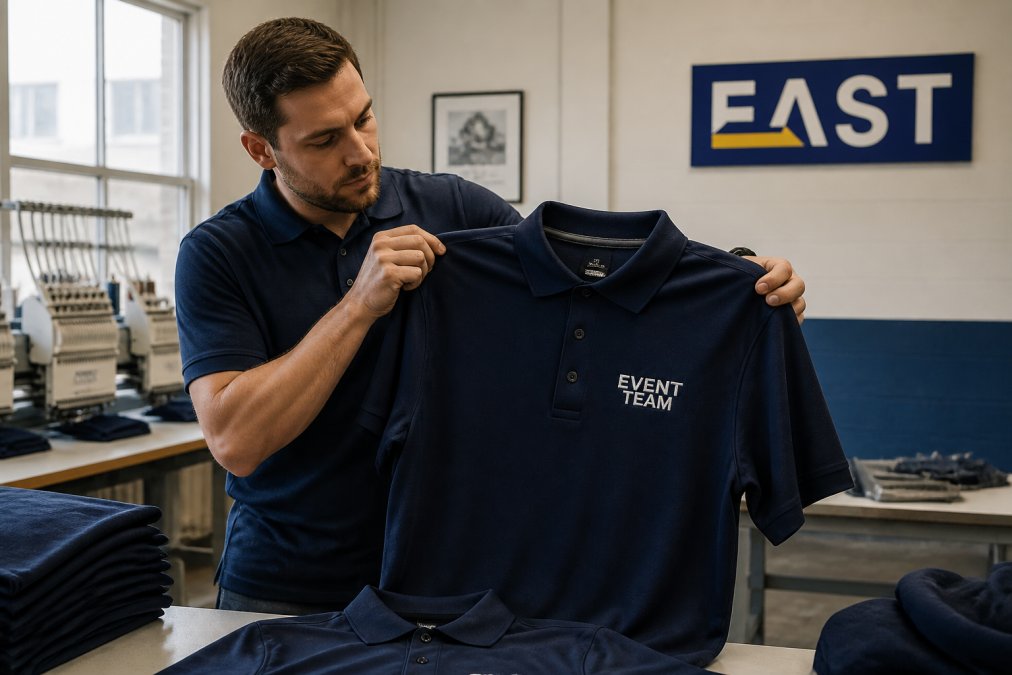
Custom embroidered workwear wins whenever the garment is worn repeatedly by the same person. Stitching does not crack, peel or fade the way a surface print can, because the decoration is structural rather than applied, a difference that shows up within months on a polo worn five days a week.
DTF Printing for Corporate Apparel: Full-Colour Logos That Survive the Wash
DTF printing for corporate apparel solves the problem that has frustrated buyers for years: full-colour logos that stay put. The design is printed onto a transfer film, coated with a powder adhesive, then heat-pressed into the garment, bonding across the whole design area so it flexes with the fabric.
Choosing Fabrics and Fits for Large Teams
Fabric choice and fit range decide whether a large order actually gets worn. A shirt that feels wrong gets left in the drawer, money wasted regardless of how good the print looked.
Cotton, Polyester or a Blend
Cotton breathes well and takes print and embroidery cleanly, making it the comfortable default for indoor events and staff wear. It shrinks slightly on first wash and creases more than synthetics.
Sizing Charts and Multi-Department Orders
Sizing is where large orders go wrong. Collect sizes from every department before you order, and use the supplier's actual sizing chart rather than assuming standard high-street fit. Branded garments often run differently from retail equivalents.
A practical approach for multi-department orders:
- Circulate the supplier's sizing chart, not a generic one
- Ask staff to measure an existing garment they like the fit of
- Add a small buffer of the most common sizes for late joiners
- Record sizes against names so reorders match the first run
Budgeting, Bulk Discounts and Turnaround Times
Budgeting for company event t-shirts is driven by five variables: quantity, decoration method, garment quality, artwork complexity and deadline. Because pricing depends on all five, the honest answer to "what will this cost" is that it varies by specification. Request a quote against your actual brief rather than working from a generic price list, Workwear East can price a full specification, and you can email info@workweareast for a quote.
How Each Variable Moves the Unit Cost
Quantity. Unit costs fall as quantity rises because setup work, screens, digitising or artwork preparation, is spread across more garments. Ordering 100 shirts in one run is cheaper per unit than ordering 50 twice, and the saving is front-loaded: the first 25 units carry most of the setup, then the curve flattens.
A Worked Cost Breakdown by Event Scale
Use this as a planning framework, not a price list. Fill in your own quoted unit rate to model each scenario.
| Event scale | Typical quantity | Best-fit method | Main cost driver |
|---|---|---|---|
| Small team away day | 15-40 | DTF printing | Artwork prep, low setup |
| Departmental conference | 50-150 | Screen print or DTF | Colour count, garment weight |
| Trade show giveaway | 200-500 | Screen print | Quantity, fabric weight |
| Staff uniform programme | 30-100 | Embroidery | Stitch density, colour count |
| Multi-site rollout | 300+ | Screen print plus embroidery | Logistics, sizing spread |
Bulk Discounts: What Actually Drives Them
Bulk discounts are real, but they reward planning rather than pressure. Fixed setup costs divided across more units mean the per-unit price falls, but the discount is not linear: the jump from 50 to 100 units is usually larger than from 100 to 150, because the setup is already absorbed.
Planning a Realistic Timeline
| Stage | Typical Duration | What Happens |
|---|---|---|
| Artwork prep | 1-3 days | Vector file checked, proof issued |
| Proof approval | 1-2 days | You sign off the design |
| Production | 5-10 days | Printing or embroidery run |
| Delivery | 1-3 days | Dispatch to your site |
Build in a buffer. The most common cause of a missed event deadline is a slow proof approval, not slow production. If your event date is fixed, work backwards from delivery and add a week.
Measuring Whether the Spend Was Worth It
Most guides stop at the invoice, but the more useful question is whether the shirts earned their cost. Divide the total order value by the number of times each shirt is likely to be worn: a giveaway shirt worn once has a high cost per wear, while a staff polo worn weekly for a year has a very low one.
Sustainable Options and What Happens After the Event
Sustainable fabrics and end-of-life planning are the two areas most buyers leave until too late. Both are easier to handle at the ordering stage than afterwards, and both are where event apparel quietly becomes waste.
Choosing Lower-Impact Fabrics
Organic cotton and recycled polyester are widely available and behave much like their conventional equivalents. Organic cotton avoids the synthetic pesticide load of conventional growing; recycled polyester diverts plastic from landfill and uses less energy than virgin production. Neither is a silver bullet, and both still carry a footprint.
Designing for a Second Life
Event giveaways have a second life as workwear if the design is simple enough. A plain logo on a good-quality shirt gets worn again. A dated slogan on a thin shirt does not. Three design decisions determine whether a shirt survives the event:
- Keep the design evergreen. Avoid dates, event names and campaign slogans that date the garment.
- Choose a neutral base colour. Navy, black, grey and white get worn; neon and novelty colours do not.
- Specify a wearable fabric weight. A shirt that feels substantial gets kept; a thin one gets binned.
Planning for Leftovers Before They Pile Up
Leftover stock is the most common sustainability failure in event apparel. Plan for it at the ordering stage, not the week after:
- Order to a realistic headcount, not a round number. Ordering 120 shirts for 100 attendees "just in case" creates 20 items of dead stock.
- Offer spare shirts to staff and volunteers first. They are the most likely to wear them again.
- Donate clean, unworn stock to local charities or community groups. Many accept new branded clothing, though some restrict logoed items, check first.
- Keep a small reserve for new starters and reorders. A handful of spares prevents a costly small reprint later.
- Recycle genuinely worn-out garments through a textile recovery scheme. Most councils accept textiles at household waste recycling centres, and charities such as WRAP textile guidance on garment longevity outline reuse and recovery routes.
What to Do With Shirts That Cannot Be Reused
That is the throughline of this whole guide: the shirts that earn their cost are the ones designed and specified to be worn after the event, not just handed out at it. Print method, fabric weight and sizing all feed into that single outcome. Workwear East supplies embroidered and printed workwear produced to order, and can advise on fabric, method and sizing before you commit, email info@workweareast for a quote.
Frequently Asked Questions
What are the best fabrics for company event t-shirts?
For indoor events and giveaways, 100% cotton at 180-200gsm feels soft and takes screen printing and DTF well. For outdoor or trade show use, a cotton-polyester blend resists shrinking and holds colour longer. Heavier weights around 200gsm suit staff who will wear the shirt repeatedly. Ask for a fabric swatch before committing to a bulk order, and check wash durability claims against the care label instructions.
Should I choose embroidery or screen printing for event apparel?
Embroidery suits polos, fleeces and workwear where a raised, premium logo finish matters, and it survives industrial washing. Screen printing works better for large, flat, multi-colour designs on lighter garments and costs less per unit at volume. DTF printing sits between the two, handling full-colour artwork on cotton, polyester and blends without minimum quantity pressure. Match the method to the garment and how often it will be worn.
How do I ensure my company branding stays professional on casual wear?
Keep the logo to one or two placements, usually left chest or centre front, and size it to the garment rather than scaling the same file across every product. Use vector artwork so lines stay sharp when enlarged. Stick to two or three brand colours and avoid busy backgrounds behind the logo. A consistent placement across polos, t-shirts and hi-vis keeps the brand recognisable at every event.
Can I order company event t-shirts without a minimum quantity?
Many suppliers now offer no minimum quantity on DTF printing, which suits small teams or pilot runs before a larger order. Embroidery and screen printing usually carry minimums because setup time is higher. If you need 15 shirts for one department, ask which method allows that volume without a setup penalty. Workwear East can advise on the best route for your numbers and deadline.