 ultimate-guide
Custom Workwear Suffolk: 2026 Branded Uniform Guide
Table of Contents
- What Custom Workwear Suffolk Businesses Actually Need
- Embroidered Workwear Benefits for Norfolk and Suffolk Teams
- DTF Printing vs Screen Printing: Which Suits Your Order?
- How to Choose Durable Workwear Fabrics That Last
- Hi-Vis, PPE and Compliance: Getting Safety Kit Right
- Bulk Orders, Turnaround Times and Costs Explained
- Caring for Custom Workwear So It Lasts
- Frequently Asked Questions
Last Updated: September 13, 2026
What Custom Workwear Suffolk Businesses Actually Need
Custom workwear is branded clothing supplied to a business and personalised with its logo, usually through embroidery or printing, so staff present a consistent identity on site and in front of customers. For teams across the region, the practical question is rarely whether to bother. It is which garments, which decoration method, and which supplier will still be holding up after a year of daily wear.
This guide from Workwear East covers exactly that. Below, we break down embroidery versus printing, fabric selection, safety compliance, bulk ordering and aftercare, so you can specify an order once and get it right.
The 2026 buying landscape has shifted. Buyers are more sceptical of cheap garment-plus-logo packages because they have been burned before, and durability now matters more than headline price.
Embroidered Workwear Benefits for Norfolk and Suffolk Teams
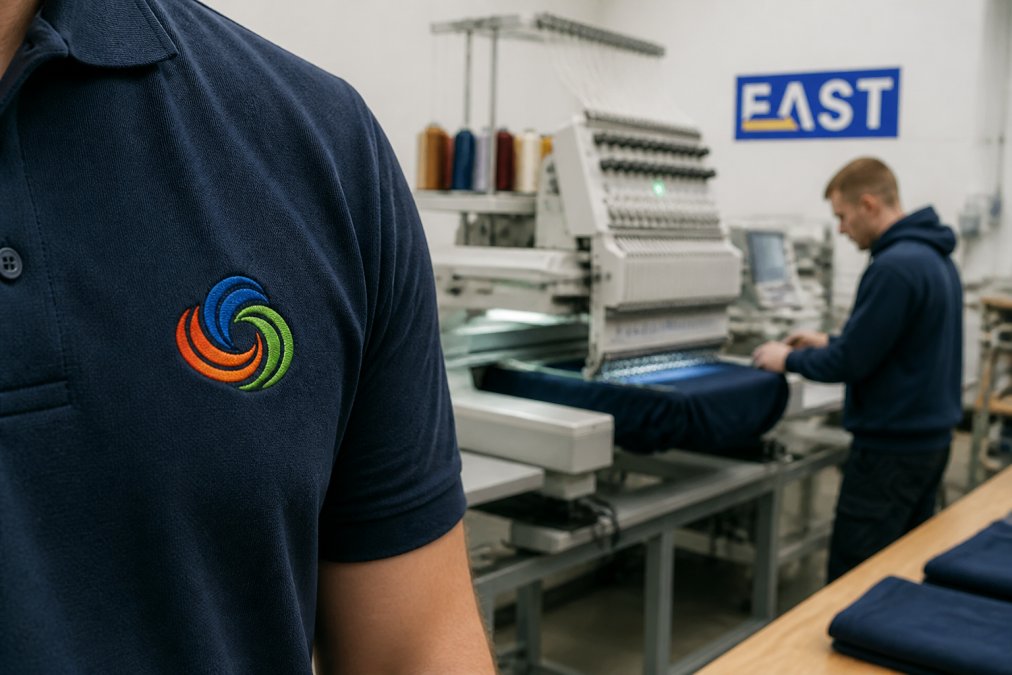
Embroidered workwear benefits come down to three things: longevity, finish quality, and how the logo reads on the garment. Stitched logos do not crack, peel or fade the way printed transfers can, and they hold their shape through repeated industrial washing.
That matters for trade and industrial teams in particular. A stitched logo sits proud of the fabric and keeps its definition on polo shirts, softshell jackets and work trousers, even after heavy use.
What most guides miss is digitising. Before anything is stitched, your logo is converted into a machine file that tells the needles where to go, and a poor digitised file is the single biggest reason embroidery looks cramped or distorted. Ask for a stitch-out sample on the actual garment before committing to a full run.
DTF Printing vs Screen Printing: Which Suits Your Order?
DTF printing versus screen printing is a question of detail, volume and fabric. DTF (direct-to-film) printing transfers a full-colour design onto a film and presses it onto the garment, which suits detailed artwork, gradients and photo-style logos on many fabrics. Screen printing pushes ink through a mesh stencil and is the cheaper route once you are producing larger quantities of a simple, low-colour design.
| Method | Best For | Detail Level | Typical Order Size |
|---|---|---|---|
| Embroidery | Polos, jackets, caps, corporate uniforms | Medium, stitched and textured | Any size, no minimum |
| DTF printing | Full-colour logos, photos, small runs | High, gradients and fine detail | Small to medium |
| Screen printing | Simple designs, large runs | Lower, solid colours | Medium to large |
For a 40-shirt event order with a detailed logo, DTF is usually the sensible pick. For 300 plain two-colour tees, screen printing wins on cost per unit.
How to Choose Durable Workwear Fabrics That Last
Choosing durable workwear fabrics starts with the fibre blend and the fabric weight, not the colour. A heavier poly-cotton weave resists abrasion and holds its shape better than a thin 100% cotton garment, which is why it dominates industrial workwear.
Look for these markers when you specify:
- Poly-cotton blends (often around 65/35) for strength and colour retention
- Reinforced stress points at shoulders, pockets and knees
- Higher fabric weight for trousers and jackets that take daily punishment
- Colour-fast dyes if the garment will be washed frequently
- Ripstop or twill weaves for trade and construction use
The sustainable option most suppliers do not mention
Recycled polyester and organic cotton blends are now genuinely viable for branded uniforms, not just a marketing line. The practical differences matter:
- Recycled polyester (often made from post-consumer plastic bottles) performs almost identically to virgin polyester in abrasion tests, but takes dye slightly differently, so very bright colour matches can be harder to guarantee across repeat orders.
- Organic cotton uses less water and no synthetic pesticides in growing, but it is softer and less abrasion-resistant than poly-cotton, so it suits office, hospitality and light-trade uniforms better than site work.
- Blended eco fabrics (for example recycled polyester with organic cotton) give you the durability of a synthetic with a lower environmental footprint, and are the most common choice for businesses with a sustainability policy to report against.
Expect eco options to sit at a modest premium per garment rather than a dramatic one, and ask for the fibre composition in writing so you can put it in your own environmental reporting. If your organisation publishes carbon or waste figures, a recycled-fabric uniform is one of the easier wins to evidence.
Matching fabric to the job
A common pattern is to over-specify one fabric across an entire workforce. In practice, most teams need two or three specifications:
| Role type | Sensible fabric choice | Why |
|---|---|---|
| Site, trade, warehouse | Heavy poly-cotton or ripstop | Abrasion resistance, shape retention |
| Office, reception, management | Poly-cotton or organic cotton blend | Comfort, appearance, easy decoration |
| Hospitality, catering | Poly-cotton with colour-fast dye | Frequent washing, stain resistance |
| Outdoor, cold storage | Softshell or bonded fleece | Wind and water resistance, layering |
Specifying per role rather than per company usually reduces both cost and replacement rates, because you stop paying for heavy-duty fabric on garments that never see a building site.
Health and Safety Executive guidance on workplace PPE
Hi-Vis, PPE and Compliance: Getting Safety Kit Right
Safety kit is where cheap sourcing goes wrong fastest. Hi-vis clothing must meet the correct standard for the risk and the environment, and the required class depends on factors like road speed and visibility conditions. If you are unsure which class applies to your site, check the current HSE personal protective equipment at work guidance before ordering.
For most industrial and construction teams, the practical checklist is:
- Correct hi-vis class for the working environment
- Retro-reflective tape that stays effective after washing
- Garments that fit properly, since ill-fitting PPE is a hazard in itself
- Branding applied without covering reflective tape or obscuring the standard marking
Embroidery and print can both be applied to hi-vis, but keep decoration clear of reflective strips. A logo stitched across a tape band compromises the garment's function.
Bulk Orders, Turnaround Times and Costs Explained
Bulk uniform procurement rewards planning, and the reason is mechanical rather than mysterious. Every decorated order carries fixed setup work: digitising the logo for embroidery, or burning a screen for each colour in a screen-printed design. Those costs do not change whether you order 15 garments or 150, so the more you order at once, the more that setup is spread across each item and the lower your unit cost becomes.
That is why the same logo can look expensive on a five-garment order and very reasonable on a fifty-garment one. It is not a discount gimmick; it is the fixed cost being divided differently.
What actually drives your lead time
Turnaround is where most buyers get caught out, and it is worth understanding the sequence rather than just asking "how long?":
- Artwork approval, you supply a vector logo, the supplier confirms it is production-ready. Delays here are the most common cause of missed deadlines.
- Digitising or screen setup, typically a day or two for embroidery, similar for a new screen print design.
- Garment sourcing, stock garments in your chosen colours and sizes are usually quick, but special-order or out-of-stock lines can add days or weeks.
- Sampling, a stitch-out or print sample on the actual garment, which you approve before the full run.
- Production, the full run itself, which scales with quantity but is rarely the bottleneck.
- Delivery, allow buffer, especially for multi-site or multi-department orders.
A common mistake is leaving an event order until two weeks before the date, then discovering the garment you want is out of stock in half the sizes. Order early, confirm sizes with a proper fitting session, and lock the artwork before production starts.
Keeping a large order manageable
- Collect sizes across every department using a simple size sheet
- Confirm the logo file is vector and approved
- Agree the decoration method per garment type
- Approve one stitch-out or print sample before the full run
- Schedule delivery with buffer ahead of your deadline
The cost-benefit case for branding
Plain workwear is cheaper per garment, but it does none of the work a branded uniform does. A branded uniform:
- Makes staff identifiable to customers and visitors, which matters for site security and for trust in trades
- Reduces the temptation for staff to wear their own clothes, which are often less safe and less presentable
- Reinforces your business every time a member of staff is seen in public
- Simplifies reordering, because everyone is specifying the same garments
For a small business, the honest calculation is not "branded versus free" but "branded versus plain plus the cost of inconsistency." Most firms find the branded option pays for itself in presentation and reorder simplicity long before it pays for itself in any notional marketing value.
Workwear East runs bulk orders. If you need a rush order for an event, it is worth asking early rather than assuming it cannot be done. Email info@workweareast for a quote, or start building your order through the workwear bundles and branded polo shirts.
ACAS guidance on providing uniforms and work clothing
Caring for Custom Workwear So It Lasts
Wash branded garments inside out at a moderate temperature and avoid biological detergents and fabric softener, which break down adhesives and dull embroidery thread over time. Tumble drying on high heat is the fastest way to shorten a garment's life.
A simple care routine:
- Turn garments inside out before washing
- Wash at 30-40°C, not hot
- Skip fabric softener entirely
- Air dry where possible, or tumble on low
- Iron around, never directly onto, the decoration
Get this right and a well-specified embroidered garment will comfortably outlast a cheap printed alternative, which is the real cost-benefit argument for spending a little more up front.
Specifying branded uniforms across multiple departments, sizes and safety requirements is genuinely fiddly, and getting it wrong costs you downtime and reprints. Workwear East handles the whole process in-house from Thetford, with embroidery, DTF printing and screen printing under one roof, and a workforce portal that lets larger teams manage sizes and reorders without the back-and-forth. Take a look at the workwear bundles and branded polo shirts to start building your order, or email info@workweareast for a quote and get your team looking the part.
Frequently Asked Questions
What are the benefits of using embroidered workwear for staff?
Embroidery stitches your logo directly into the fabric, so it will not crack, peel or fade the way a cheap transfer can after repeated washing. It gives a smart, professional appearance that holds up to daily wear on site or in a customer-facing role. For teams in Norfolk and Suffolk, embroidered workwear also reinforces brand visibility every time a member of staff is out on a job, and it helps staff feel part of a proper team rather than just wearing generic kit.
Is DTF printing better than screen printing for work uniforms?
It depends on the order and the design. DTF printing handles detailed, full-colour artwork on a range of fabrics and suits smaller runs where setting up screens would not be economical. Screen printing is more cost-effective for large orders of the same design on similar garments. If your logo has fine detail or you need a handful of items quickly, DTF is often the better fit; for 100 identical t-shirts, screen printing usually wins on value.
How do I choose the right fabric for heavy-duty workwear?
Match the fabric to the job. Look for a tight weave and a decent fabric weight for trades that snag and rub against surfaces, and check whether the garment is rated for the conditions your team works in. Poly-cotton blends resist shrinking and hold colour well, while heavier cotton is comfortable but wears faster under abrasion. If in doubt, ask what other firms in your trade use and check the garment's wash and durability guidance before ordering in bulk.
How should I care for embroidered workwear to ensure longevity?
Wash embroidered garments inside out at a moderate temperature and avoid biological detergents and fabric softener, which break down threads over time. Do not tumble dry on high heat and never iron directly over the embroidery. Following the care label keeps the stitching and the base fabric in good condition, which matters when you have invested in branded kit for a whole team. Email info@workweareast for a quote and care guidance for your specific garments.