 listicle
Eco-Friendly Workwear Branding Options: 2026 Guide
Table of Contents
- Why Eco-Friendly Workwear Branding Matters for Your Business
- Sustainable Workwear Fabrics: What Actually Works
- Durable Embroidery for Eco-Friendly Clothing
- Benefits of DTF Printing on Recycled Materials
- Screen Printing for Bulk Eco-Conscious Orders
- How to Choose Sustainable Uniforms for Your Team
- End-of-Life Recycling and Circular Economy Options
- Frequently Asked Questions
Last Updated: September 29, 2026
Why Eco-Friendly Workwear Branding Matters for Your Business
Eco-friendly workwear branding options UK are no longer a niche choice, they're becoming a business imperative. Companies that invest in sustainable branded uniforms signal commitment to environmental responsibility whilst strengthening corporate identity. At Workwear East, we've helped businesses across Norfolk understand that durable, ethically-made workwear isn't just better for the planet; it's better for your bottom line.
Professionally branded sustainable apparel signals quality and values. Employees report higher engagement, customers notice, and sustainable workwear lasts longer, reducing replacement costs.
This guide breaks down eco-friendly workwear branding from fabric selection through end-of-life considerations, helping you align decisions with budget and values.
Sustainable Workwear Fabrics: What Actually Works
Not all sustainable fabrics perform equally in a working environment. The right choice depends on your industry, climate, and how often garments need washing.
Organic Cotton vs Recycled Polyester
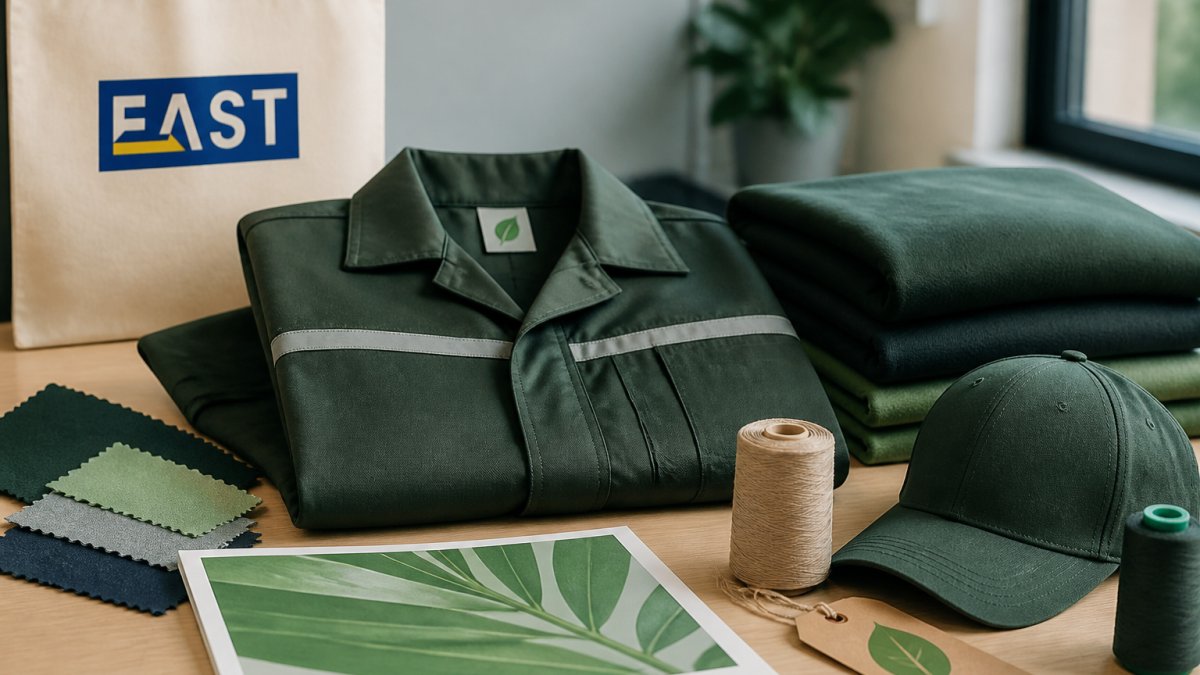
Organic cotton is grown without synthetic pesticides, making it lower-impact. It's breathable and soft but requires more water and wrinkles easily. Ideal for office or lighter-duty roles; less suitable for heavy industrial work.
Recycled polyester (rPET) transforms plastic bottles into durable, shrink-resistant fabric ideal for construction, warehouse, and outdoor roles. Trade-off: lower breathability in warm conditions.
Blended fabrics (60% organic cotton, 40% rPET) combine breathability with durability, ideal for mixed-role teams.
Certifications That Prove Sustainability
GOTS (Global Organic Textile Standard) verifies organic fabric from field to finished product, covering pesticide restrictions, worker welfare, and chemical processing.
OEKO-TEX Standard 100 tests finished textiles for harmful chemicals, guaranteeing safety for daily skin contact.
Fair Wear Foundation ensures factory workers earn fair wages and work in safe conditions, demonstrating ethical supply chain commitment.
Look for garments carrying at least one certification; multiple certifications show thoroughness.
Durable Embroidery for Eco-Friendly Clothing
Embroidery is the gold standard for workwear branding because it lasts. Unlike printing, embroidery stitches into the fabric itself, surviving hundreds of washes without cracking or peeling.
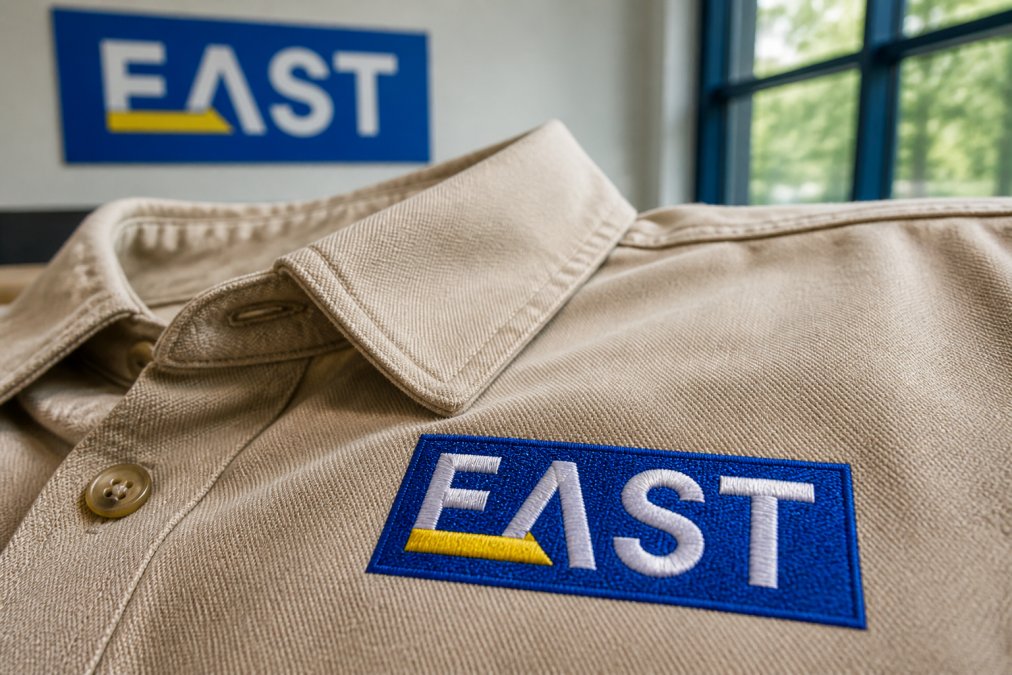
Embroidery pairs well with sustainable fabrics, with stitching becoming part of the garment's structure so logos stay vibrant through years of wear.
Advanced embroidery machines handle intricate designs without compromising fabric integrity. A uniform lasting five years beats cheaper alternatives needing replacement after eighteen months.
Embroidery adds slight weight and stiffness, barely noticeable in most applications, with durability gains outweighing minor comfort trade-offs.
Benefits of DTF Printing on Recycled Materials
Direct-to-Film (DTF) printing uses water-based inks applied directly to garments, creating vibrant, detailed full-colour logos that won't crack or fade.
DTF excels on recycled polyester, enabling photographic-quality images and fine detail that screen printing can't match, ideal for promotional apparel and events.
DTF uses less ink waste than screen printing and water-based inks reduce chemical impact, with durable prints extending garment life.
DTF performs best on dark fabrics; on light fabrics, ink saturation may show through slightly. For most workwear applications, DTF performs well.
DTF enables small batches without minimum-order penalties, making fifty branded polos economical where screen printing requires larger runs.
Screen Printing for Bulk Eco-Conscious Orders
Screen printing is most cost-effective for orders of fifty or more staff, delivering the lowest per-unit cost on sustainable fabrics.
Screen printing creates a mesh screen for each colour, then presses ink through onto garments. Modern water-based inks reduce environmental impact compared to solvent-based methods.
Screen printing creates a permanent bond on organic cotton that survives industrial laundering, with logos staying sharp through hundreds of washes.
Screen printing works best with simple designs and limited colours; each colour requires a separate screen. For solid-colour logos and simple graphics, it's unbeatable for durability and cost.
How to Choose Sustainable Uniforms for Your Team
Selecting eco-friendly workwear branding requires balancing durability, comfort, environmental impact, and cost. The key question: "What's the business case?"
The ROI of Sustainable Workwear for Businesses
Sustainable uniforms cost 15-25% more upfront but total cost of ownership over three to five years often favours them due to longer lifespan and reduced replacement cycles.
For a 20-person team over five years: budget workwear at £25/garment replaced annually costs £2,500; sustainable workwear at £35/garment replaced every 2.5 years costs £1,400, saving £1,100. Scale to 100 staff and savings exceed £5,500.
Employee retention and engagement. CIPD research shows employees at environmentally committed businesses report higher job satisfaction and lower turnover, reducing recruitment and training costs.
Brand perception and customer loyalty. Sustainable branding signals quality and responsibility, strengthening customer trust and repeat business in customer-facing roles.
Corporate social responsibility (CSR) alignment. Sustainable uniforms demonstrate compliance with corporate procurement standards, opening contract opportunities unavailable to competitors.
Regulatory positioning. The Environment Act 2021 establishes legally binding waste reduction targets. Early adoption avoids future compliance costs and penalties.
Defining Your Team's Actual Needs
Role and climate. Warehouse teams need different fabrics than office staff. Construction workers need reinforced seams; customer-facing roles need premium finishes. Outdoor roles demand quick-drying synthetics; indoor roles can prioritise breathable organic cotton.
Laundry frequency and method. Industrial laundering demands robust synthetic fibres; in-house washing allows delicate organic cotton. Ask your laundry provider for recommendations.
Branding complexity. Simple logos: screen printing is most economical. Detailed designs: DTF delivers vibrant results. Intricate logos: embroidery provides highest durability.
Budget and volume. Small teams benefit from DTF's flexibility; large teams (50+) justify screen printing's economy. Embroidery suits premium roles. Workwear East offers Workwear Bundles that combine multiple items at better value, and Branded Polo shirts as a versatile base for any branding approach.
Evaluating True Durability and Longevity
True workwear cost is total cost over lifespan. A premium sustainable uniform worn five years costs significantly less per year than budget options replaced every eighteen months.
Request sample garments and wash them using your actual workplace laundry process.
Managing Supply Chain Transparency
Know where your workwear comes from. Legitimate suppliers provide transparent information about manufacturing locations, labour practices, and material sourcing. You need a responsive partner for supply chain reliability.
End-of-Life Recycling and Circular Economy Options
Sustainable workwear branding requires addressing end-of-life recycling. Circular economy thinking transforms workwear from a cost centre into part of your environmental strategy.
How Textile Recycling Actually Works
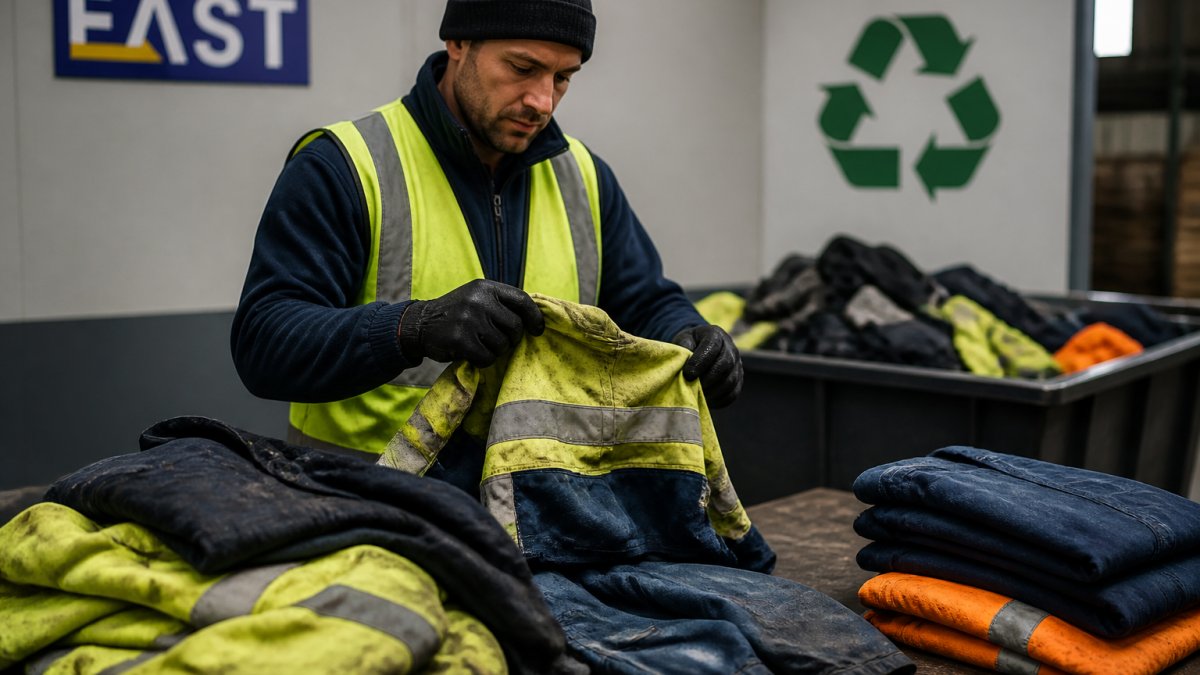
Fibre-to-fibre recycling (closed-loop). The gold standard: worn uniforms are shredded and respun into new yarn. Your old uniform becomes a new uniform indefinitely. Requires separation by fibre type.
Verifying Recycling Partnerships
Ask suppliers about recycling partnerships: Do they facilitate take-back? Track where garments go? Provide environmental impact reporting?
Ask suppliers to provide:
- Documentation of their recycling partner's certification
- Annual impact reports (tonnes recycled, CO₂ avoided, new products created)
- Clear instructions for your team on how to return worn uniforms
- Proof that returned garments are actually recycled, not exported to developing countries for landfill
Designing for Recyclability
Not all uniforms are equally recyclable. Fabric composition, dyes, and construction methods affect whether garments can be recycled at end-of-life.
Calculating Your Circular Impact
Over a five-year uniform cycle, closed-loop recycling delivers measurable environmental benefit:
Example: 50-person team, replacing uniforms every 2.5 years
- Year 2.5: 50 uniforms (approximately 750 kg) returned for recycling
- Year 5: Another 50 uniforms returned
- Total: 1,500 kg of textile material recycled
If recycled through closed-loop fibre-to-fibre systems:
- CO₂ avoided (vs. landfill): 3,000-4,500 kg
- Water saved (vs. new virgin fibre production): 45,000-60,000 litres
- New uniforms created from recycled material: Approximately 1,500 kg of new fabric
Closing the Loop: From Purchase to Recycling
For circular economy to work, your business must commit to the full cycle. This means:
- Purchasing uniforms designed for recyclability (single-fibre or certified-blend fabrics)
- Maintaining uniforms properly to extend their working life (see care instructions below)
- Returning worn uniforms to your supplier's recycling programme when they reach end-of-life
- Tracking and reporting the environmental impact of your recycling participation
Frequently Asked Questions
What makes workwear eco-friendly and how does branding affect sustainability?
Eco-friendly workwear uses organic cotton, recycled polyester (rPET), or other low-impact fabrics produced with reduced water consumption and fewer chemical dyes. Branding methods matter too: embroidery and water-based DTF printing maintain sustainability better than traditional plastisol screen printing. When you choose sustainable fabrics paired with durable branding techniques, your uniforms last longer, reducing replacement waste and your business's overall carbon footprint. Email info@workweareast for advice on combining sustainable materials with professional branding.
Is recycled polyester a good choice for branded uniforms?
Yes, recycled polyester (rPET) is an excellent choice for branded workwear. It diverts textile waste from landfills, requires less water than virgin polyester, and performs well under repeated washing and wear. rPET holds embroidery and DTF printing durably without peeling or cracking when applied correctly. Many businesses find rPET blends offer the best balance of sustainability, cost-effectiveness, and durability for corporate apparel that needs to withstand daily workplace use and regular laundering.
How does DTF printing compare to embroidery for sustainable garments?
DTF printing excels at reproducing detailed, full-colour logos on sustainable fabrics without adding bulk or weight. It uses water-based inks that are gentler on eco-friendly materials and produces vibrant results that resist fading. Embroidery, by contrast, creates a three-dimensional, tactile finish that often lasts longer under heavy wear and frequent washing. For recycled polyester and organic cotton, both methods work well, but embroidery typically offers superior longevity for workwear subjected to daily wear. Your choice depends on logo complexity and durability requirements.
What certifications should I look for in sustainable branded workwear?
Look for GOTS (Global Organic Textile Standard) for organic cotton items, OEKO-TEX certification for low-chemical processing, and Fair Wear Foundation credentials for ethical labour practices. These certifications verify that fabrics are produced responsibly and meet environmental and social standards. When branding garments, ask your supplier whether they use water-based inks and whether their printing processes are certified low-impact. Workwear East can discuss certified sustainable options and branding methods that maintain these standards. Email info@workweareast for details on certified eco-friendly branding solutions.