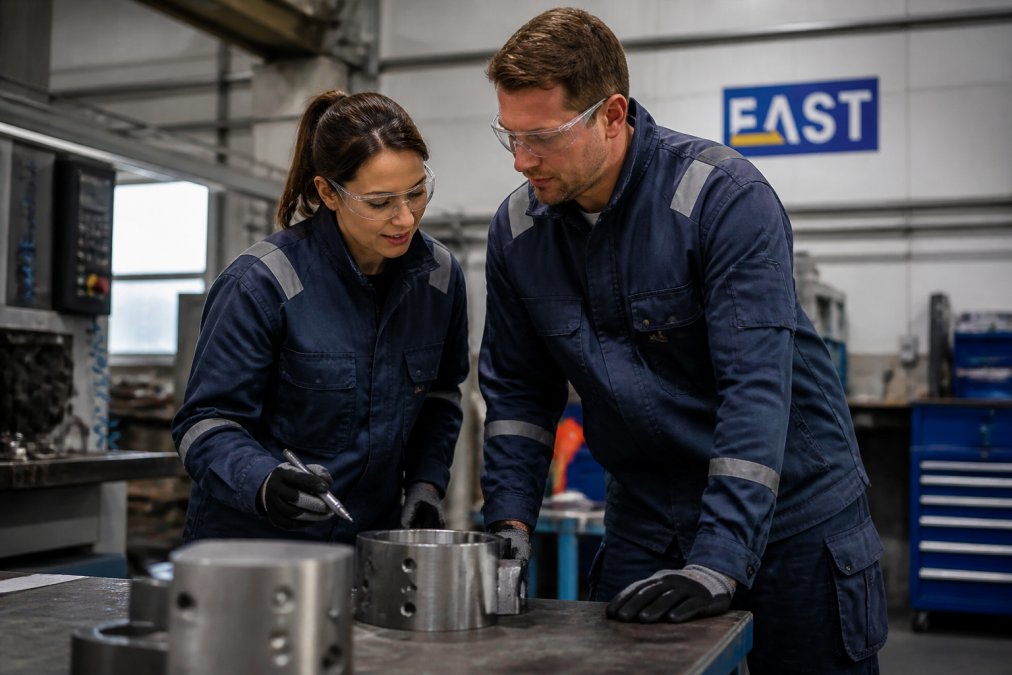
 ultimate-guide
Engineering Workwear: 2026 UK Buying Guide
Table of Contents
- What to Look for in Engineering Workwear
- Workwear Safety Standards UK: What Your Gear Must Meet
- Custom Embroidered Workwear for Engineering Teams
- DTF Printing for Uniforms: Full-Colour Branding That Survives the Wash
- Hi-Vis, Protective Footwear and Weather-Resistant Outerwear
- Sizing, Bulk Orders and Maintenance for Engineering Workwear
- Conclusion
- Frequently Asked Questions
Last Updated: September 17, 2026
What to Look for in Engineering Workwear
Engineering workwear is the category of protective and branded clothing designed for engineers working across site, workshop and plant environments, where abrasion, heat, chemicals and moving machinery are daily hazards. This guide from Workwear East covers what actually holds up. Most buying guides list products. Fewer explain why one garment survives eighteen months on a fabrication floor while another fails in three.
The difference usually comes down to two things: fabric construction and fit. Get those wrong and everything else, including your logo, is wasted.
Fabric Durability and Abrasion Resistance
The single biggest cause of premature workwear failure is abrasion at contact points: knees, cuffs, shoulders and pocket edges. Look for abrasion resistance ratings and reinforced stitching at stress seams.
Practical checks before you buy:
- Fabric weight: heavier cotton-poly blends resist tearing better than lightweight pure cotton
- Reinforcement: double-stitched or bar-tacked seams at pocket corners and crotch
- Tear-resistant panels: ripstop weaves stop small snags becoming large tears
- Colour retention: dyed fibres rather than surface-printed colour survive industrial laundering
A common mistake is choosing on price per garment alone. A cheaper item replaced twice a year costs more than a durable one replaced once.
Ergonomic Fit and Thermal Regulation
Ergonomic fit means the garment moves with the body rather than restricting it. For engineers who kneel, reach overhead or climb, this matters more than style.
Key fit considerations:
- Gusseted crotches and articulated knees for unrestricted movement
- Adjustable cuffs and hems to seal out drafts and debris
- Layering systems so one base garment works across seasons
- Moisture-wicking inner layers under breathable fabric outer shells
Thermal regulation is about managing heat, not just staying warm. Overheating causes fatigue and reduces concentration, which is itself a safety risk.
Workwear Safety Standards UK: What Your Gear Must Meet
Compliance is not optional, and it is not something a supplier can simply claim. Personal protective equipment placed on the market must meet the requirements of the Personal Protective Equipment (Enforcement) Regulations 2018, which enforce Regulation (EU) 2016/425 as retained in law. Garments must carry UKCA marking and the correct performance standard for the hazard.
The standards you will encounter most often:
| Hazard | Relevant Standard | What It Covers |
|---|---|---|
| High visibility | BS EN ISO 20471 | Reflective and fluorescent clothing |
| Thermal/flame | BS EN ISO 11612 | Heat and flame-resistant clothing |
| Welding | BS EN ISO 11611 | Protective clothing for welding |
| Electrostatic | BS EN 1149 | Static dissipative clothing |
| Weather | BS EN 343 | Protection against rain |
| Cold | BS EN 342 | Protection against cold environments |
| Thermal hazards | BS EN ISO 11612 | Limited flame spread and convective heat |
Mapping Workwear to HSE Risk Assessment Categories
Most buying guides stop at the standards table. The practical step is linking each garment to the hazards identified in your risk assessment, so the specification is defensible rather than assumed.
- Identify the hazard: abrasion, heat, flame, chemical splash, electrical arc, cold, rain, or moving machinery.
- Check the standard: match the hazard to the relevant BS EN standard, not to a generic "safety" claim.
- Confirm the performance level: many standards have categories or classes (for example, BS EN ISO 20471 Class 1, 2 or 3; BS EN 343 waterproof and breathability classes). The class must suit the exposure.
- Verify the garment combination: layering a non-compliant jacket over a compliant coverall can compromise the overall protection.
- Record the decision: keep the declaration of conformity and test reports with the risk assessment so the choice is auditable.
Verifying Compliance Before You Order
A supplier's word is not evidence. Ask for:
- The declaration of conformity for the exact garment and standard.
- Test reports from a notified body or accredited test house.
- Confirmation that branding (embroidery or print) has been assessed against the standard.
- Care instructions that preserve the certified performance.
Workwear East supplies certified workwear and can advise on which standard applies to your site conditions. Email info@workweareast for a quote and we will help you match garments to your risk assessment.
Custom Embroidered Workwear for Engineering Teams
Custom embroidered workwear is the default choice for engineering firms that want a professional, durable branded uniform. Embroidery stitches thread directly into the fabric, so the logo becomes part of the garment rather than a layer sitting on top of it.
Embroidery vs Print: Which Lasts Longer?
Embroidery outlasts print in almost every high-wear application. The trade-off is cost and detail: embroidery handles bold, multi-colour logos well but struggles with fine gradients, while print reproduces photographic detail but sits on the surface.
| Method | Durability | Best For | Detail Level |
|---|---|---|---|
| Embroidery | Excellent | Logos, names, heavy wear | Bold, multi-colour |
| DTF printing | Good | Full-colour graphics | Photographic |
| Screen printing | Good | Large single-colour runs | Simple, flat |
DTF Printing for Uniforms: Full-Colour Branding That Survives the Wash
DTF printing for uniforms transfers a full-colour design onto fabric using a heat-applied film, which bonds to the material and flexes with it. It handles detailed artwork, gradients and photography that embroidery cannot reproduce.
What to check when comparing suppliers:
- Whether the print is stretch-tested on the actual garment fabric
- Wash-care guidance supplied with the order
- Whether the supplier tests adhesion before dispatch
Hi-Vis, Protective Footwear and Weather-Resistant Outerwear

- S1: anti-static, energy absorption at the heel, closed seat region.
- S2: S1 plus water penetration and absorption resistance.
- S3: S2 plus penetration resistance and cleated outsole.
- S5: S3 plus a fully waterproof upper, often for wet or chemical environments.
Maintenance and Inspection for Hi-Vis and Protective Gear
Most sites focus on buying the right gear and then neglect it. Reflective tape degrades with industrial washing, abrasion and UV exposure, and hi-vis garments lose their fluorescent properties over time. A practical inspection routine:
- Check reflective tape for cracking, lifting or dullness before each shift.
- Retire garments when the fluorescent colour fades or the tape no longer reflects under a torch.
- Wash hi-vis separately to avoid abrasive contamination from other garments.
- Follow the care label exactly; it is written for the specific fabric and finish.
- Avoid fabric softener, which coats moisture-wicking fibres and reduces performance.
Sizing, Bulk Orders and Maintenance for Engineering Workwear
Sizing is where most bulk orders go wrong. A team of fifty across different departments needs a system, not a spreadsheet of guesses.
A practical approach:
- Collect sizes using a fit preference, not just measurements (some staff prefer loose, others fitted)
- Order sample garments in two sizes before committing to the full run
- Keep a recorded size list per employee so replacements match
- Confirm lead times in writing before setting a start date
Industrial Laundry and Care
Industrial laundry cycles are far harsher than domestic washing. High temperatures and strong detergents strip colour and degrade elastic and reflective tape over time.
Care rules that extend garment life:
- Follow the care label exactly; it is written for the specific fabric and finish
- Avoid fabric softener, which coats moisture-wicking fibres and reduces performance
- Wash hi-vis separately to prevent abrasive contamination from other garments
- Inspect reflective tape regularly and retire garments when visibility drops
Conclusion
The challenge with engineering workwear is that the wrong choice fails quietly: a cracked logo, a torn knee, a non-compliant vest that no one checks until an inspection. Getting fabric, fit, certification and branding right from the start avoids all three.
Frequently Asked Questions
What features should high-quality engineering workwear include?
Look for reinforced stitching at stress points, abrasion-resistant fabric, and a fit that allows full arm and shoulder movement. Moisture-wicking linings help with thermal regulation across long shifts, while multi-pocket utility layouts keep tools accessible. If your site requires it, flame retardant or static dissipative finishes matter too. Workwear East can talk you through which specification suits your working environment.
How do you ensure engineering workwear complies with safety standards?
Start with a risk assessment for each role, then match garments to the hazards identified. Hi-vis clothing should carry the relevant certification for your site's conditions, and protective footwear needs the right toe and sole protection for the tasks involved. Ask your supplier to confirm what each garment is certified to, and keep records of that certification for inspections. Workwear East can advise on compliant options.
What is the difference between embroidered and printed workwear?
Embroidery stitches your logo directly into the fabric, which gives a raised, hard-wearing finish that suits polos, fleeces and jackets. DTF printing lays full-colour detail onto the garment, so it handles complex logos, gradients and small text that embroidery cannot reproduce cleanly. Both survive repeated washing when applied correctly. For engineering teams, embroidery often suits heavier garments while DTF works well for detailed branding on lighter ones.
Why is fabric durability critical for engineering environments?
Engineering work exposes clothing to abrasion from machinery, sharp edges and repeated industrial laundering. Garments with tear-resistant weave and reinforced stitching at seams and pockets last longer, which reduces how often you replace them. That matters when you are kitting out a whole team, because replacing workwear every few months costs far more than buying durable gear once. Check the fabric weight and reinforcement details before ordering in bulk.