 ultimate-guide
Hospitality Uniforms: The Complete 2026 UK Buying Guide
Table of Contents
- What Makes Hospitality Uniforms Different From Standard Workwear
- Front of House, Kitchen and Housekeeping: Matching Uniforms to Each Role
- Hospitality Uniform Fabric Guide: Choosing Breathable, Durable Materials
- Custom Embroidered Workwear and Branding Options Explained
- Workwear Maintenance Tips to Extend Garment Longevity
- Sustainability, Compliance and the Psychology of Staff Uniforms
- How to Build a Hospitality Uniform Supply Chain That Works
- Conclusion
- Frequently Asked Questions
Last Updated: September 18, 2026
What Makes Hospitality Uniforms Different From Standard Workwear
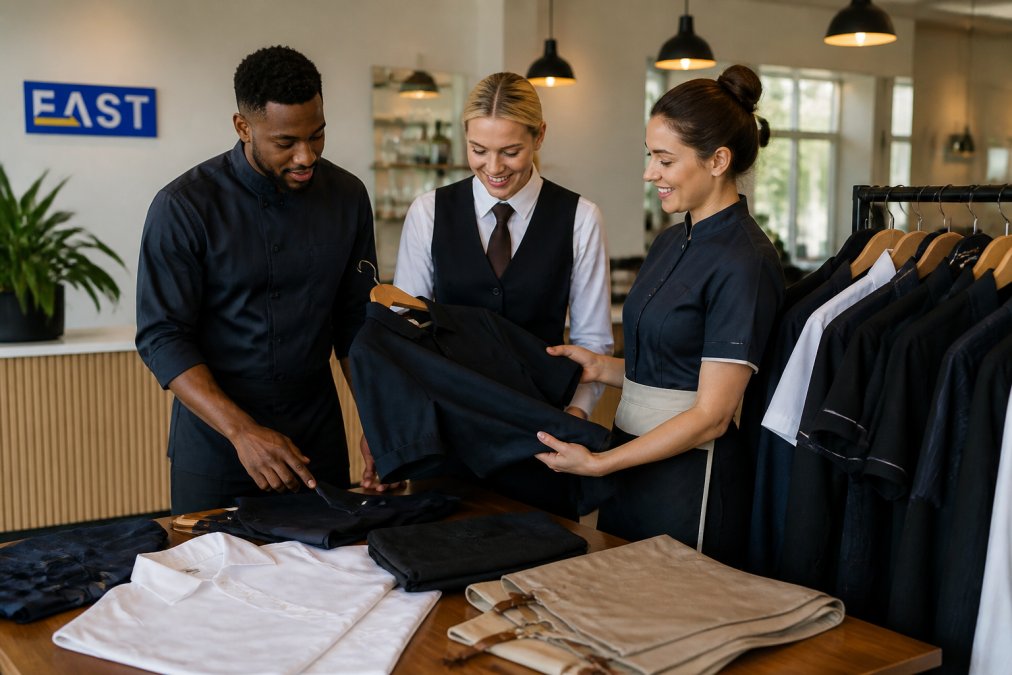
Hospitality uniforms are garments designed for customer-facing environments, where appearance, comfort during long shifts and wash durability matter as much as protection. This guide from Workwear East breaks down how to choose them by role, fabric and branding method.
The difference comes down to three pressures that standard workwear rarely faces at once: staff are visible to paying customers all day, they move constantly across hot kitchens and busy floors, and the garments get washed far more often than a typical trade polo. A construction polo can survive on toughness alone. A hospitality uniform has to look sharp at hour ten of a twelve-hour shift.
Get any one of those three wrong and the cost shows up quickly, in replacement orders, in staff complaints, or in how the venue looks to customers.
Front of House, Kitchen and Housekeeping: Matching Uniforms to Each Role
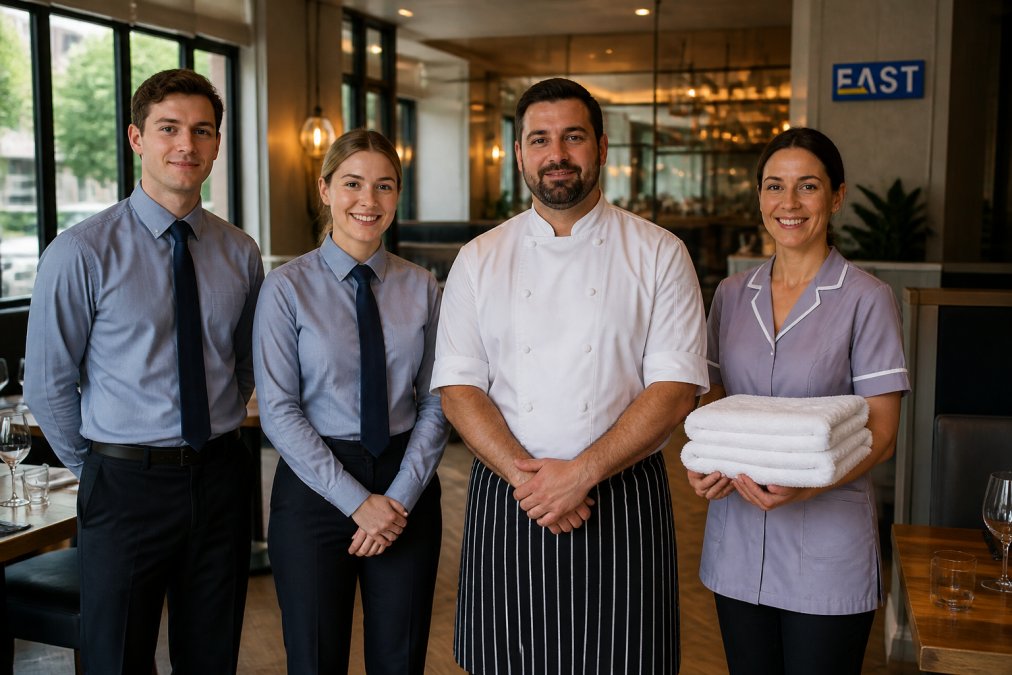
One uniform policy for every department is the most common mistake we see. Each role has a different job to do, and the uniform should reflect that.
Front of House and Bar Staff Attire
Front of house staff need smart trousers, tailored shirts, waistcoats or aprons that hold their shape through a full service. Bar staff attire adds one more requirement: movement. Reaching, bending and carrying mean the fabric has to stretch or drape without pulling at the seams.
Chef Coats and Kitchen Catering Clothing
Chef coats and kitchen catering clothing prioritise heat tolerance and easy laundering. Look for breathable materials that release steam rather than trapping it, and a cut that allows full arm movement over a stove. Light colours help hide flour and show up stains early, which matters when hygiene is visible to customers.
Housekeeping and Maintenance Uniforms
Hotel housekeeping teams spend the day bending, lifting and moving between floors. Tunics with side vents and stretch panels make a real difference here, as does a darker colour that hides the marks that come with the job. Maintenance staff need the same durability with more reinforcement at the knees and elbows.
Hospitality Uniform Fabric Guide: Choosing Breathable, Durable Materials
Fabric choice decides how a uniform performs after twenty washes, not how it looks on day one. A hospitality uniform fabric guide should always start with the fibre blend, because that is what determines breathability, colour retention and shape.
Poly-cotton blends are the workhorse for most hospitality roles. The cotton keeps the garment comfortable against the skin while the polyester holds colour and resists shrinking. For kitchens, a higher cotton content improves heat tolerance.
How Fibre Blends Behave in a Commercial Wash Cycle
The blend that looks best on the hanger is rarely the one that survives a hospitality laundry regime. Most venues wash uniforms at least five times a week, and some kitchen and housekeeping garments go through daily. That is the equivalent of a domestic wash load every working day, and the fibre mix determines what happens next.
- 65/35 poly-cotton (the industry standard). Holds colour and shape well through repeated 30°C cycles. Expect minimal shrinkage after the first wash, then stability. The trade-off is that it can feel warmer than pure cotton in a hot kitchen.
- 50/50 poly-cotton. Softer against the skin and more breathable, which suits front of house and bar staff on long shifts. It creases more easily and may need a light press after tumble drying.
- 100% cotton. Best heat tolerance and the most comfortable in a kitchen, but it shrinks, fades and creases faster. It also takes longer to dry, which matters if you rely on same-day turnaround.
- Polyester-rich blends (80/20 or higher). The most durable and the easiest to launder, but they trap heat and can feel clammy during a busy service. Best for housekeeping and maintenance where appearance and longevity outweigh breathability.
Matching Fabric to Role, Not to Price
A common pattern is to buy one fabric across the whole venue to simplify ordering. That usually backfires. Kitchen staff in a polyester-rich polo overheat; front of house in heavy cotton look creased by mid-service; housekeeping in a light weave wear through the fabric at the knees within months.
- Kitchen and catering: higher cotton content (50% or more) for heat tolerance, with a tight weave to resist oil and flour penetration.
- Front of house and bar: 50/50 or 65/35 blends that drape well and hold a press, with enough stretch or side vents for reaching and carrying.
- Housekeeping and maintenance: polyester-rich blends with reinforced knees and elbows, in darker colours that hide marks.
The Wash-Test Rule
Before committing to a full order, ask any supplier for a wash-test sample. Run it through ten industrial cycles at the temperature you actually use, then check for colour fade, seam stress, pilling and logo cracking. It takes a week and saves a full reorder.
Custom Embroidered Workwear and Branding Options Explained
Custom embroidered workwear lasts longer than printed branding because the thread is stitched into the fabric rather than sitting on top of it. For uniforms that get washed daily, that difference is decisive.
Health and Safety Executive guidance on workplace PPE
Workwear Maintenance Tips to Extend Garment Longevity
Workwear maintenance tips matter more in hospitality than in almost any other sector, because these garments are washed far more often. Treating them like domestic laundry is the fastest way to shorten their life. The difference between a uniform that lasts six months and one that lasts two years is usually the wash routine, not the fabric.
A Role-by-Role Laundry Guide
Different roles expose garments to different soils, and the right wash routine changes accordingly.
The Five Rules That Matter Most
- Wash at the lowest temperature that still cleans the garment, usually 30°C for poly-cotton blends and 40°C for cotton-rich kitchen wear.
- Turn embroidered garments inside out before washing to protect the stitching and prevent logo cracking.
- Avoid fabric softener, which coats fibres and dulls colour over time.
- Skip the tumble dryer where possible; line drying preserves shape and elasticity.
- Repair loose seams early rather than waiting for a full split.
Rotation and Reorder Planning
For venues that need help setting up a consistent uniform programme with reliable replacement supply, email info@workweareast for a quote or visit Workwear East to discuss your requirements.
Sustainability, Compliance and the Psychology of Staff Uniforms
Sustainability and eco-friendly fabrics are no longer a niche concern for hospitality buyers. Recycled polyester blends and organic cotton options now perform close to their conventional equivalents, and specifying them is a straightforward way to align procurement with wider environmental commitments.
| Consideration | What It Affects | Practical Action |
|---|---|---|
| Fabric blend | Breathability and lifespan | Match fibre mix to role heat and wash frequency |
| Branding method | Logo durability | Embroidery for daily-wash garments |
| Fit and sizing | Staff comfort and wear | Offer two fits and a full size range |
| Sustainability | Environmental impact | Specify recycled or organic options |
| Compliance | Legal safety duties | Check role-specific hazards before ordering |
How to Build a Hospitality Uniform Supply Chain That Works
A reliable uniform supply chain is built on three things: a consistent sizing system, a reorder process that does not stall, and a supplier who can handle both a full rollout and a single replacement.
Conclusion
Getting hospitality uniforms right is a procurement problem before it is a design problem. The venues that struggle are usually the ones that picked a supplier on price alone, then spent the next year replacing cracked logos and ill-fitting garments.
Frequently Asked Questions
What are the benefits of branded hospitality uniforms?
Branded hospitality uniforms do more than look smart. They build instant brand recognition, help guests identify staff quickly, and create a sense of team pride. Research into staff presentation shows that customers perceive uniformed teams as more professional and trustworthy. For venues with high staff turnover, uniforms also simplify dress code enforcement and reduce the risk of inappropriate clothing. Custom embroidered workwear with your logo reinforces your corporate image every time a staff member interacts with a guest.
How do I choose the right fabric for hospitality workwear?
Start with the role. Front of house needs breathable materials like cotton-rich blends that hold a press and look smart through a full shift. Kitchen staff need heat-resistant, easy-care garments that withstand frequent washing at high temperatures. Housekeeping teams benefit from durable poly-cotton that resists fading and shrinking. Look for high-quality textiles with a weight of at least 200gsm for trousers and 180gsm for shirts. Always request fabric samples before committing to a large order.
What is the difference between embroidery and DTF printing for uniforms?
Embroidery stitches your logo directly into the fabric using threads, creating a premium, textured finish that lasts for years and suits polo shirts, chef coats, and jackets. DTF printing transfers a full-colour design onto the garment, which handles complex logos, gradients, and fine detail that embroidery cannot reproduce. DTF works well on cotton, polyester, and blends. For durability, embroidery generally outlasts printing on garments that face heavy washing, but modern DTF prints are far more resistant to cracking than older transfer methods.
Are there specific health and safety standards for catering clothing?
Yes. UK food businesses must comply with Food Standards Agency requirements and the Food Safety Act 1990, which mandate that food handlers wear clean, suitable clothing that protects food from contamination. For kitchen environments, this means aprons, chef coats, and hair coverings where appropriate. Where staff handle hazardous substances or work in industrial kitchens, the Control of Substances Hazardous to Health (COSHH) Regulations 2002 may also apply. Always check your specific venue's risk assessment to confirm uniform requirements.