 how-to
How to Manage Staff Uniform Sizes: A Step-by-Step Guide
Table of Contents
- Why Accurate Uniform Sizing Matters for Your Business
- Step 1: Create a Staff Uniform Size Template
- Step 2: How to Track Employee Uniform Inventory
- Step 3: Best Practices for Uniform Ordering
- Step 4: Managing Uniform Replacement Cycles
- Step 5: Handling Size Variants and Non-Standard Body Types
- Step 6: Streamlining the Ordering Process
- Common Mistakes to Avoid When Managing Uniform Sizes
Last Updated: August 19, 2026
Why Accurate Uniform Sizing Matters for Your Business
Getting staff uniform sizes right isn't just about comfort, it's about operational efficiency, brand consistency, and cost control. Poor-fitting uniforms lead to unhappy employees, wasted procurement budget, and a team that doesn't represent your brand effectively.
Managing uniform sizes across a growing workforce becomes exponentially harder without a proper system. You're juggling different body types, seasonal staff changes, unpredictable new hires, and constant pressure to control costs. Most businesses approach this haphazardly: spreadsheets, scattered notes, and eventually bulk orders of the wrong sizes.
At Workwear East, we've worked with many businesses across Norfolk who've solved this problem by treating uniform sizing as an operational system, not an afterthought. This guide walks you through the exact steps to build that system for your business.
Step 1: Create a Staff Uniform Size Template
The foundation of effective uniform management is a standardized size template that captures everything you need to order correctly and track inventory over time.
Decide what measurements matter for your specific uniforms. For most workwear, you'll need chest, waist, inseam, and sleeve length. The key is consistency: measure the same points the same way every time.
What Information to Collect
Your size template should capture:
- Employee name and ID
- Department
- Chest measurement (for tops)
- Waist measurement (for bottoms)
- Inseam or length (for bottoms and sleeves)
- Sleeve length (for long-sleeved shirts)
- Date measured
- Notes on fit preferences and special requirements
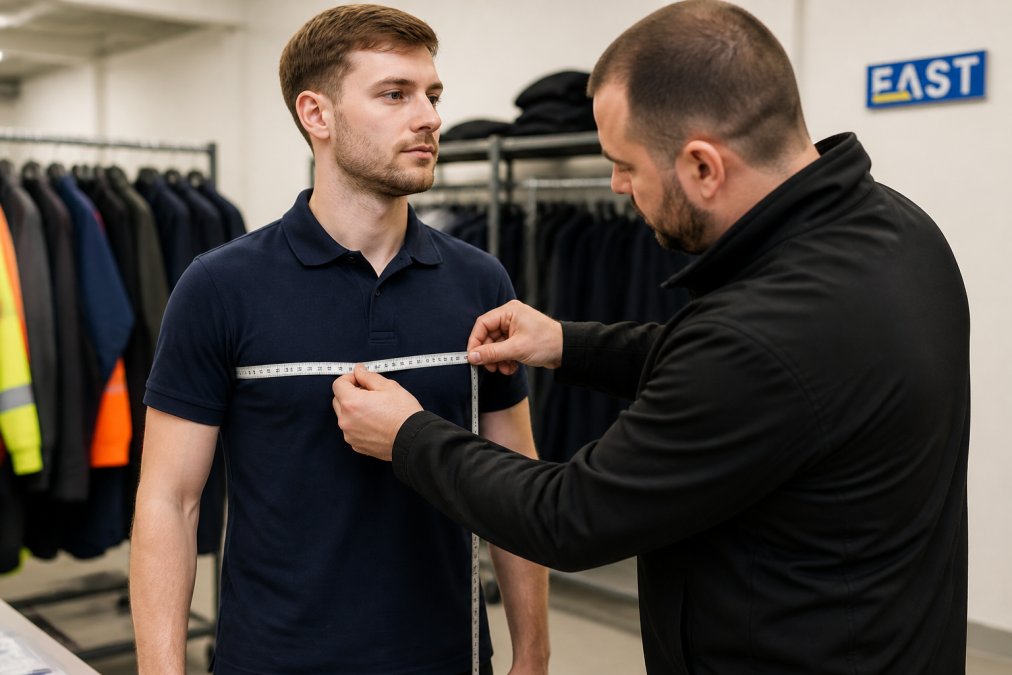
Include a field for any special requirements: tall sizes, loose fit preferences, or accessibility needs. This becomes invaluable when reordering for new staff.
Using Flexible Tape Measures for Accurate Measurements
Accuracy depends entirely on your measurement method. A flexible tape measure is essential; rigid rulers won't work and produce inconsistent results.
Chest: Wrap the tape around the fullest part of the chest, keeping it parallel to the ground. The employee should stand relaxed. Record to the nearest centimetre.
Waist: Measure at the natural waistline, usually an inch or two above the hip bone. Keep the tape parallel and don't pull tight.
Inseam: Have the employee stand with feet shoulder-width apart. Measure from the inside of the ankle bone up to the crotch seam. This is the most critical measurement for trousers.
Sleeve: With the arm bent at 90 degrees, measure from the centre back neck, across the shoulder, down the outside of the arm to the wrist bone.
Record measurements immediately. Don't rely on memory or estimates.
Step 2: How to Track Employee Uniform Inventory
Once you've collected sizes, you need a system to track what you've issued, what needs replacing, and what's outstanding. Your inventory system must answer three questions: Who has uniforms? What condition are they in? When do they need replacing?
Manual Tracking vs Digital Portals
Manual tracking using spreadsheets works for very small teams (under 20 people). Create a simple table with employee name, sizes issued, date issued, and condition notes.
The problem emerges as your team grows. Spreadsheets become outdated, employees forget what they were issued, and you end up reordering unnecessarily. You lose the ability to forecast demand.
Digital portals solve this. Many workwear suppliers now offer online systems where employees log in, confirm sizes, and request replacements. These systems automatically track inventory levels, flag items due for replacement, and generate ordering forecasts. Workwear East offers a Workforce Portal that integrates directly with your ordering process, giving you real-time visibility across your entire team.
A digital system also handles the human element: employees can update their own sizes, flag damaged items, and request urgent replacements. This removes administrative burden and reduces delays from manual coordination.
Step 3: Best Practices for Uniform Ordering
Ordering uniforms is where most cost control happens. A poor ordering strategy wastes money on wrong sizes, emergency reorders, and surplus stock. A good strategy minimizes waste and keeps your team properly equipped.
The core principle is this: order in bulk when you can, but only for sizes you actually need. This means forecasting demand based on your workforce and planning orders around predictable cycles.
Bulk Ordering and Size Ratios
When you order 100 uniforms, the unit cost drops significantly. But only if you order the right mix of sizes. Order too many small sizes and too few large, and you've wasted budget on unusable inventory.
Build a size ratio based on your actual workforce. If you have 50 employees and your measurements show 8 wear extra small, 15 wear small, 18 wear medium, 7 wear large, and 2 wear extra large, that's your ordering ratio. When you order 100 units, you'd order 16 XS, 30 S, 36 M, 14 L, and 4 XL.
Most businesses guess at size ratios instead of using data. A proper size template gives you facts instead of assumptions.
Planning for Staff Turnover
Staff turnover creates hidden costs in uniform management. When someone leaves, their uniforms are either returned (and may need cleaning or repair) or lost. When someone new joins, you need uniforms immediately.
Budget for turnover. If your industry has 20% annual turnover and you have 50 employees, that's 10 new uniforms per year just to cover replacements. Add that to your regular replacement cycle for a clearer annual ordering picture.
New hires also create a delay problem. If uniforms aren't ready on their first day, they can't do their job properly. Plan your ordering so you have a small buffer of common sizes ready for unexpected hires.
Step 4: Managing Uniform Replacement Cycles
Uniforms don't last forever. Depending on quality, role, and care, workwear typically lasts 12-24 months of regular use. Understanding your replacement cycle prevents coverage gaps and helps you budget accurately.
Assessing Garment Durability and Lifespan
Higher-quality embroidered or DTF-printed workwear lasts longer than cheaper alternatives. Stitching holds up better, colours don't fade as quickly, and fabric resists wear. Investing in durable uniforms actually reduces your total cost of ownership because you replace them less often.
Track when uniforms start showing wear. Are seams coming loose after 12 months? Is embroidery cracking after 18 months? Are colours fading after two years? Use this data to set your replacement schedule.
For most industrial and trade roles, an 18-month replacement cycle is standard. For high-wear roles, 12-15 months is more realistic. For office-based roles with lighter use, 24 months is achievable.
Document your replacement cycle in your inventory system. When you issue a uniform, note the expected replacement date. This gives you visibility into when you'll need to reorder.
Sustainable Disposal of Old Uniforms
Old uniforms represent a cost if you're paying for disposal, but also an opportunity if handled responsibly. Many textile recycling schemes now accept workwear, and some suppliers offer take-back programmes.
Consider these options: textile recycling keeps old uniforms out of landfill and often costs nothing. Donation to charities builds goodwill and supports your community. Some workwear suppliers, including Workwear East, can discuss disposal options when you place large replacement orders.
Tracking disposal also provides a secondary check on your inventory. If you issue 50 uniforms and get back 48 at replacement time, you know two were lost, useful data for your next forecasting cycle.
Step 5: Handling Size Variants and Non-Standard Body Types
One of the biggest mistakes in uniform management is assuming a standard size range covers everyone. Your workforce includes people of different heights, builds, and body shapes, and poorly fitting uniforms create real problems: reduced mobility, lower morale, and higher turnover.

Expand your size range beyond standard XS-XL. Offer tall and short variants for trousers. Offer different cut options for tops, as some people need a wider chest but narrower waist, and others the reverse.
When collecting measurements, look for outliers. If you have employees significantly taller or shorter than average, or with larger or smaller frames, flag these during measurement. Work with your uniform supplier to find solutions, whether that's tall/short sizing, extended ranges, or custom fitting.
Inclusive sizing also improves retention. Employees who feel their employer has thought about their comfort are more likely to stay, reducing turnover costs and keeping experienced staff.
Step 6: Simplifying the Ordering Process
Once your sizing system is in place, simplify the actual ordering process so it doesn't create bottlenecks or delays.
Setting Up a Collection Appointment System
For larger orders or regular replacements, a collection appointment system works better than shipping individual uniforms. This is especially useful with a local supplier like Workwear East, where you can collect orders in bulk and distribute them directly to your team.
Set a regular collection schedule, perhaps the first Friday of each month, or quarterly depending on your replacement cycle. Employees know when uniforms are available, you avoid shipping costs on small orders, and your supplier can batch-prepare your order in advance.
Document the process: when do employees request replacements? When does the deadline close? When and where do they collect? A simple one-page guide prevents confusion and ensures consistency.
For remote or distributed teams, collect requests over two weeks, place one bulk order, and have it shipped to a central point where employees can collect or have it forwarded to them.
Common Mistakes to Avoid When Managing Uniform Sizes
Most businesses make the same errors when implementing uniform sizing systems.
Measuring once and assuming sizes never change: People's sizes change. Remeasure at least annually, or whenever an employee requests a size change.
Ordering without data: Guessing at size ratios wastes budget. Use your actual workforce data to inform every order.
Ignoring fit feedback: If multiple employees complain that sleeves are too short or waists are too tight, that's data. Adjust for the next order.
Not planning for growth: If you're hiring, your uniform inventory needs to grow too. Factor in new staff when forecasting orders.
Losing track of issued uniforms: Without a system, you can't tell who has what. This leads to duplicate orders, lost uniforms, and cost overruns. Implement tracking from day one.
Choosing cheap uniforms to save money: Low-quality uniforms fall apart faster, need replacing more often, and damage your brand image. The total cost of ownership is higher. Invest in durable, well-made uniforms from the start.
Managing staff uniform sizes effectively transforms a chaotic, costly process into a predictable, controlled system. The steps outlined here, building a size template, tracking inventory, ordering strategically, managing replacement cycles, and handling size diversity, form the foundation of uniform management that works at scale.
If you're ready to implement this system, Workwear East specialises in durable, high-quality embroidered and DTF-printed workwear designed to withstand regular use in demanding roles. Our team can help you plan your initial order based on your workforce data and set up a system that grows with your business. For a personalised quote tailored to your team size and requirements, email info@workweareast for a quote or visit https://www.workweareast.co.uk/ to explore our Workwear Bundles and sizing options.
Frequently Asked Questions
How do I accurately collect uniform sizes from my team?
Use a standardised staff uniform size template that captures chest, waist, sleeve, and inseam measurements. Provide employees with a flexible tape measure and clear written instructions, or arrange a collection appointment where someone trained takes measurements. Record all data in one centralised system to avoid duplicates and errors. This approach ensures consistency across your entire workforce and reduces sizing issues when uniforms arrive.
What is the best way to track employee uniform inventory?
Implement a digital tracking system that records each employee's size, issue date, and condition of uniforms. Digital portals allow staff to request replacements and provide visibility into your stock levels. If digital systems aren't feasible, maintain a detailed manual log with employee names, sizes, and replacement dates. Regular audits help identify which uniforms need replacing and catch sizing issues early. This prevents wasteful over-ordering and ensures timely replacements.
How often should employers replace their uniform?
Uniform lifespan depends on fabric quality, frequency of wear, and washing intensity. Most durable workwear lasts 12-24 months with daily wear. Higher-quality embroidered or DTF-printed uniforms tend to outlast cheaper alternatives. Establish a replacement cycle audit at least annually to assess garment condition. Monitor for fading, seam damage, or print deterioration. When uniforms reach the end of their useful life, consider sustainable disposal options such as textile recycling programmes rather than landfill.
How can I minimise waste when ordering bulk staff uniforms?
Calculate size ratios based on your team's measurements before placing orders. If you have 50 staff, analyse how many fall into small, medium, large, and extra-large categories. Order proportionally to these ratios rather than equal quantities of each size. Account for staff turnover by ordering a small buffer of popular sizes. Use a staff uniform size template to forecast demand accurately. Contact Workwear East at info@workweareast for a quote tailored to your team's specific requirements and to discuss bulk ordering strategies that reduce waste.
This article was written using GrandRanker