 how-to
Printed Hoodies Thetford: Custom Workwear Guide 2026
Table of Contents
- Custom Printed Hoodies in Thetford: What Local Businesses Need to Know
- Hoodie Printing Methods Explained
- Hoodie Logo Placement: Front, Back and Sleeve Options
- Hoodie Artwork Requirements: Preparing Your Design Files
- How to Choose Durable Hoodie Printing That Lasts
- Ordering Printed Hoodies in Thetford: A Step-by-Step Process
- Step 1: Define the brief before you contact anyone
- Step 2: Prepare artwork to a print-ready standard
- Step 3: Shortlist providers using transparent criteria
- Step 4: Request a quote with your full brief
- Step 5: Approve a visual mock-up
- Step 6: Confirm sizing against the supplier's chart
- Step 7: Approve a sample where offered
- Step 8: Place the order and confirm the date in writing
- Step 9: Plan for reorders
- What Affects the Cost of Custom Hoodies
- Conclusion
- Frequently Asked Questions
Last Updated: October 12, 2026
Custom Printed Hoodies in Thetford: What Local Businesses Need to Know
Printed hoodies are garments decorated with a design, logo or text using embroidery, DTF printing or screen printing.
This guide from Workwear East covers what matters when you order: which decoration method suits your logo, where to place it, how to prepare artwork, and how to judge whether a print will survive a working week.
Buyers are now more careful about garment quality and print longevity, because cheap decoration that cracks after a few washes costs more in replacements than it saved upfront.
Hoodie Printing Methods Explained
Three methods cover almost every job: embroidery, DTF printing and screen printing.
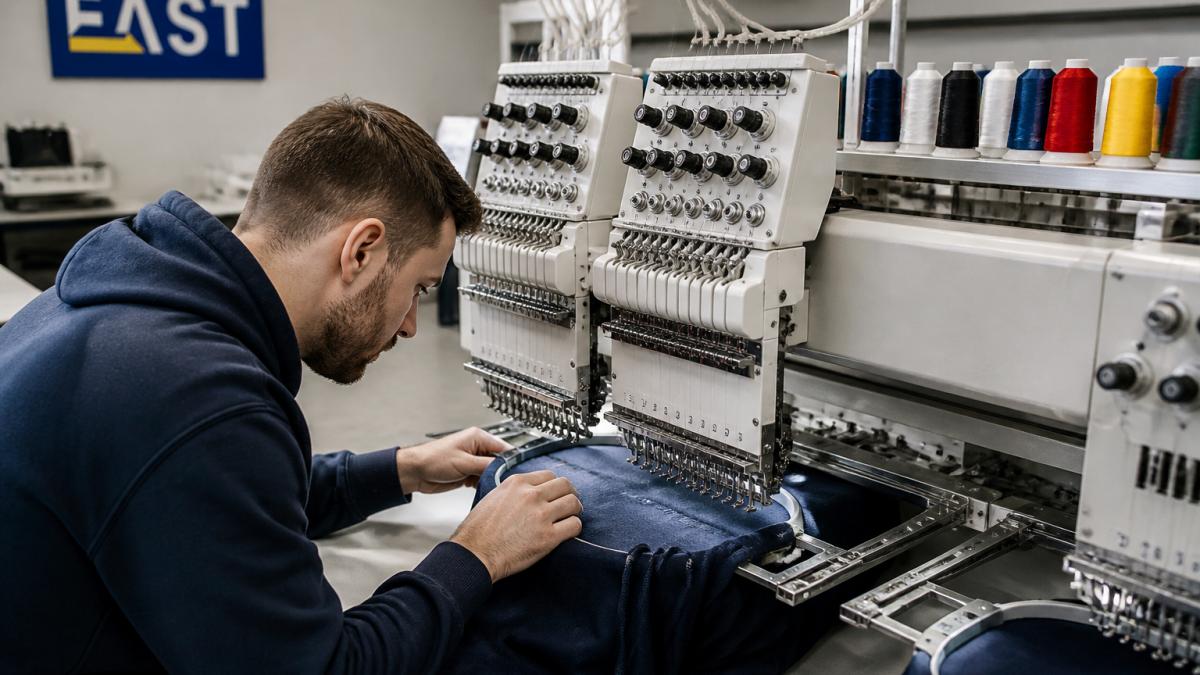
Embroidery stitches thread directly into the fabric.
DTF printing, or direct-to-film, prints a full-colour design onto film and heat-presses it onto the garment.
Screen printing pushes ink through a mesh stencil, one screen per colour.
Embroidery vs DTF Printing vs Screen Printing
| Method | Best For | Detail Level | Durability | Order Size Suits |
|---|---|---|---|---|
| Embroidery | Logos, text, workwear | Bold shapes | Highest | Any size |
| DTF printing | Full-colour, photos | Very high | High | Small to medium |
| Screen printing | Simple, bold designs | Medium | High | Large runs |
Hoodie Logo Placement: Front, Back and Sleeve Options
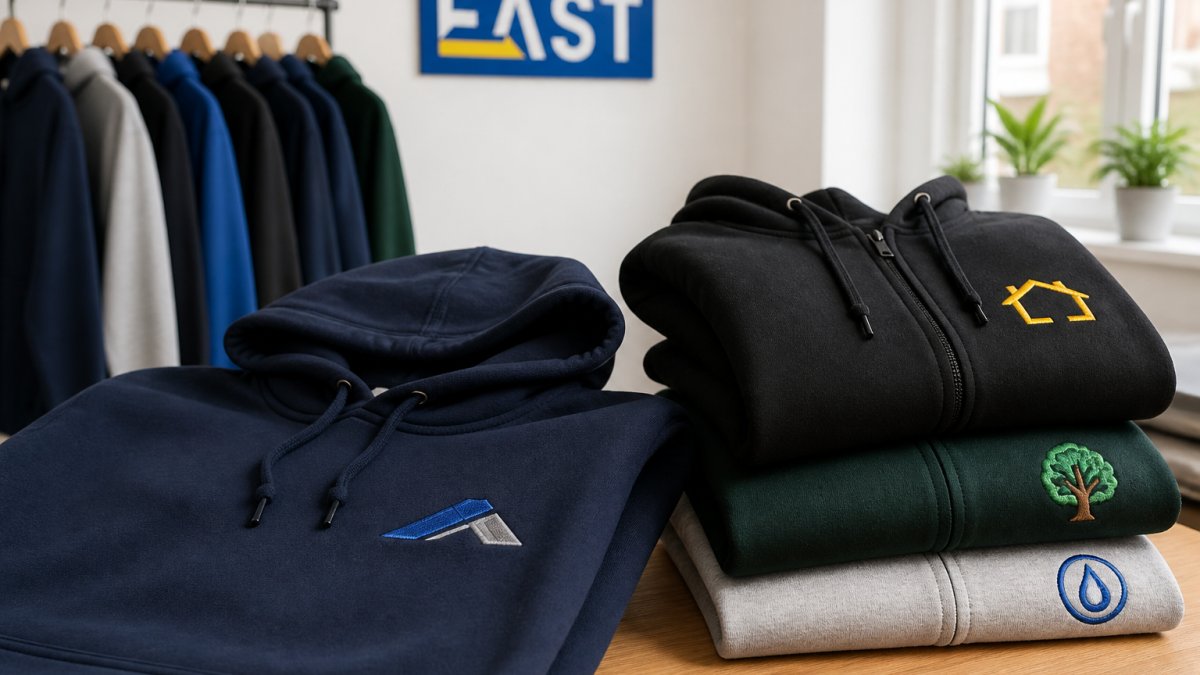
Where your logo sits changes how the garment reads. A left-chest logo says workwear; a large back print says event or retail; a sleeve mark says team kit. Most businesses combine two of the three.
Left chest is the default for corporate and trade uniforms because it is visible, tidy and does not interfere with movement or hi-vis requirements.
A few practical points we would flag before you commit:
- Check that a chest logo clears any pocket or zip line
- On zip-ups, avoid printing across the centre front
- Keep back prints above the shoulder blades so they stay visible under a coat
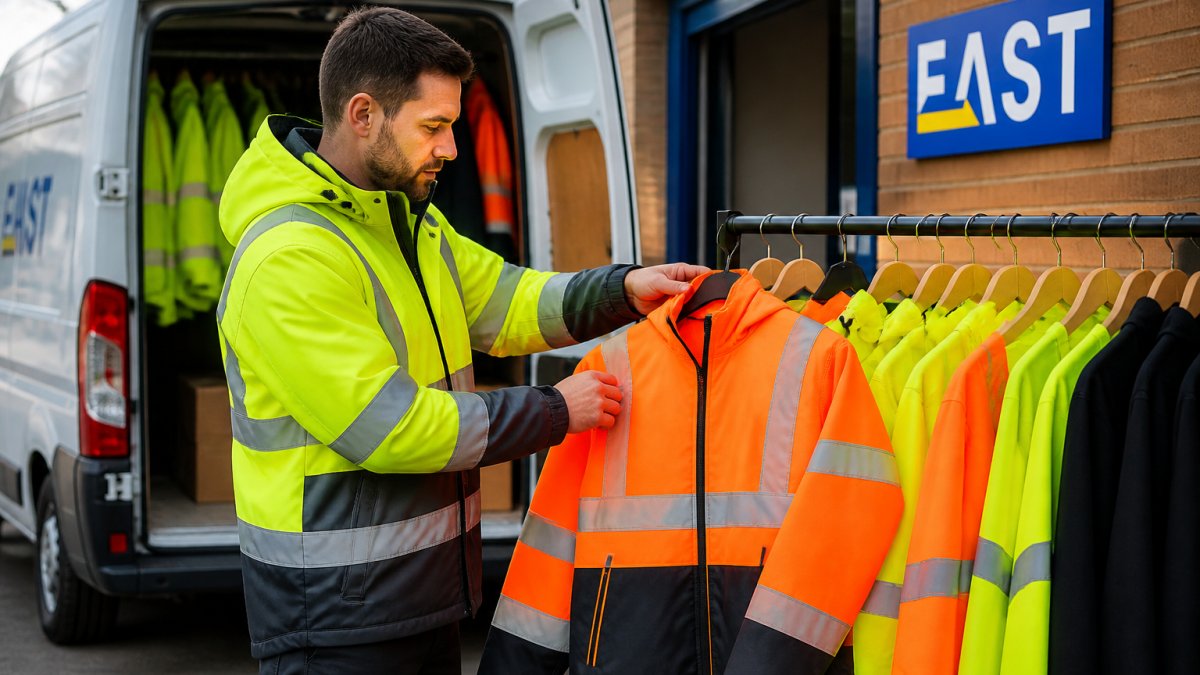
- If the hoodie doubles as hi-vis layering, keep decoration away from reflective tape
Hoodie Artwork Requirements: Preparing Your Design Files
Good artwork is the difference between a clean print and a reprint. Send vector files where you have them, and high-resolution raster files where you do not.
Vector files (AI, EPS, PDF, SVG) scale to any size without losing sharpness, making them the preferred format for logos. Raster files (PNG, JPG, TIFF) are made of pixels and blur if enlarged too far.
What we need from you:
- The logo or design in the highest quality version you hold
- Exact colour references, ideally Pantone or CMYK values
- The finished print size in millimetres, width and height
- Any text converted to outlines so fonts do not substitute
How to Choose Durable Hoodie Printing That Lasts
Durability comes down to three things: the decoration method, the garment fabric, and how the finished item is washed.
Embroidery is the most hard-wearing option because thread is stitched into the garment rather than sitting on top of it.
Fabric matters just as much. A heavier cotton or cotton-polyester blend holds decoration better than a thin, loosely woven garment that distorts in the wash.
Care advice worth passing to your team:
- Wash inside out at 30°C or lower
- Do not tumble dry decorated garments
- Do not iron directly over a print or embroidery
- Turn garments inside out before washing to reduce friction
Ordering Printed Hoodies in Thetford: A Step-by-Step Process
Most guides stop at "send us your logo". The steps below are the ones that actually prevent reprints, wrong sizes and missed deadlines, work through them in order and you remove almost all risk before production starts.
Step 1: Define the brief before you contact anyone
Write down five things: garment style (pullover or zip-through), quantity per size, decoration method, number of print positions, and the date you need the garments. Suppliers quote faster and more accurately when these are settled. If unsure about the method, ask for a recommendation based on your artwork.
Step 2: Prepare artwork to a print-ready standard
Gather vector files (AI, EPS, PDF, SVG) where you have them, or the highest-resolution raster files you hold. Confirm colour references and the finished print size in millimetres. If your logo only exists as a screenshot or low-resolution JPG, flag this early, it is the most common cause of delay.
Step 3: Shortlist providers using transparent criteria
Rather than picking the first listing you find, compare providers on the same five points:
- Location and coverage, whether they serve your area and can deliver to your site or office
- Decoration options, embroidery, DTF and screen printing in-house, or subcontracted
- Minimum order quantities, whether they will take a small team order or only large runs
- Turnaround, standard production time and whether rush options exist
- Delivery, included or charged separately, and whether split deliveries are possible
Ask each provider the same questions so the answers are comparable. A provider that is vague on turnaround or minimums is usually vague on everything else.
Step 4: Request a quote with your full brief
Send the brief from Step 1 and the artwork from Step 2. Ask explicitly what is included: setup or digitising charges, delivery, and any minimum order. A quote that omits these is not like-for-like.
Step 5: Approve a visual mock-up
Ask for a mock-up showing the logo at the correct size and position on the actual garment. Check that a chest logo clears any pocket or zip line, back prints sit above the shoulder blades, and sleeve marks are not lost in a seam. This is the cheapest point to catch a placement error.
Step 6: Confirm sizing against the supplier's chart
Collect sizes from your team and check them against the specific supplier's size chart rather than assuming a standard fit. Hoodie sizing varies noticeably between brands. For mixed teams, consider ordering one or two try-on samples before committing to the full run.
Step 7: Approve a sample where offered
For larger runs, a single decorated sample removes almost all risk, confirming print colour, placement, size and garment feel before the full order is produced. If a sample is not offered, ask whether one can be arranged.
Step 8: Place the order and confirm the date in writing
Confirm the turnaround in writing before production starts, including the delivery date and who handles any split deliveries. Keep a copy of the approved mock-up alongside the order confirmation.
Step 9: Plan for reorders
Once the first order is complete, keep the artwork, size breakdown and garment specification on file. Reordering is then a matter of sending a size list rather than starting from scratch. For teams spread across departments, a workwear portal keeps sizes, names and reorders in one place, removing the annual scramble of chasing forty people for their size.
For a quote on printed hoodies for your team, email info@workweareast or visit our site to see the full clothing range and get started.
What Affects the Cost of Custom Hoodies
There is no single figure that fits every job, because the final cost is built from several interacting variables. Understanding how each works lets you make informed trade-offs rather than guessing at a budget.
Quantity and setup costs
The biggest driver is quantity. Screen printing requires a separate screen per colour, and embroidery requires a one-off digitising charge to convert artwork into a stitch file. These fixed setup costs spread across the run: the more garments you order, the lower the per-item cost. That is why a small multi-colour screen print order is rarely economical, while a large run of the same design is.
Garment choice
Garment quality affects cost and how long the decoration lasts. A heavier cotton or cotton-polyester blend holds decoration better than a thin, loosely woven garment that distorts in the wash. Reducing garment quality to hit a budget usually costs more over time in replacements.
Decoration method
Each method has a different cost curve:
- Embroidery carries a one-off digitising charge but no per-colour cost, so it suits logos and text at any order size.
- DTF printing has minimal setup and handles full-colour designs, making it practical for small to medium runs.
- Screen printing has the highest setup but the lowest per-item cost at volume, so it suits large runs of simple, bold designs.
Number of print positions
A second print position, such as a back print alongside a chest logo, adds cost but usually less than a separate order would. Each additional position adds setup and production time, so decide early whether one position is enough.
Turnaround
Standard production timelines are more economical than rushed jobs. Building your order around a known event date keeps costs sensible and gives you time to approve a mock-up and a sample.
Delivery and minimums
Delivery may be included or charged separately depending on the provider and your location. Minimum order quantities also vary: some providers take small team orders, others only larger runs. Confirm both before comparing quotes.
For an accurate figure based on your garment, quantity and decoration, email info@workweareast and we will put together a quote. You can also visit our site to see the full clothing range.
Conclusion
The hardest part of ordering branded hoodies is not the printing, it is choosing a method and garment that still look right after a year of site work and washing. Get that right and everything else follows.
Workwear East provides embroidered and printed workwear from our Norfolk base, covering embroidery for logos and text, DTF printing for full-colour designs, and screen printing for larger runs, from a handful of team hoodies to full corporate uniform programmes.
For a quote on printed hoodies for your team, email info@workweareast or visit our site to see the full clothing range and get started.
Frequently Asked Questions
What is the best printing method for hoodies?
The right method depends on your design and fabric. Embroidery suits simple logos and gives a professional, hard-wearing finish that handles frequent washing well. DTF printing reproduces detailed, full-colour graphics on cotton and poly-cotton blends. Screen printing keeps unit costs low on larger runs of one or two colours. For workwear that gets worn daily, embroidery and DTF are usually the most practical choices.
How do I prepare artwork for printing on a hoodie?
Supply vector files such as AI, EPS or PDF where possible, because they scale without losing sharpness. If you only have a JPEG or PNG, send the highest resolution version available, ideally 300dpi at the final print size. Include exact Pantone or hex colour references and confirm the logo's clear space. A print specialist can check your file and flag anything that will not reproduce cleanly before production starts.
How can I make a hoodie print last longer?
Wash hoodies inside out at 30°C or lower and avoid fabric softener, which breaks down adhesives and inks. Skip the tumble dryer where you can, and iron on the reverse, never directly over the print. Embroidery generally outlasts printed graphics because the stitching is part of the garment. Choosing the right method for the fabric at the outset matters more than any aftercare step.
Can you print a logo on the front and back of a hoodie?
Yes. A common workwear layout is a small left-chest logo paired with a larger back print for company name or department. Sleeve prints and nape labels are also available. Multiple placements add to the unit cost, so decide early which positions matter most. Send your artwork and preferred placements to info@workweareast for a quote before ordering.