 comparison
DTF vs Screen Printing: Choose the Right Method
Table of Contents
- DTF vs Screen Printing: A Direct Comparison
- DTF vs Screen Printing for Small Orders
- DTF Printing Durability: What to Expect
- Screen Printing Durability and Long-Term Wear
- Design Capabilities: Colour Range and Detail
- Choosing the Best Printing Method for Custom Workwear
- Fabric Compatibility and Garment Suitability
- Production Time and Turnaround
- Frequently Asked Questions
Last Updated: October 4, 2026
DTF vs Screen Printing: A Direct Comparison
Choosing between DTF and screen printing for custom workwear depends on order size, design complexity, fabric type, and durability needs. Both deliver professional results, but the right choice depends on your specific requirements.
DTF (direct-to-film) printing applies a design via heat transfer film, while screen printing pushes ink through a mesh screen onto the garment. Understanding these differences ensures you choose the method that fits your business needs.
How Each Method Works
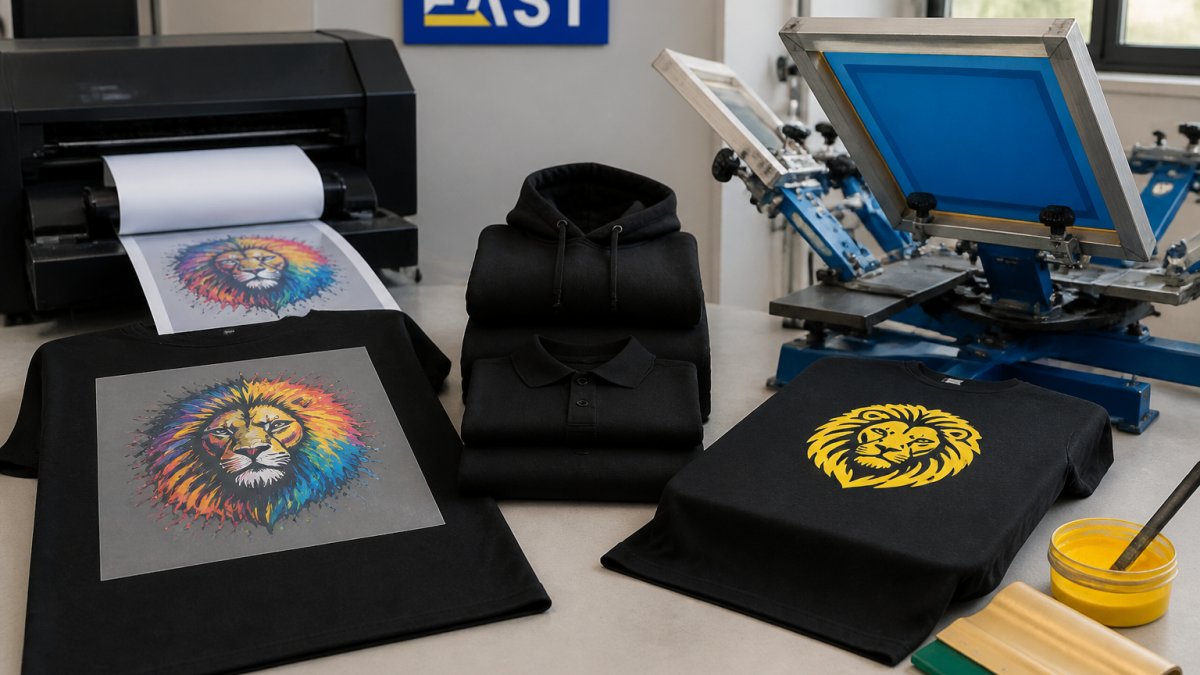
DTF printing prints artwork onto a special film, then applies it to the garment using a heat press. Minimal setup means no need for separate screens per colour, making DTF ideal for small quantities, design variety, and quick changes.
Screen printing requires preparing a mesh screen for each colour. Setup takes longer, but once screens exist, printing each additional garment is fast and cheap, making screen printing ideal for high-volume runs.
Comparison Table
| Factor | DTF Printing | Screen Printing |
|---|---|---|
| Setup Time | Minimal (digital only) | Several hours (screen preparation) |
| Best for Order Size | Small runs (1-50 units) | Large runs (100+ units) |
| Design Complexity | Full-colour, photorealistic, gradients | Solid colours, simple designs |
| Colour Range | Unlimited colours per garment | Limited by number of screens |
| Fabric Compatibility | Cotton, polyester, blends | Cotton, polyester, blends |
| Cost per Unit (small order) | Lower | Higher |
| Cost per Unit (large order) | Higher | Much lower |
| Turnaround Time | 3-5 days typical | 5-7 days typical |
DTF vs Screen Printing for Small Orders
For small orders, cost depends on comparing setup costs, per-unit printing costs, and total order value. Understanding the break-even point helps you choose correctly.
Cost Model: Setup vs Per-Unit Printing
Screen printing requires upfront screen preparation. Once screens exist, printing each additional garment has a per-unit cost.
DTF has minimal setup with no screen cost, but per-unit costs are higher.
Break-Even Analysis
For a simple, single-colour design, screen printing becomes cost-competitive at certain order volumes. For multi-colour designs, the break-even point shifts to higher unit counts. For complex, full-colour designs, DTF is often the only option.
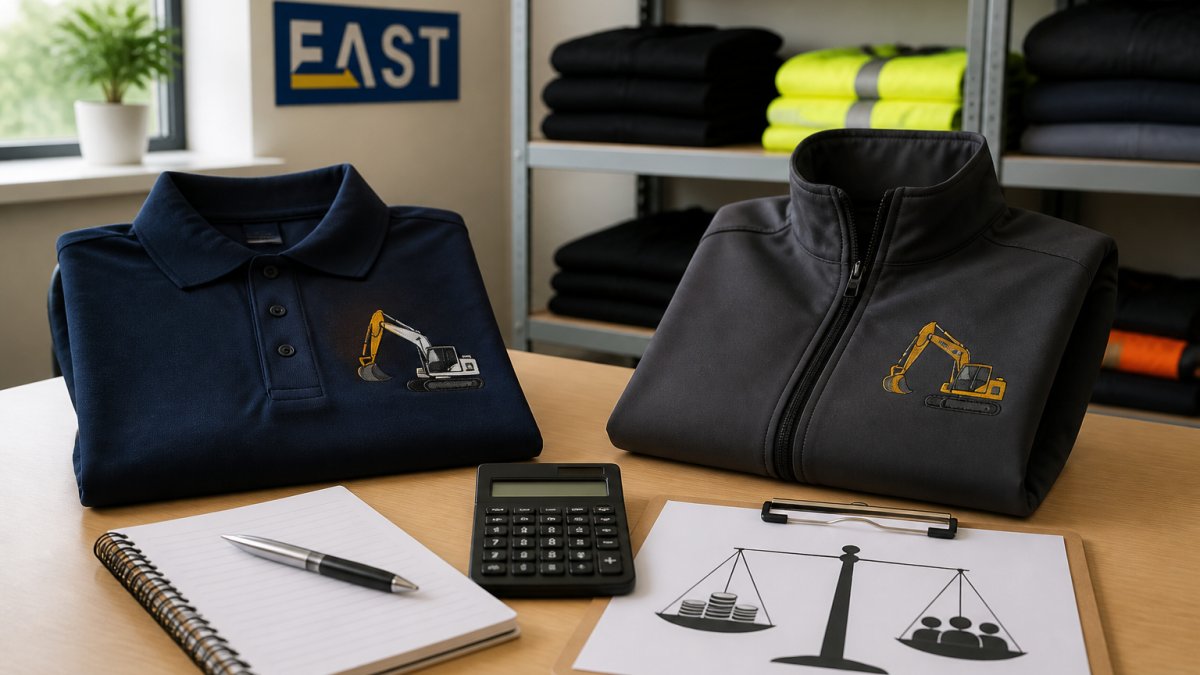
DTF offers flexibility screen printing cannot match. If you need 10 shirts with Design A and 10 with Design B, DTF prints both without additional setup; screen printing would require two screen sets. This flexibility suits event merchandise, promotional items, seasonal uniforms, and small businesses testing designs. If you're building a branded polo shirt collection with multiple design variations, DTF's adaptability can be a significant advantage.
For 30+ units of the same simple design, screen printing's per-unit savings often justify setup cost. For complex designs or design variety, DTF is usually better. Email info@workweareast.co.uk for a quote tailored to your specific order and design.
DTF Printing Durability: What to Expect
DTF durability depends on application quality, fabric type, wash method, and intended use. The print sits on the fabric surface rather than bonding into fibres, so understanding these variables helps set realistic expectations.
Wash Performance and Fade Patterns
A correctly applied DTF print typically survives a good number of standard home washes. Cold water extends life; hot washes accelerate degradation. DTF performs well on synthetic blends. High-stress areas may fade faster. Gentle detergents can extend print life.
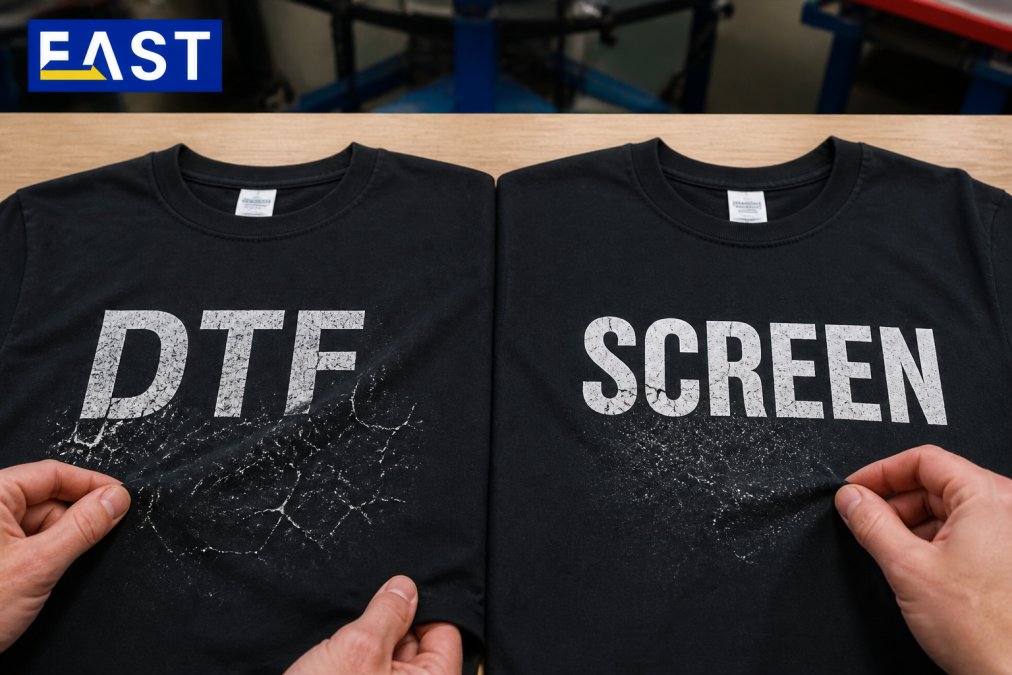
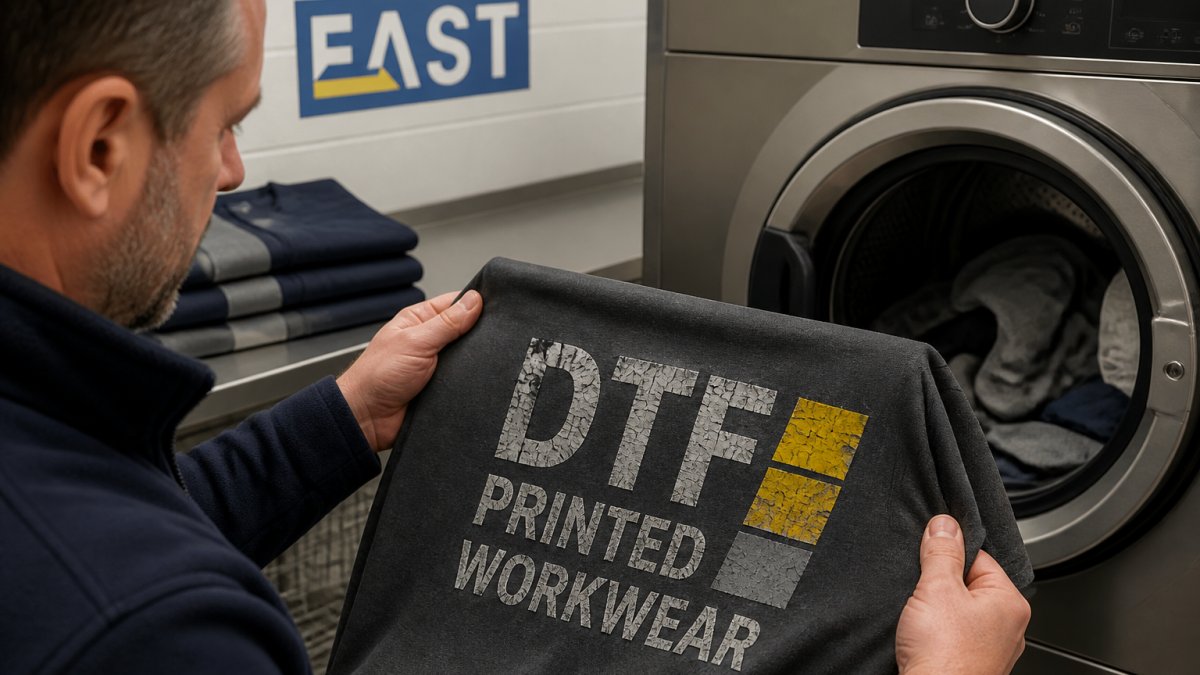
DTF prints may show wear patterns such as edge cracking, peeling at seams, colour shift, and brittleness in cold conditions.
Extending DTF Print Life
Proper care significantly extends durability:
- Wash inside-out in cold water (below 30°C) with mild detergent.
- Avoid the tumble dryer; air dry instead. Heat accelerates ink degradation and can cause the print to become brittle.
- Don't bleach or use fabric softener, which can break down the ink binder.
- Avoid ironing directly over the print; if ironing is necessary, use a pressing cloth and low heat.
Followed consistently, these practices can extend print life, approaching screen printing durability for lighter-use garments.
When DTF Durability Falls Short
For heavy workwear, construction uniforms, warehouse overalls, industrial laundry cycles, DTF is adequate for seasonal use but not ideal for year-round, high-frequency wear. If your team washes garments frequently in warm water and uses a commercial dryer, DTF prints may show visible wear within a shorter timeframe. Screen printing is often the stronger choice for that scenario.
Screen Printing Durability and Long-Term Wear
Screen-printed garments are built to last. The ink is pushed directly into the fabric fibres, creating a bond that withstands repeated washing, stretching, and wear. A well-executed screen print can survive 100+ washes before visible fading becomes a problem.
This durability is why workwear manufacturers favour screen printing for uniforms and safety apparel. Construction workers, warehouse staff, and field teams need clothing that survives months of heavy use. Screen printing delivers that longevity.
The trade-off is that screen printing works best with solid-colour designs or simple multi-colour artwork. Complex gradients, photorealistic images, and fine detail don't reproduce well with screen printing. You're limited by the number of screens you're willing to create and the precision of the printing process itself.
Ninja Transfers' analysis of durability differences notes that screen-printed apparel maintains print integrity through industrial washing cycles, making it the standard for professional workwear in demanding environments.
Design Capabilities: Colour Range and Detail
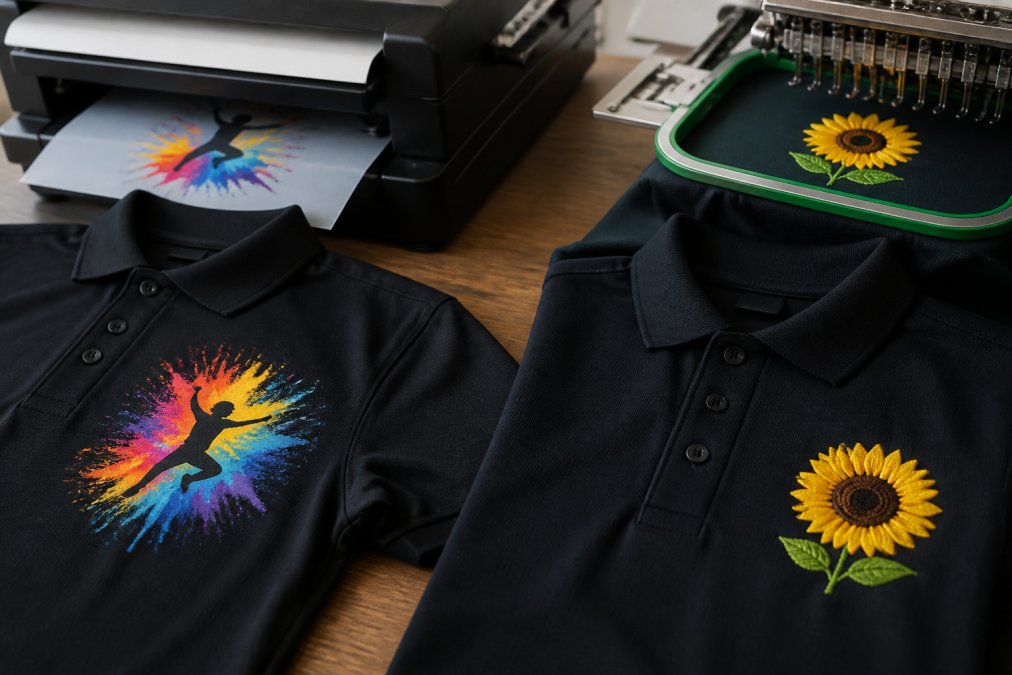
DTF printing handles complex artwork that screen printing simply cannot. Full-colour photographs, gradients, fine detail, and multi-colour designs with subtle transitions all work beautifully with DTF. If your design includes a photorealistic company logo or a detailed image, DTF is your only realistic option.
Screen printing works best with bold, solid-colour designs. You can create multi-colour designs, but each colour requires a separate screen. A design with five colours means five screens, which adds cost and complexity. Fine detail gets lost because the ink is pushed through a mesh, the resolution isn't as sharp as DTF.
For branded workwear with a simple company logo, screen printing is perfectly adequate and often preferable for durability. For complex artwork or full-colour designs, DTF is the only choice. Consider what your design actually needs before defaulting to either method.
Choosing the Best Printing Method for Custom Workwear
The decision comes down to three questions: How many garments do you need? How complex is your design? How long does the print need to last?
Choose DTF if: you're ordering fewer than 100 units, your design includes multiple colours or photorealistic elements, you need quick turnaround, or you want flexibility to change designs frequently. DTF is ideal for event merchandise, small team uniforms, or promotional items where variety matters.
Choose screen printing if: you're ordering 100+ units, your design is simple and bold, durability is critical, or you're printing the same design repeatedly. Screen printing is the standard for industrial workwear, safety uniforms, and high-volume corporate apparel.
Heart & Hook's guide to fabric compatibility in printing recommends considering not just the printing method but also the garment fabric. Cotton and cotton blends work well with both methods, while synthetic fabrics sometimes respond better to DTF's lower-temperature application.
At Workwear East, we help businesses navigate this choice by understanding their actual workload. A construction firm with 20 staff members wearing the same uniform daily needs screen printing's durability. A small event team needing custom branded shirts for a one-off occasion needs DTF's flexibility. Most businesses benefit from having both methods available depending on the project. If you're managing multiple teams or departments, our Workwear Bundles can help coordinate consistent branding across different garment types and printing methods.
Fabric Compatibility and Garment Suitability
Both DTF and screen printing work on cotton, polyester, and most blended fabrics. The difference lies in how they perform on specific materials.
DTF prints adhere well to synthetic fabrics like 100% polyester, which can sometimes be challenging for screen printing. If you're printing on performance wear or moisture-wicking fabrics, DTF often delivers better results. The heat transfer process bonds the ink effectively to synthetics.
Screen printing performs exceptionally well on natural fibres like cotton. The ink soaks into the fabric and creates a durable bond. High-quality 100% cotton workwear with screen printing is the gold standard for longevity.
Both methods work on blended fabrics, which are common in modern workwear. A 65% polyester, 35% cotton blend handles both methods equally well. Your choice should be driven by order size and design complexity rather than fabric type, unless you're using specialty performance fabrics.
Production Time and Turnaround
DTF typically delivers faster turnaround: 3-5 days from order to delivery is common. Because there's no screen preparation, the process moves quickly. You can order on Monday and have printed garments by Friday.
Screen printing takes longer, usually 5-7 days, because of the screen preparation phase. However, once the screens are made, additional garments print rapidly. If you need 500 units, screen printing might take the same time as DTF because the printing phase is so fast, even though setup took longer.
For urgent orders, DTF is your answer. For planned, high-volume runs, screen printing's slightly longer timeline is worth it for the cost savings and durability you get.
Choosing between DTF and screen printing doesn't have to be complicated. DTF wins on flexibility, design complexity, and small-batch economics. Screen printing wins on durability, cost per unit at scale, and long-term wear in demanding environments.
At Workwear East, we specialise in both methods and can advise you on which approach makes sense for your specific workwear needs. Whether you're outfitting a construction team, creating event merchandise, or building a professional uniform programme, we deliver consistent, high-quality results designed to withstand daily wear. Get in touch with our team at info@workweareast.co.uk for a quote tailored to your project, or visit Workwear East online to explore our full range of embroidered and printed workwear solutions.
Frequently Asked Questions
How long does DTF printing last compared with screen printing?
DTF printing typically lasts 50-100+ washes when properly applied and cared for, with durability depending on ink quality and fabric preparation. Screen printing often outlasts DTF on natural fibres like cotton, sometimes lasting 100+ washes or more, because the ink bonds directly to the fabric. Both methods fade gradually over time with repeated washing and sunlight exposure. The difference narrows on synthetic blends and performance fabrics. For workwear subjected to heavy use and frequent washing, screen printing often provides longer-term value; DTF suits designs requiring full-colour detail that must remain vibrant for 12-24 months of regular wear.
Is DTF or screen printing better for small orders?
DTF is significantly better for small orders. Screen printing requires setup costs (screens, colour separation, registration) that are only economical when spread across dozens or hundreds of units. DTF has minimal setup, so a 5-unit order costs nearly the same per garment as a 50-unit order. Screen printing becomes cost-effective at higher unit counts, depending on design complexity. For small batches, multi-colour designs, or one-off promotional items, DTF delivers faster turnaround and lower per-item cost without the overhead of screen preparation.
Which printing method is better for detailed, multi-colour designs?
DTF printing excels at detailed, multi-colour designs. It can reproduce photorealistic images, gradients, fine lines, and unlimited colours in a single pass without colour separation. Screen printing requires a separate screen for each colour, making multi-colour work labour-intensive and costly. Screen printing is best suited to bold, simple designs with 1-4 solid colours. If your workwear or promotional apparel features a complex logo with gradients, photographic elements, or many colours, DTF is the clearer choice.
Can both DTF and screen printing work on different fabric types?
Both methods work on different fabrics, but with different strengths. DTF prints on cotton, polyester, cotton blends, and synthetics with consistent results; the ink sits on the fabric surface. Screen printing bonds directly to natural fibres like cotton and works well on heavier garments, but struggles on slick synthetics because the ink doesn't adhere as well. For workwear that mixes fabric types, cotton shirts, polyester hi-vis, or blended performance wear, DTF offers more reliable versatility across your entire range.