 comparison
DTF vs Screen Printing Durability: Which Lasts Longer?
Table of Contents
- How Ink Bonds to Fabric Differently
- Why Durability Matters for Workwear
- Durability Comparison Table: Key Metrics
- DTF Wash Test Results and Real-World Performance
- Screen Printing Durability: Why It's the Workwear Standard
- Best Printing Method for Workwear: Making Your Choice
- How to Care for DTF Printed Garments to Extend Life
- Cost Implications: Durability Versus Initial Price
- Pros and Cons: DTF Printing and Screen Printing for Durability
- Frequently Asked Questions
DTF vs Screen Printing Durability: Which Lasts Longer?
Last Updated: August 3, 2026
When businesses invest in branded workwear, durability becomes the deciding factor. The question of DTF printing vs screen printing durability determines whether your team's uniforms look professional after 50 washes or start cracking after five. This guide breaks down exactly how these two printing technologies perform under real-world stress, so you can make a decision backed by performance data rather than marketing claims.
How Ink Bonds to Fabric Differently
Screen printing forces plastisol ink directly into the fabric weave during curing. The ink penetrates multiple layers of fibres, creating a bond that becomes part of the garment structure itself. DTF printing works differently: a film carries adhesive powder and ink as a complete layer that fuses to the fabric surface through thermal bonding. The print sits on top of the garment rather than within it.
This distinction matters enormously for durability. Screen printing's ink penetration means the print can only fail if the fabric itself fails. DTF's adhesive layer can separate from the substrate if heat-press application is incorrect or if the garment experiences extreme stress at the print edges.
Why Durability Matters for Workwear
Professional uniforms must survive industrial laundering, chemical exposure, and constant physical wear. A construction worker's branded polo shirt endures heat, sweat, and concrete dust. A chef's jacket faces grease, high-temperature water jets, and bleach-based sanitisers. A logistics team member's vest gets stretched, thrown in and out of vehicles, and washed dozens of times monthly.
When a print fails on workwear, it damages brand perception immediately. Cracked logos communicate carelessness. Beyond perception, failed prints create liability. A faded hi-vis vest becomes a safety issue if reflective properties degrade. The cost of replacement compounds quickly: a small team of 15 staff requiring new uniforms every six months instead of annually doubles annual spend.
Durability Comparison Table: Key Metrics
Metric | DTF Printing | Screen Printing | Winner |
|---|---|---|---|
Wash Fastness (cycles) | 50-80 washes | 100+ washes | Screen |
Cracking Resistance | Moderate (edges vulnerable) | Excellent | Screen |
Fading Resistance | Good | Excellent | Screen |
Fabric Compatibility | Broad (cotton, polyester, blends) | Limited (best on 100% cotton) | DTF |
Print Flexibility | High | Lower | DTF |
Setup Time | Minutes | Hours (per colour) | DTF |
Suitable for Complex Designs | Yes (full colour, gradients) | No (spot colours only) | DTF |
DTF Wash Test Results and Real-World Performance
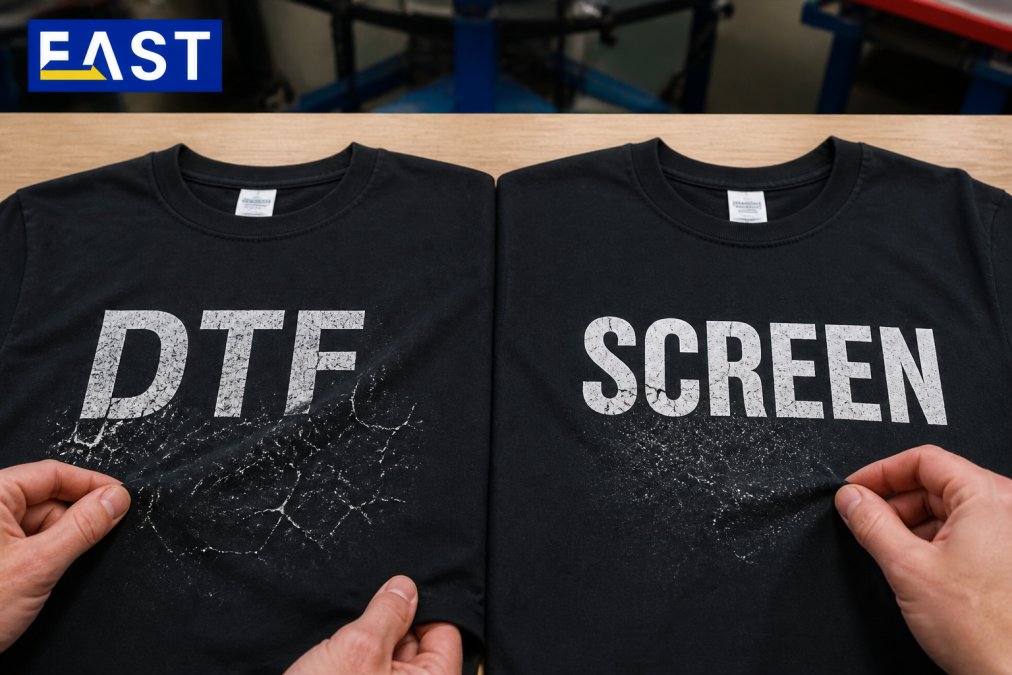
DTF printing delivers impressive results in the first 20 washes. Colours remain vibrant, edges stay clean, and the print feels soft. Performance degrades noticeably after 50 washes. The print begins to show stress at edges, particularly around corners and text details. By 80 washes, many DTF prints show visible cracking, especially on darker garments where damage is obvious.
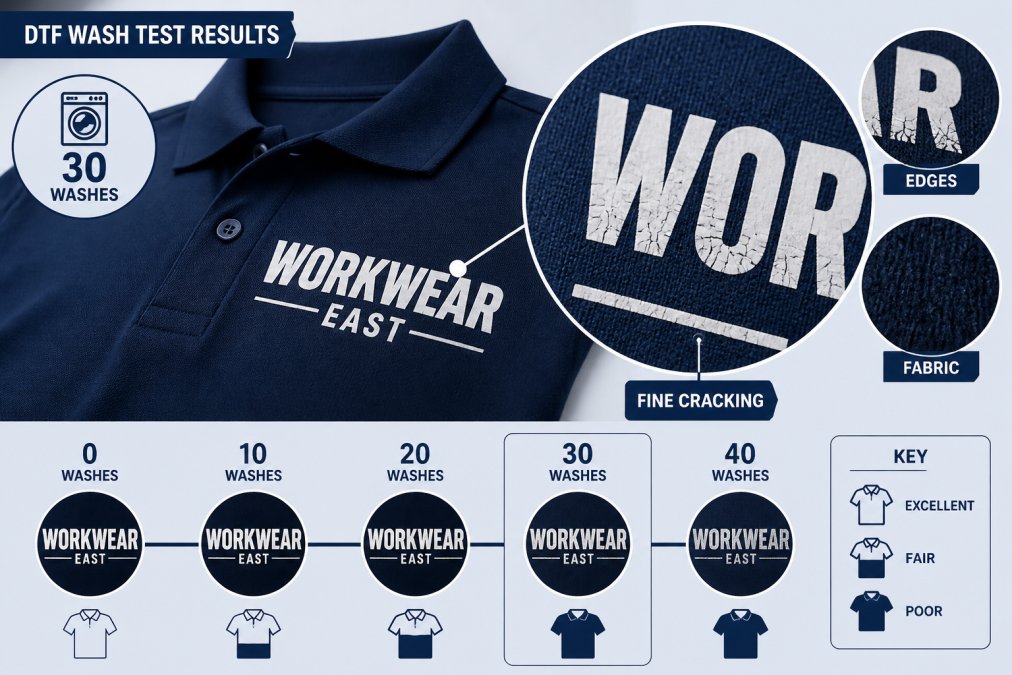
The failure pattern is predictable: edges first, then gradual spread toward the centre. Gradients and detailed designs fail faster than solid blocks of colour because fine details experience higher stress concentration.
Water temperature and commercial laundering accelerate failure. Domestic washing at 30-40°C is gentler than industrial facilities using 60°C or higher. Many workwear operations use commercial laundering, exposing uniforms to hotter water, more aggressive agitation, and chemical detergents designed for heavy-duty cleaning. DTF prints don't handle this environment as well as screen printing.
Cracking and Peeling: The Main Failure Points
Cracking appears first because the adhesive layer experiences tension during washing. The fabric contracts and expands with water absorption and drying. The print layer, being less flexible than the substrate, resists this movement. Repeated cycles create stress at the adhesive boundary, particularly at design edges.
Peeling follows cracking. Once microscopic separation begins at edges, mechanical action during washing accelerates the separation. Prevention requires precise heat-press application. Insufficient pressure leaves gaps in the adhesive bond. Excessive heat can damage the adhesive layer itself. Temperature must be exact; too low and the adhesive won't fully cure; too high and the film can over-cure, becoming brittle.
Fabric Type Impact on DTF Longevity
DTF printing works across a broader range of fabrics than screen printing, but durability varies significantly by substrate. Cotton blends perform better than 100% polyester because cotton fibres provide mechanical grip for the adhesive layer.
Polyester presents a challenge. The smooth surface offers less mechanical grip. The adhesive relies more heavily on chemical bonding, which is weaker than mechanical interlocking. Polyester uniforms printed with DTF often fail within 50 washes rather than 80. Stretch fabrics complicate durability further, as the elastane expands and contracts more than standard cotton, creating additional stress on the adhesive layer.
Screen Printing Durability: Why It's the Workwear Standard

Screen printing has dominated workwear for decades because it simply lasts longer. The ink penetrates fabric fibres rather than sitting on the surface. Industry testing shows screen-printed garments remain visually acceptable after 150 washes. No cracking, no peeling, no edge separation. The print becomes part of the garment's structure.
This durability comes from how plastisol ink cures. During the curing process (typically 175-205°C for 2-4 minutes), the ink melts slightly and flows into the fabric weave. As it cools, it hardens within the fibres. The only way the print fails is if the fabric itself tears or degrades.
Ink Penetration Versus Surface Adhesion
Screen printing's plastisol ink becomes chemically bonded to the fabric at a molecular level when cured properly. The ink molecules intermesh with the cellulose or synthetic polymer chains of the fabric itself. This bond doesn't weaken with washing because the ink isn't separate from the fabric.
DTF's adhesive powder creates a mechanical bond between the film layer and the fabric surface. It's a separate layer held in place by chemical adhesion and mechanical interlocking. This bond is strong initially but degrades as the adhesive ages and the fabric moves beneath it.
The practical consequence: screen printing's durability improves slightly with age as the ink fully cures. DTF's durability declines with age as the adhesive weakens through repeated stress cycles.
Performance in Harsh Commercial Laundering
Commercial laundries use processes that would destroy most DTF prints within 30-40 washes. Industrial washers operate at 60-70°C with high mechanical action, aggressive tumbling and wringing designed to remove heavy soils. Chemical detergents are formulated for heavy-duty cleaning.
Screen-printed garments handle this environment without degradation. The ink has already survived the most stressful part of its lifecycle, the initial curing at high temperature. Commercial laundering can't harm what's already been chemically bonded into the fabric structure.
Best Printing Method for Workwear: Making Your Choice
Neither method is universally superior; they optimise for different priorities.
Small Teams and Budget Constraints
Small teams (under 20 staff) with tight budgets often benefit from DTF printing. Setup costs are lower, no need to create separate screens for each colour. Turnaround time is faster. However, this calculation changes if your team uses commercial laundering. If uniforms go through industrial washing weekly, the durability advantage of screen printing justifies the higher initial cost. You'll replace DTF-printed uniforms within 12 months but screen-printed uniforms within 24-36 months. Screen printing becomes cheaper over time.
High-Volume Orders and Long-Term Durability
Large orders (100+ units) and organisations prioritising durability should choose screen printing. The setup cost per unit becomes negligible at volume. For organisations like construction firms, logistics companies, and industrial manufacturers, durability is non-negotiable. If your uniforms will be laundered more than 50 times annually, screen printing's durability advantage becomes a cost saving.
Complex Designs and Detailed Branding
DTF printing excels at design complexity. Full-colour photographs, gradients, fine details, and multi-colour designs that would require dozens of screens for screen printing are simple for DTF. If your branding includes photographic imagery or complex colour transitions, DTF is your only practical option. The durability trade-off is real but manageable. Plan for replacement cycles of 18-24 months rather than 36 months.
How to Care for DTF Printed Garments to Extend Life
If you've chosen DTF printing, proper care extends lifespan significantly.
Washing Temperatures and Cycle Selection
Wash DTF-printed garments at 30-40°C maximum. Hot water accelerates adhesive degradation. Use a gentle or synthetic cycle rather than heavy-duty. Turn garments inside out before washing to reduce direct friction on the print surface. Avoid fabric softeners and bleach. Dry at low temperature. Air drying is ideal; tumble drying on low heat is acceptable. Avoid high-temperature dryers, which can cause the adhesive to over-cure and become brittle.
Drying and Storage Best Practice
Air drying is gentler than machine drying and extends print life noticeably. Hang garments in a well-ventilated area away from direct sunlight. UV exposure fades all prints, but it's particularly visible on DTF because the ink sits on the surface. Store DTF-printed garments away from heat sources in a cool, dry area. Fold rather than hang for long-term storage to avoid stretching the garment under its own weight.
Cost Implications: Durability Versus Initial Price
The cost comparison between DTF and screen printing is more complex than comparing per-unit printing fees. True cost includes replacement frequency and lifespan.
Cost Per Unit Over the Garment Lifespan
DTF printing has lower upfront costs but higher total cost of ownership if you factor in replacement frequency. A team requiring new uniforms every 18 months spends more annually than a team replacing uniforms every 36 months, even if the initial per-unit printing cost is lower.
For a precise cost comparison for your specific situation, email info@workweareast.co.uk for a quote that accounts for your team size, replacement cycle expectations, and design requirements.
Screen printing requires setup time that DTF doesn't. Creating screens takes hours; each additional colour requires another screen. For single orders of 20 units with complex designs, this setup cost per unit is substantial. However, bulk orders invert this calculation. A 500-unit order spreads screen setup across each garment, reducing per-unit setup cost to pennies. At this volume, screen printing becomes cheaper than DTF while delivering superior durability.
Pros and Cons: DTF Printing and Screen Printing for Durability
DTF Printing Strengths and Weaknesses
Strengths:
- Minimal setup time, orders completed in days
- Handles complex designs, photographs, and gradients
- Works across broad fabric range including synthetics and blends
- Lower per-unit cost for small orders
- Soft hand feel, garment doesn't stiffen
- True full-colour capability
Weaknesses:
- Print fails after 50-80 washes in normal use
- Edges vulnerable to cracking and peeling
- Adhesive layer degrades with age and stress
- Higher total cost of ownership if replacement frequency is factored in
- Fading occurs faster than screen printing
Screen Printing Strengths and Weaknesses
Strengths:
- Exceptional durability, prints survive 100+ washes
- Ink penetrates fabric, becoming part of the garment structure
- Handles harsh commercial laundering without degradation
- Superior colour saturation and vibrancy
- No edge peeling or cracking
- Lowest total cost of ownership over 3+ years
- Proven method with decades of reliability data
Weaknesses:
- Setup time is substantial, each colour requires a separate screen
- Complex designs with many colours become expensive
- Limited to spot colours, true full-colour designs aren't possible
- Longer turnaround time
- Higher per-unit cost for small orders
- Stiffens fabric under the print
The choice between DTF printing and screen printing durability ultimately depends on your priorities. If durability and long-term cost matter most, and for workwear they should, screen printing wins decisively. If you need complex designs completed quickly for small teams, DTF is your solution.
For durable embroidered and printed workwear that stands up to daily use, Workwear East supplies high-quality branded uniforms for businesses across Thetford, Norfolk, Suffolk and East Anglia. Whether you need long-lasting screen printing or detailed DTF printing, our team can recommend the best solution for your budget and working environment. Visit https://www.workweareast.co.uk to explore our range or contact us for a no-obligation quotation.
Frequently Asked Questions
Does DTF printing last as long as screen printing on workwear?
Screen printing typically lasts longer for industrial workwear. DTF prints sit on the fabric surface with an adhesive powder layer, which can crack or peel after 50-100 wash cycles depending on care and fabric type. Screen ink penetrates fabric fibres directly, often lasting 200+ cycles. For construction uniforms or safety apparel that endures frequent commercial laundering, screen printing remains the more durable choice.
What causes DTF prints to crack and peel after washing?
DTF prints fail when the adhesive layer breaks down under mechanical stress from washing. Incorrect heat-press application, washing in water above 40°C, or using harsh chemicals accelerates this. Cotton-polyester blends handle DTF better than 100% cotton. Turning garments inside out and using gentle cycles extends DTF durability significantly. Workwear East can advise on the best fabric choices for your printing method.
Which printing method is best for small team uniforms with a tight budget?
DTF printing suits small orders (10-50 units) because it has no setup fees and handles detailed, full-colour designs. Screen printing requires separate screens per colour, making small runs costly. However, if your team will wear the uniforms for 12+ months with frequent washing, screen printing's durability may justify higher upfront costs. For a permanent solution, email info@workweareast.co.uk with your team size and wash frequency for a tailored quote.
How should I care for DTF printed garments to make them last longer?
Wash DTF prints at 30-40°C maximum in a gentle cycle, turn garments inside out, and avoid bleach or fabric softener. Air dry rather than tumble dry when possible. Store in cool, dry conditions away from direct sunlight. These steps can extend DTF durability from 50-100 washes to 100-150 washes. Screen-printed garments are more forgiving and tolerate hotter water and standard wash cycles without degradation.
Is screen printing still the gold standard for durable workwear in the UK?
Yes, for heavy-duty workwear exposed to frequent washing, harsh chemicals, or industrial laundering, screen printing remains the proven standard. Its ink penetration and resistance to commercial wash cycles make it ideal for construction, trade, and manufacturing uniforms. DTF is improving but suits lighter-duty corporate apparel or designs requiring photographic detail. Workwear East offers both methods; contact info@workweareast.co.uk to discuss which fits your durability needs.
This article was written using GrandRanker