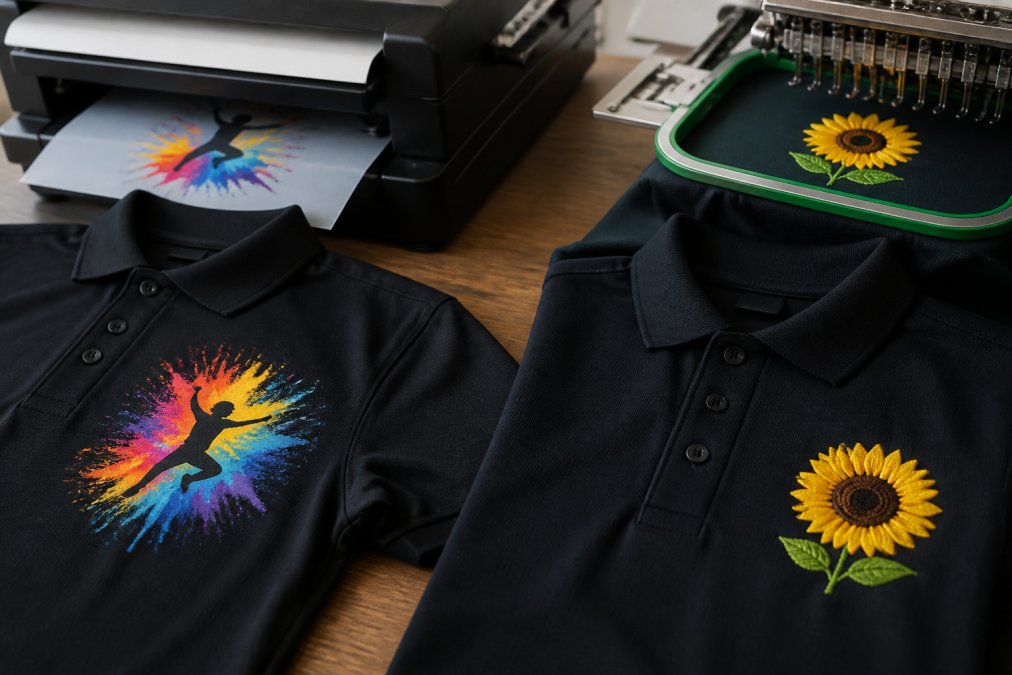
 comparison
DTF Printing vs Embroidery for Uniforms: 2026 Guide
Table of Contents
- DTF Printing vs Embroidery for Uniforms: Quick Comparison Table
- Durability of Uniform Printing: Which Method Lasts Longer?
- Fabric Compatibility Matrix: What Works With Each Method
- Cost of DTF Printing UK vs Embroidery: What Affects Your Budget
- Design Complexity, Detail, and Colour Vibrancy
- Weight, Comfort, and Wearability on the Job
- Environmental Impact and Repairability: The Overlooked Factors
- Best Printing Method for Workwear UK: Which Should You Choose?
Last Updated: July 30, 2026
Choosing between DTF printing vs embroidery for uniforms is one of the most consequential decisions when branding your team's workwear. Getting it wrong costs more than money, cracking logos, pilling threads, and garments that look tired after ten washes are common failures. Below, we break down exactly how each method performs across durability, fabric compatibility, cost, and comfort, so you can make the right call before committing to a full order.
Each method has a specific performance profile, and the wrong choice for your fabric or use case will fail regardless of print quality.
DTF Printing vs Embroidery for Uniforms: Quick Comparison Table
DTF printing is a decoration method where a design is printed onto a special film using pigment inks, coated with hot-melt adhesive powder, and then heat-transferred directly onto a garment. Embroidery is the process of stitching a design directly into the fabric using thread, guided by a digitised file that maps every stitch path.
| Feature | DTF Printing | Embroidery |
|---|---|---|
| Best for | Complex, full-colour logos | Simple, bold logos |
| Fabric suitability | Cotton, polyester, blends, synthetics | Medium-to-heavy wovens, fleece, caps |
| Colour vibrancy | Photographic-quality gradients | Limited palette, solid colours |
| Durability (wash cycles) | Good; may fade or peel over time with poor care | Excellent; thread does not fade |
| Setup cost | Low; no digitising fee | Higher; digitising required |
| Cost-per-unit at scale | Competitive for small-to-medium runs | Cost-effective at high volumes |
| Design resolution | High; fine detail and photography possible | Lower; small text and thin lines risk distortion |
| Weight added to garment | Minimal | Noticeable on lightweight fabrics |
| Repairability | Not repairable once damaged | Individual stitches can be re-sewn |
| Environmental impact | Ink and film waste; solvent-free options exist | Thread waste; no chemical processes |
Durability of Uniform Printing: Which Method Lasts Longer?
Embroidery wins on raw longevity, but DTF printing is far more durable than its reputation suggests when applied correctly and maintained properly.
How Embroidery Holds Up Through Industrial Laundry
Embroidery is essentially permanent. Thread stitched into fabric becomes structurally part of the garment, meaning it does not fade, peel, or crack regardless of wash cycles. A well-digitised design with appropriate underlay stitching will hold its shape and colour through hundreds of washes. According to the Textile Services Association on garment care in commercial laundry, high-temperature commercial washing above 60°C is the primary cause of premature garment degradation, and embroidered logos consistently outlast printed alternatives under these conditions.
How DTF Transfers Perform Over Repeated Wash Cycles
High-quality DTF transfers use flexible adhesive layers that bond at a molecular level with fabric fibres during heat pressing, creating a soft, stretch-resistant print that moves with the garment rather than cracking. Wash durability depends on curing temperature during application, wash temperature, and whether the garment is turned inside out. Washed at 30-40°C inside out, a well-applied DTF transfer will maintain colour vibrancy and adhesion for many dozens of wash cycles.
The limitation is real: the transfer sits on top of the fabric rather than within it. Edge lifting is the most common failure mode, particularly on garments wrung out or tumble-dried at high heat.
Fabric Compatibility Matrix: What Works With Each Method
Fabric choice is where many uniform orders go wrong. Applying the wrong decoration method to the wrong fabric produces poor adhesion, puckering, or an unprofessional finish from day one.
DTF Transfers UK: Fabric Types and Suitability
DTF printing is one of the most versatile decoration methods available in the UK market. The heat-transfer process works on a broad range of substrates because the adhesive powder bonds to the fibre surface rather than requiring ink to penetrate the weave.
| Fabric Type | DTF Suitability | Notes |
|---|---|---|
| 100% cotton | Excellent | Bonds cleanly; wash durability high |
| Polyester blends | Excellent | Ideal for sports and hi-vis workwear |
| 100% polyester | Good | Use lower press temperature to avoid scorching |
| Nylon | Good | Test press settings; some nylons are heat-sensitive |
| Fleece | Moderate | Texture can affect edge definition |
| Waterproof/coated fabrics | Poor | Coating prevents adhesion |
| Mesh fabrics | Poor | Gaps in weave prevent full bonding |
DTF printing struggles with waterproof or DWR-coated outerwear. The hydrophobic coating that repels rain also repels the adhesive layer, leading to premature peeling.
Embroidery and Fabric Weight Considerations
Embroidery requires fabric to support stitch tension without puckering or distorting. Fabric weight is critical, typically measured in grams per square metre (GSM).
- Heavyweight fabrics (280 GSM and above): Ideal for embroidery. Fleece jackets, workwear trousers, and heavy cotton sweatshirts carry dense stitch counts without distortion.
- Mid-weight fabrics (180-280 GSM): Good candidates with appropriate backing. Polo shirts and standard corporate shirts fall here.
- Lightweight fabrics (below 180 GSM): Problematic for embroidery. Fine-knit t-shirts will pucker under stitch tension. DTF printing is almost always the better choice.
Embroidery is also limited on curved or structured surfaces. Cap fronts and chest pockets are manageable; large back panels on thin garments are not.
Cost of DTF Printing UK vs Embroidery: What Affects Your Budget
Pricing for both methods depends on quantity, design complexity, garment type, and turnaround time. Workwear East does not publish a fixed price list because no two orders are identical. Contact Workwear East directly for a quote tailored to your requirements.
Setup Costs and Minimum Order Quantities
Embroidery carries a one-time digitising fee for each new design. Embroidery digitising converts your logo into a stitch file that tells the machine exactly where each thread goes, at what density, and in which direction.
DTF printing has no equivalent setup cost. Your artwork file is processed digitally and printed directly to film, making DTF particularly cost-effective for small runs, one-off orders, or designs that change frequently.
Cost-Per-Unit at Scale: Bulk Ordering Considerations
The cost-per-unit dynamic shifts at higher volumes. Embroidery has a relatively flat cost-per-unit curve once the digitising fee is absorbed, making it competitive for bulk orders. For large orders of 50 or more garments with a simple chest logo, embroidery often becomes the more cost-effective choice per unit. For orders involving large back prints, photographic designs, or multiple colour gradients, DTF printing retains its advantage regardless of volume.
Design Complexity, Detail, and Colour Vibrancy
DTF printing reproduces designs at high resolution, handling photographic images, fine gradients, and hundreds of colours without additional cost or complexity. A full-colour company logo with subtle shading, photographic elements, or complex illustrations is straightforward for DTF.
Embroidery works differently. Every colour requires a separate thread, and colour transitions are achieved through blended stitching rather than pixel-level mixing. Photographic gradients are not achievable. Fine text below approximately 5mm in height becomes illegible because stitch width cannot replicate the detail.
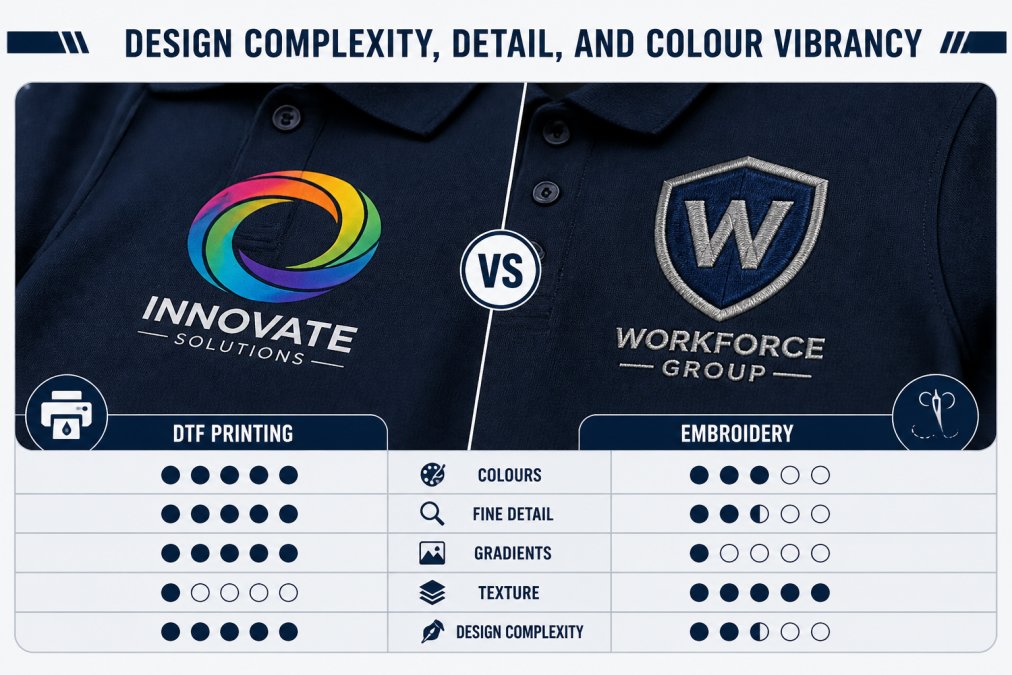
Where embroidery excels is in its three-dimensional quality. A well-executed embroidered logo has a raised, tactile finish that reads as premium. On corporate polo shirts, fleece jackets, and caps, that texture communicates quality in a way that a flat print cannot replicate.
If your logo contains gradients, photography, or fine detail, choose DTF. If your logo is bold, uses solid colours, and benefits from a premium textured finish, embroidery will serve you better.
Weight, Comfort, and Wearability on the Job
For staff wearing branded uniforms for eight or more hours a day, the physical comfort of the decoration matters.
Embroidery adds measurable weight and stiffness to the decorated area. On a lightweight summer polo shirt, a large chest logo in dense embroidery can create a stiff panel that feels uncomfortable against the skin. DTF transfers add a thin, flexible layer that moves with the fabric. High-quality transfers have a soft hand feel, unlike cheap iron-on transfers that feel plasticky and rigid.
For physical roles in construction, warehousing, or any job involving repetitive arm movement, a stiff embroidered panel on the chest or upper arm can cause minor but persistent irritation over a long shift. According to the Health and Safety Executive guidance on personal protective equipment and workwear comfort, discomfort in workwear is a recognised factor in compliance, as staff are less likely to wear PPE or branded garments consistently if they find them uncomfortable.
Environmental Impact and Repairability: The Overlooked Factors
DTF printing uses pigment inks and a PET film carrier. The film is discarded after transfer, generating plastic waste. However, modern DTF inks are water-based and free from solvents associated with older screen printing processes.
Embroidery generates thread waste and requires significant energy to run industrial machines, but involves no chemical processes and no single-use plastics. The longevity advantage also matters: a garment that lasts twice as long has half the environmental cost per wear.
Embroidery can be repaired. Individual stitches can be re-sewn, and a damaged section of a logo can sometimes be restored by a skilled operator. DTF transfers cannot be repaired. Once a transfer begins to peel or crack, the options are removal and re-application, or replacement of the garment.
Best Printing Method for Workwear UK: Which Should You Choose?
The best printing method depends on four variables: your logo's complexity, fabric type, laundering conditions, and order volume.
When DTF Printing Is the Right Call
Choose DTF printing when:
- Your logo contains gradients, photography, or more than four colours
- You are decorating lightweight garments below 200 GSM
- You need a small run of fewer than 15-20 garments
- You are printing on polyester blends or technical fabrics
- You need a fast turnaround without a digitising lead time
- You want a large back print or full-chest design at an accessible price point
When Embroidery Is the Stronger Choice
Choose embroidery when:
- Your logo is bold, uses solid colours, and benefits from a premium finish
- You are decorating heavyweight garments: fleece jackets, polo shirts above 220 GSM, caps, and structured outerwear
- Your uniforms go through commercial or industrial laundry at high temperatures
- You are ordering 30 or more garments and the digitising cost is easily amortised
- You want a decoration that will genuinely last the lifetime of the garment
- Corporate identity and professional aesthetic are priorities over design complexity
For many Norfolk businesses, the answer is both. A construction firm might use embroidery for heavyweight fleece jackets and safety sweatshirts, and DTF printing for lightweight summer polo shirts. Mixing methods based on garment type and use case is the most sophisticated approach.
Workwear East offers both advanced embroidery and DTF printing, which means you are not forced into a single method across your entire uniform range. The team can advise on the right approach for each garment in your order, ensuring that every item in your branded workwear programme performs as well as it looks.
Choosing between DTF printing and embroidery for uniforms becomes straightforward once you match the method to the garment, the logo, and the working conditions. Workwear East provides both advanced embroidery using high-specification machines capable of intricate multi-colour designs, and versatile DTF printing for detailed full-colour images across a broad range of fabrics. If you are ready to get the right decoration method for your team's workwear, get a quote from Workwear East and we will recommend the best approach for your specific requirements.
Frequently Asked Questions
What is the main difference between DTF printing and embroidery for uniforms?
DTF printing uses heat-transferred film to apply full-colour designs directly onto fabric, making it ideal for detailed graphics, gradients, and photographic images. Embroidery stitches thread directly into the garment using a digitised design file, producing a raised, textured finish. For branded workwear, embroidery tends to suit structured garments and simple logos, while DTF printing excels on softer fabrics and complex, multi-colour designs. The best choice depends on your fabric type, design complexity, and how frequently the garments will be washed.
Which is more durable for uniforms, DTF printing or embroidery?
Embroidery generally offers superior long-term durability for uniforms subject to industrial laundry and heavy daily wear. Because the stitching is physically woven into the fabric, it resists fading and peeling far better over many wash cycles. DTF printing, when applied correctly, produces a flexible, durable finish that holds up well under normal washing conditions. However, for workwear that goes through frequent high-temperature or industrial laundering, embroidery typically maintains its professional appearance for longer, making it a strong choice for trade and construction environments.
Is DTF printing cheaper than embroidery for uniforms in the UK?
The cost of DTF printing UK-wide varies based on design size, garment type, and order quantity. DTF printing generally has lower setup costs than embroidery, which requires an embroidery digitising fee for each new design. For small runs with complex, full-colour artwork, DTF transfers can be more cost-effective. Embroidery often becomes more competitive at higher volumes on simpler designs. Pricing for both methods depends on quantity, turnaround, and the specific garment, contact Workwear East directly for an accurate quote tailored to your requirements.
Can DTF printing be used on all fabric types for uniforms?
DTF transfers UK suppliers confirm the method works on a wide range of fabrics including cotton, polyester blends, denim, and canvas, on both light and dark garments. This makes it highly versatile for custom apparel across different uniform styles. However, very stretchy or heavily textured fabrics can affect adhesion and longevity. Embroidery is better suited to structured, woven fabrics with sufficient fabric weight to support the stitching without puckering. Always check fabric suitability with your supplier before committing to a bulk order.
When should I choose embroidery over DTF printing for my company's uniforms?
Choose embroidery when your corporate identity calls for a premium, professional aesthetic, particularly on structured garments such as polo shirts, fleeces, sweatshirts, and jackets. It is the best printing method for workwear UK businesses use in trade, construction, and corporate settings where garment longevity and a high-end finish matter most. Embroidery is also preferable for logo placements on caps and heavy-duty workwear that will endure industrial laundry. If your design is simple with limited colours and your priority is long-term durability, embroidery is typically the stronger investment.
This article was written using GrandRanker