 Comparison
Embroidered vs Printed Logo Durability for Uniforms
Table of Contents
- Embroidered vs Printed Logo Durability for Uniforms: The Core Differences
- DTF Printing vs Embroidery for Uniforms: How Each Method Works
- Printed Workwear Logo Lifespan: What to Expect
- Durability Comparison: Embroidery vs Printing (Pros and Cons)
- How to Wash Embroidered Uniforms (and Printed Ones) Correctly
- Best Logo Method for Work Uniforms: Industry Use-Cases
- Conclusion
- Frequently Asked Questions
Last Updated: October 20, 2026
Embroidered vs Printed Logo Durability for Uniforms: The Core Differences
Logo durability is the single most important factor when choosing between embroidered and printed branding for staff uniforms. This guide from Workwear East explains exactly how each method ages, so you can pick the right finish for your team.
The core difference comes down to how the logo attaches to the fabric. Embroidery stitches coloured thread directly into the garment, while printing bonds ink or a film to its surface. Stitched thread sits inside the weave; print sits on top of it. That distinction drives everything that follows, from wash performance to how a logo looks after a year of daily wear.
Below, we break down both methods, compare their lifespans, and show which suits construction, medical, and corporate uniforms.
DTF Printing vs Embroidery for Uniforms: How Each Method Works
Embroidery is a branding technique where a machine stitches coloured thread into the fabric to form the logo. High stitch density and tight thread tension produce a textured finish that holds its shape wash after wash.
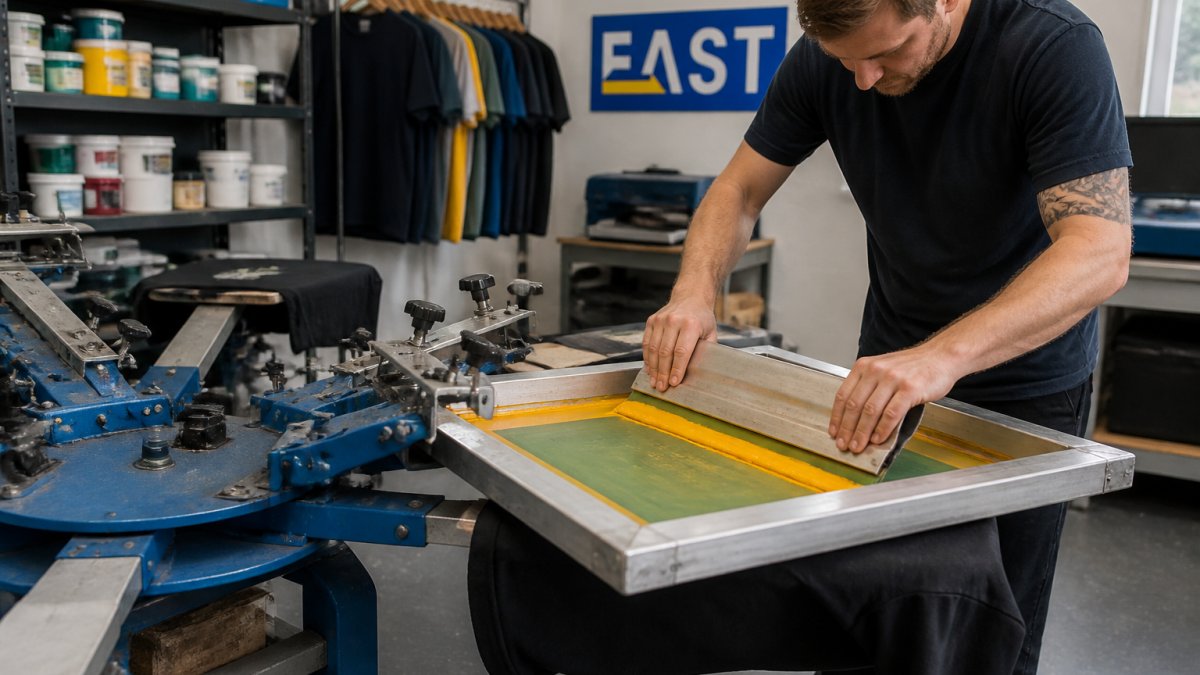
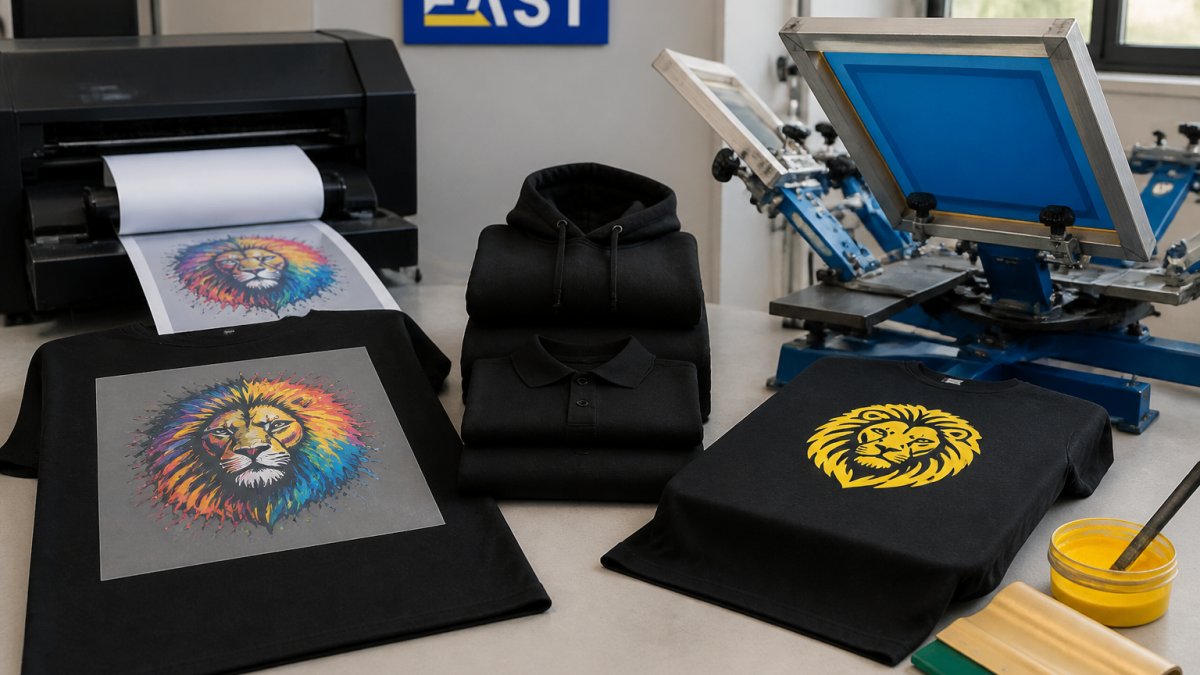
DTF printing (direct-to-film) is a process where a design is printed onto a special film, then heat-pressed onto the garment. The ink bonds to the fabric fibres, giving full-colour detail and smooth gradients.
Each method has trade-offs. Embroidery handles intricate multi-colour crests well but struggles with fine gradients. DTF printing captures photographic detail and colour blends, though the print layer sits on the fabric surface.
Printed Workwear Logo Lifespan: What to Expect
Printed workwear logo lifespan depends on the print method, the fabric it sits on, and the wash routine. There is no single number, but a common pattern is that a well-applied DTF print on a suitable polycotton or cotton uniform will hold up through roughly 30-50 domestic wash cycles before the first signs of cracking or edge lift appear.
Why the range is so wide comes down to the bond. DTF uses a heat-pressed film carrying the ink; the film adheres to the fabric surface. Every wash flexes that film, and every tumble dry shrinks and stretches it against the weave. Screen printing pushes ink through a mesh and cures it, so the ink sits partly within the fibres and flexes with them.
Common failure points for printed logos include:
- Cracking where the ink film flexes across the fabric, usually first at the elbows, chest, and shoulder blades
- Peeling at the edges if the heat-press bond was weak or the garment was washed before the print fully cured
- Fading from repeated hot washes, harsh detergents, and UV exposure on outdoor uniforms
- Colour bleed on dark garments where a white underbase shows through as the top layer wears
Embroidery avoids these specific failures because there is no film to crack or peel. The thread is colourfast, so it resists fading, and stitched logos often outlast the garment itself. The main risks are snagging on rough surfaces and thread abrasion in high-friction areas such as a shoulder strap or a tool belt.
For a procurement manager comparing methods, the practical takeaway is to match the print type to the expected wash regime. A uniform washed daily and tumble dried will punish a DTF print far faster than one air-dried on a gentle cycle. If you need help specifying a print method for a particular fabric or wash routine, email info@workweareast for a quote and our team can advise on the right finish for your branded polo shirts.
Durability Comparison: Embroidery vs Printing (Pros and Cons)
Embroidery wins on longevity. Printed logos offer more design flexibility. The right choice depends on how hard your team works and how complex your logo is.
| Factor | Embroidery | Printing (DTF/Screen) |
|---|---|---|
| Wash durability | Excellent, thread resists fading | Good, but film can crack |
| Colour range | Limited to thread colours | Full colour, gradients |
| Fabric suitability | Best on woven, heavier fabrics | Works across most fabrics |
| Feel on garment | Textured, raised | Smooth, flat |
| Repair options | Hard to repair damage | Cannot repair once cracked |
| Best for | Long-life uniforms, crests | Promotional items, detail |
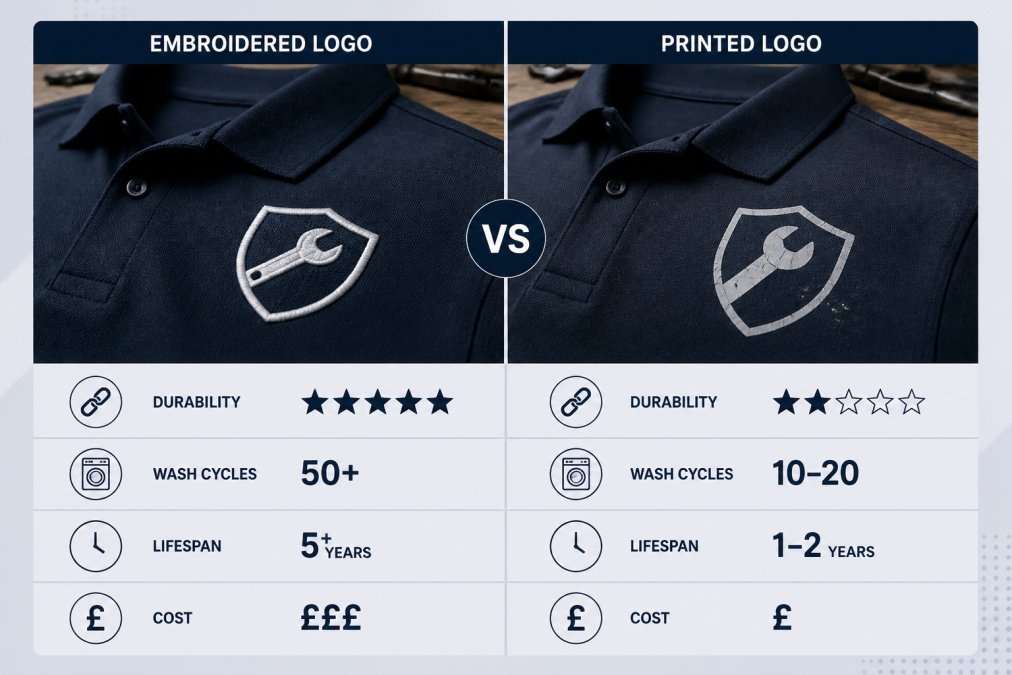
Embroidery pros: colourfast thread, textured professional finish, often outlasts the garment, no cracking or peeling.
Embroidery cons: limited colour blends, heavier feel, can snag on rough surfaces.
Printing pros: full-colour detail, smooth finish, lower cost on large simple orders.
Printing cons: can crack, peel, and fade over time, especially with frequent laundering.
How to Wash Embroidered Uniforms (and Printed Ones) Correctly
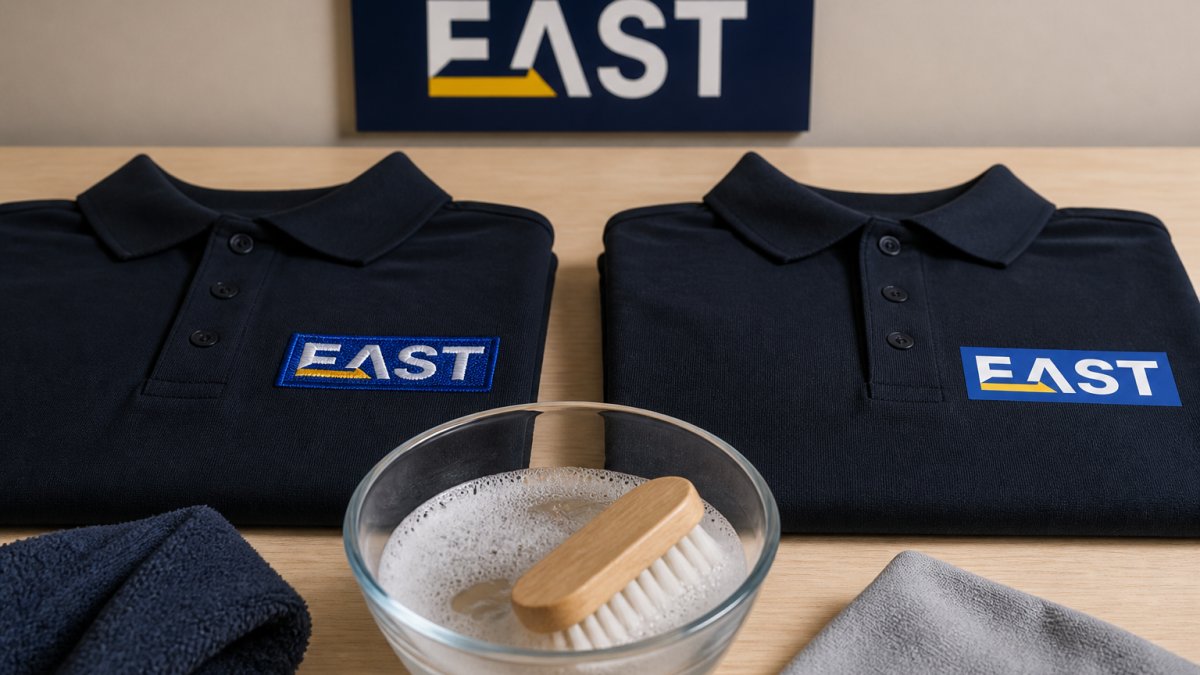
Wash embroidered uniforms inside out at 30-40°C on a gentle cycle to protect the stitching and surrounding fabric. Printed uniforms need the same care, plus strict temperature control to keep the print layer intact.
A simple routine extends garment longevity:
- Turn garments inside out before washing
- Use a mild detergent, no bleach or fabric softener on prints
- Wash at 30-40°C on a gentle cycle
- Avoid tumble drying prints; air dry where possible
- Iron embroidered items on the reverse, never directly on the print
For teams with heavy soiling, a workwear portal helps track garment care and replacement cycles so branding consistency holds across the whole workforce.
Best Logo Method for Work Uniforms: Industry Use-Cases
The best logo method depends on your sector, but the decision is sharper than a simple embroidery-versus-printing split. Below is how the trade-offs play out in the sectors where uniform branding has to survive real wear.
Construction and trade uniforms. Embroidery is the stronger choice here. Stitched logos survive frequent laundering, resist the abrasion of tool belts and harnesses, and do not crack when a garment is stretched climbing or lifting. The main risk is snagging on exposed fixings, so specify a tight stitch density and avoid large, loose designs on high-friction panels. On hi-vis garments, embroidery is also the safer option because it adds no surface film that could affect garment performance or reflectivity.
Medical and care uniforms. Embroidery again leads, for two reasons. First, colourfast thread holds its appearance through the high-temperature wash cycles that clinical uniforms often require. Second, a stitched logo does not create the cracked, flaking edges that a print can develop, an important consideration where a professional appearance matters to patients. Fine-line logos and small text are the weak point, so simplify crests for embroidery.
Corporate and event apparel. DTF printing suits this sector where full-colour detail, gradients, and photographic logos matter more than maximum lifespan. The trade-off is that a print on a polo worn weekly and washed hot will show wear sooner than an embroidered equivalent. For a short campaign or a one-off event, that trade-off is usually acceptable.
High-volume promotional runs. Screen printing remains the cost-effective route for simple designs on large orders. It cures into the fabric, so it often outlasts DTF on the same wash regime, but it cannot reproduce fine gradients or photographic detail.
A useful way to compare the options is cost per wear rather than upfront price. An embroidered logo that outlasts the garment spreads its cost across every wash cycle the uniform survives; a cheaper print that cracks after a season may cost more per wear once replacement branding is factored in. Most procurement teams find that for daily-wear uniforms, embroidery wins on this measure, while printing wins for short-life or detail-heavy apparel.
For help matching a method to your sector and fabric, email info@workweareast for a quote or explore our hi-vis options and workwear bundles built for daily wear.
Conclusion
Choosing between embroidered and printed logos comes down to how long you need the branding to last and how complex your design is. For most uniforms worn daily and washed often, embroidery delivers the durability that keeps your corporate identity sharp.
At Workwear East, we offer advanced embroidery machines for intricate designs, versatile DTF printing for full-colour detail, and cost-effective screen printing for large orders. To discuss the right method for your team, email info@workweareast for a quote or explore our workwear bundles. Visit Workwear East to get started.
Frequently Asked Questions
Do embroidered or printed logos last longer on uniforms?
Embroidered logos generally last longer. Stitched thread becomes part of the fabric and does not crack, peel or fade in the way printed ink can. Embroidery often outlasts the garment itself, while printed logos have a more limited lifespan depending on the method and wash routine. For uniforms washed frequently, embroidery is usually the more durable choice. That said, modern DTF printing has improved significantly and can perform well when cared for properly. The right choice depends on your fabric, logo complexity and how often the garment is laundered.
How many washes can a printed uniform logo withstand?
There is no single figure because printed workwear logo lifespan depends on the printing method, ink quality, fabric and wash routine. Screen-printed logos typically hold up well over many wash cycles when washed inside out at low temperatures. DTF prints are durable but can start to crack or peel if subjected to high heat, harsh detergents or frequent tumble drying. To maximise lifespan, follow the care label, avoid fabric softener on printed areas and wash at 30°C or lower. Request a quote from Workwear East to discuss the best print method for your wash frequency.
Can printed logos crack, peel or fade?
Yes. Printed logos can crack, peel or fade over time, especially with frequent laundering, high washing temperatures or tumble drying. Screen printing is more prone to cracking along fold lines, while DTF prints can peel at the edges if not cared for correctly. Embroidery avoids these issues because thread does not crack or peel. Choosing the right print method for your fabric and following correct washing guidance significantly reduces the risk. If durability is your priority, embroidery is the safer option for daily-wear uniforms.
Is embroidery suitable for lightweight uniform fabrics?
Embroidery can work on lightweight fabrics, but it requires the right backing and stitch density to avoid puckering or distortion. Very thin or stretchy materials may be better suited to printed branding. For most uniform polo shirts and workwear, embroidery is perfectly suitable. Workwear East uses advanced embroidery machines that handle multi-colour designs on a range of fabrics. If you are unsure, email info@workweareast for a quote and the team can advise on the best method for your specific garment.
How should uniforms with embroidered or printed logos be washed?
Wash embroidered uniforms inside out at 30°C or lower and avoid fabric softener, which can degrade thread and ink. For printed uniforms, the same low-temperature rule applies, and tumble drying should be avoided to prevent cracking. Iron embroidered garments on the reverse, never directly on the stitching. Printed logos should not be ironed at all. Following these steps extends logo lifespan and keeps branding consistent. For high-visibility or frequently washed uniforms, embroidery is often the more resilient choice.