 review
Best Quality DTF Printing for Clothing: A 2026 Buyer's Guide
Table of Contents
- What Is Best Quality DTF Printing for Clothing and How Does It Work?
- DTF Printing Durability: What to Expect After Repeated Washing
- DTF Printing vs Screen Printing: Which Is Right for Your Workwear?
- Suitable Fabric Types: Cotton, Polyester Blends, and Performance Wear
- File Preparation Best Practices for High-Definition DTF Prints
- Cost of DTF Printing UK: What Influences Pricing for Clothing Orders
- DTF Printing Services UK: How to Identify a Quality Supplier
- Best Quality DTF Printing for Clothing: Environmental Considerations
Last Updated: July 31, 2026
Finding the best quality DTF printing for clothing requires understanding what separates genuine quality from marketing claims. At Workwear East, we work with businesses across Thetford and Norfolk who have been burned by prints that peel after five washes instead of lasting 50. This guide breaks down how DTF works, what defines real quality, and how to choose a supplier who delivers.
What Is Best Quality DTF Printing for Clothing and How Does It Work?
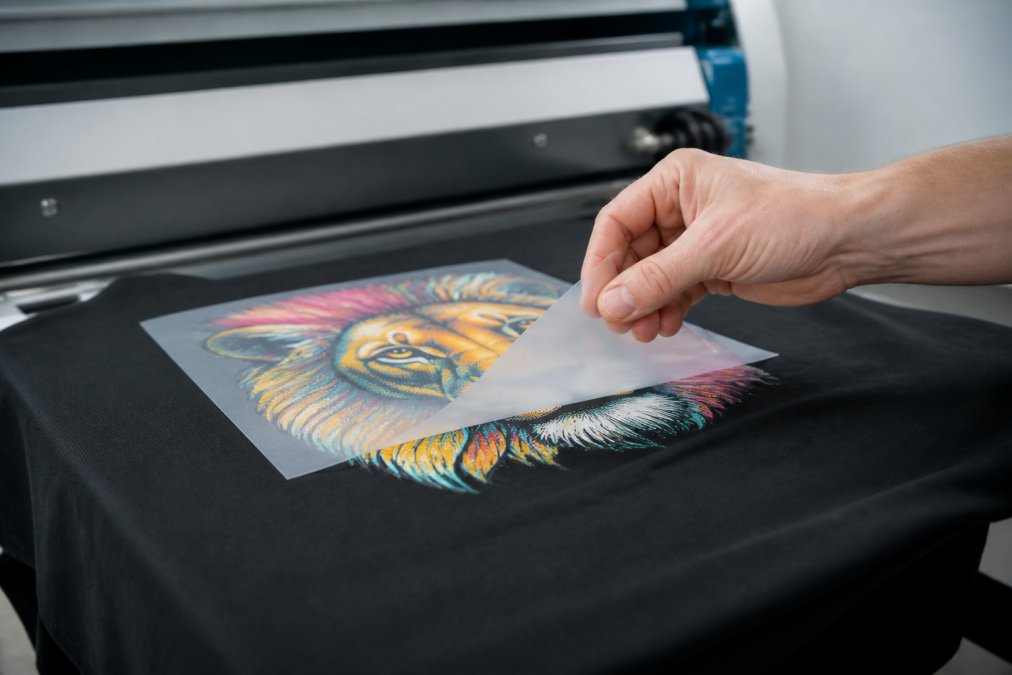
Direct to film printing is a textile decoration method in which a design is printed onto specialised PET film, coated with hot-melt adhesive powder, cured in an oven, and then heat-pressed onto a garment. The result is a full-colour, high-definition print that bonds directly to fabric fibres rather than sitting on top as a thick layer.
DTF printing combines high print resolution with advanced adhesive technology. Modern DTF printers reproduce fine detail, gradients, and photographic imagery with genuine colour accuracy. The adhesive powder, when cured correctly, creates a flexible bond that moves with the fabric rather than against it.
The best quality DTF printing depends on three variables: ink saturation at printing, correct adhesive powder application, and precise heat press settings. If any one fails, the final garment suffers regardless of printer quality.
The DTF Process Step by Step: Film, Adhesive Powder, and Heat Press
- Design preparation: Artwork is formatted as a high-resolution file with transparent background and sent to RIP software controlling ink output.
- Film printing: The design is printed onto PET film using pigment-based inks, including a white underbase layer for dark fabrics.
- Adhesive powder application: Hot-melt adhesive powder is applied evenly across wet ink. Uneven application causes patchy adhesion later.
- Curing: The film passes through a curing oven, melting the powder into a continuous adhesive layer.
- Heat press application: The cured transfer is pressed onto the garment at correct temperature and pressure for a set dwell time.
- Cold peel or hot peel: The film is removed, leaving the design bonded to fabric.
The curing process is most often skimped on by lower-quality suppliers. Under-cured transfers feel stiff, crack earlier, and fail wash tests that properly cured prints pass easily.
DTF Printing Durability: What to Expect After Repeated Washing
A correctly produced DTF transfer on standard cotton or polyester blend garments should maintain appearance through repeated washing without visible cracking, fading, or peeling. The soft hand feel of a quality DTF print is a useful indicator: stiff or rubbery prints have often been over-pressed or under-cured and degrade faster.
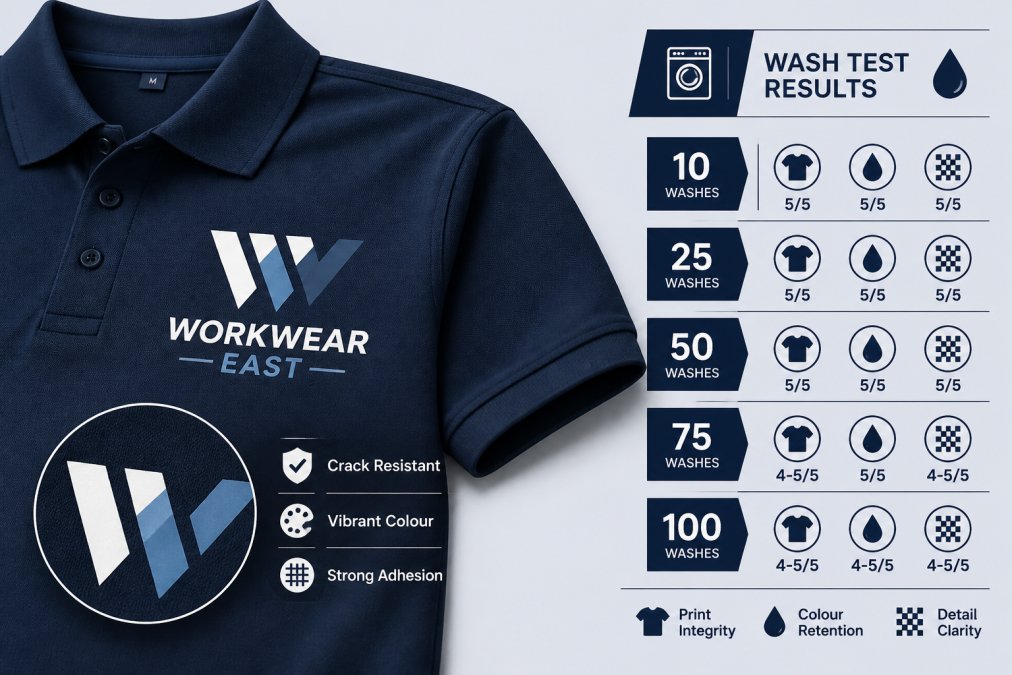
Wash-fastness measures a print's resistance to colour loss during laundering. According to the Textile Services Association's guidance on garment care and durability, correct care labelling and appropriate washing temperatures are among the most significant factors in extending printed garment longevity. Washing branded workwear at 60°C when rated for 40°C will degrade any print.
For workwear, garment longevity is also influenced by use frequency and nature. A construction crew's polo shirts face different stresses than a receptionist's branded top. Quality suppliers advise on the right garment weight and fabric composition for your working environment.
Why Logos Crack and Peel and How Quality DTF Prevents It
Logo cracking and peeling is almost always a production failure, not an inherent DTF flaw. The three most common causes are insufficient adhesive powder coverage, incorrect heat press temperature, and inadequate dwell time.
A print applied at too low a temperature will not fully bond. One applied too high may scorch the adhesive, making it brittle. The correct combination varies by fabric type: performance wear requires lower press temperatures than heavyweight cotton fleece.
Quality suppliers calibrate heat press settings per fabric type and verify transfers with wash tests before fulfilling orders. If a supplier cannot tell you their press temperature and dwell time settings, that is a red flag.
DTF Printing vs Screen Printing: Which Is Right for Your Workwear?
The choice between DTF and screen printing is context-dependent. Screen printing excels at large, single-location prints on high-volume orders with limited solid colours. Per-unit cost drops considerably at scale, but setup cost is high: each colour requires a separate screen, making small runs or multi-colour photographic designs expensive.
DTF printing removes those constraints. There are no screens, no minimum colour limits, and no minimum order quantities. A single garment with a 12-colour photographic design costs the same per print as a 500-unit run. For businesses needing small quantities, multiple design variations, or complex artwork, DTF is more practical.
As documented in the British Promotional Merchandise Association's industry guidance on print methods, suitability depends on design complexity, order volume, and fabric substrate.
| Factor | DTF Printing | Screen Printing |
|---|---|---|
| Minimum order quantity | No minimum | Usually 12-24 units minimum |
| Colour complexity | Unlimited, photographic | Best for 1-6 solid colours |
| Setup cost | Low | Higher per design |
| Best fabric | Cotton, polyester blends, performance wear | Cotton-heavy fabrics |
| Turnaround time | Fast, no screen prep | Longer for new designs |
| Cost at high volume | Competitive | Often lower per unit |
| Soft hand feel | Yes, when correctly applied | Varies by ink type |
DTF Transfer Quality vs Direct-to-Garment Printing
DTF and direct-to-garment printing are frequently confused. Direct-to-garment applies ink directly to fabric using a modified inkjet printer. It produces excellent results on 100% cotton but struggles on polyester blends and performance wear, where ink has difficulty bonding to synthetic fibres.
DTF transfers bond via the adhesive layer rather than relying on ink absorption. This makes DTF more versatile across fabric types and produces sharper edges on fine detail, which matters when reproducing complex logos with thin lines or small text.
If your workwear includes polyester hi-vis vests, performance polo shirts, or blended fabrics, DTF is the more reliable choice for consistent print quality standards.
Suitable Fabric Types: Cotton, Polyester Blends, and Performance Wear
DTF printing's genuine advantage is compatibility with a broad range of substrates. Cotton fabrics, polyester blends, nylon, and performance wear all accept DTF transfers reliably when heat press settings are adjusted accordingly.
Cotton at standard weights (180-280gsm) is the most forgiving substrate. The adhesive bonds well, the print sits cleanly, and wash-fastness is consistently strong. Polyester blends require lower press temperatures to avoid heat damage, but bond quality is equally reliable when settings are correct.
Performance wear is common in trade and construction workwear. Moisture-wicking fabrics, stretch materials, and lightweight technical fabrics all accept DTF transfers, but the elastic nature means the print must retain flexibility after curing. A quality DTF print on performance wear should stretch with the fabric without cracking.
DTF does not suit very rough textures like heavy canvas or terry towelling, where uneven surfaces prevent full contact during pressing.
File Preparation Best Practices for High-Definition DTF Prints
File quality is the most commonly overlooked factor in print quality and is entirely within your control. A print is only as sharp as the artwork supplied.
Artwork for DTF printing should be supplied at a minimum of 300 DPI at intended print size. A logo that looks sharp on screen at 72 DPI will print with visible pixelation when scaled to garment size. Vector files (AI, EPS, or PDF) are preferable because they are resolution-independent and can be scaled without quality loss.
DTF printers work in CMYK, so RGB artwork will be converted during the RIP process. This conversion can shift colours, particularly saturated reds and blues. Supplying CMYK artwork with Pantone references for critical brand colours gives your supplier the best chance of matching brand standards accurately.
Practical file preparation checklist:
- Artwork supplied at 300 DPI minimum at final print size
- File format: AI, EPS, PDF (vector) or high-resolution PNG/TIFF (raster)
- Transparent background (PNG) for non-rectangular designs
- Colour mode: CMYK where possible, with Pantone references for brand colours
- Text converted to outlines to prevent font substitution
- Print dimensions confirmed against garment placement area
Cost of DTF Printing UK: What Influences Pricing for Clothing Orders
DTF printing services UK pricing varies based on design size, order quantity, garment type, and turnaround time. Any supplier quoting a flat rate without understanding your requirements should be treated with caution.
Larger print areas use more ink and film, so full-front designs cost more per unit than small left-chest logos. Order quantity affects unit cost because setup time and material preparation spread across more garments. A run of 100 polo shirts has lower per-unit cost than 10, though total spend is higher.
Gang sheets, where multiple designs are arranged on a single film sheet to reduce waste, can reduce cost on mixed small-quantity orders. Quality suppliers suggest this proactively when it benefits customers.
For accurate pricing on your specific requirements, request a quote with your design, garment specification, quantities, and delivery date. Workwear East provides quotes based on actual order details rather than generic price lists. Get a quote directly through the Workwear East website for accurate figures for your project.
According to the Office for National Statistics data on UK manufacturing input costs, material costs across UK textile and print production have shifted over recent years, making live quoting more accurate than published price tables.
DTF Printing Services UK: How to Identify a Quality Supplier
The DTF printing services UK market has expanded rapidly, and not all suppliers operate to the same standard. Identifying a quality supplier before committing to a full order is worthwhile.
The clearest indicators of quality are equipment transparency, sample availability, and honest communication about lead times. A supplier who can tell you their printing equipment brand and model, curing process, and heat press calibration demonstrates operational competence. One who deflects these questions is not.
Physical samples are non-negotiable for new supplier relationships. Request a printed sample of your actual artwork on your intended garment, then wash it according to your standard process. Cracking resistance, colour accuracy, and soft hand feel after washing tell you far more than marketing claims.
Local suppliers carry practical advantages for Norfolk businesses. Shorter supply chains mean faster resolution when corrections are needed, easier communication, and the ability to see production facilities in person. Workwear East operates from Thetford, allowing Norfolk businesses to discuss requirements directly and expect responsive service without delays from large anonymous platforms.
Turnaround Times, Delivery, and Rush Orders
Turnaround time is a genuine operational concern for businesses ordering branded workwear. Whether a supplier can handle a rush order for 40 polo shirts in three weeks depends on whether quality is maintained under time pressure.
Standard turnaround for DTF printing orders varies by supplier and order complexity. Custom apparel orders typically require time for artwork approval, production, and quality checking before dispatch. A supplier promising overnight turnaround on complex multi-colour orders without caveats is compressing the process in ways that usually affect quality.
For genuine rush orders, some lead time is always required for quality results. Ask whether the rush process skips quality steps or simply prioritises your order in the production queue. The latter is acceptable; the former is a risk.
Best Quality DTF Printing for Clothing: Environmental Considerations
Environmental impact deserves more attention in DTF printing discussions. The best quality DTF printing involves not just print performance but responsible production.
DTF printing uses water-based pigment inks with a lower volatile organic compound profile than solvent-based alternatives. The PET film used in transfers is a single-use plastic component, and responsible suppliers manage film waste rather than discarding it. Asking about waste management is a reasonable question that quality operations can answer.
Garment longevity is itself an environmental argument. A print surviving the full working life of a garment reduces replacement order frequency, lowering cumulative resource cost over time. Investing in quality production is more sustainable than repeatedly replacing cheaper garments that fail early.
The WRAP UK guidance on sustainable textiles and clothing longevity highlights that extending active garment life is one of the most effective ways to reduce textile production environmental impact. Choosing suppliers prioritising garment longevity aligns with this principle.
Branded workwear that peels after a handful of washes undermines your team's professional appearance and costs you in repeated replacement orders. Workwear East provides DTF printing and embroidery services built for businesses needing consistent, durable results across their full uniform range, with versatile printing across cotton fabrics, polyester blends, and performance wear. Get a quote from Workwear East and find out what quality DTF printing actually looks like in practice.
Frequently Asked Questions
What makes DTF printing high quality for clothing?
High-quality DTF printing relies on several factors working together: accurate colour profiles, a correctly cured adhesive powder layer, consistent heat press application, and properly prepared artwork files. The result is a high-definition print with a soft hand feel, strong wash-fastness, and resistance to cracking and fading. Poor results typically stem from incorrect curing temperatures, low-resolution artwork, or substandard inks, not the DTF process itself.
How does DTF printing compare to screen printing for workwear durability?
Both methods can produce durable results, but they suit different needs. DTF printing excels for small runs, full-colour designs, and complex logos because there are no screen setup costs and no colour limits. Screen printing is generally more cost-effective for very large bulk orders of simple designs. For branded workwear with detailed logos across mixed fabric types, DTF printing often offers greater flexibility and comparable garment longevity when applied correctly.
What factors influence the cost of DTF printing in the UK?
Pricing for DTF printing services in the UK typically depends on order quantity, print size, number of colours, garment type, and required turnaround time. Gang sheets, where multiple designs are printed on a single film, can reduce cost per unit on smaller runs. Rush orders and specialist fabrics may carry additional charges. For an accurate figure, it is always best to request a quote directly from your supplier with your exact specifications.
Can DTF printing achieve vibrant colours on all fabric types?
DTF printing performs well across a wide range of fabrics including cotton, polyester blends, nylon, and performance wear, unlike some methods that struggle on synthetic fibres. Because the ink is transferred via a film rather than printed directly onto the fabric, colour accuracy and ink saturation remain consistent regardless of the base material. This makes it particularly useful for mixed-fabric workwear ranges where consistent brand colours across garments are essential.
What should I look for in a DTF printing supplier in the UK?
Look for a supplier who can demonstrate wash-fastness results, provides clear file preparation guidelines, and offers transparent turnaround times. Ask whether they use quality inks and proper curing processes, these directly affect garment durability. A local supplier based in or near your area can also simplify communication, reduce delivery times, and allow you to inspect samples before committing to a full order. Proven experience with business workwear orders is a strong indicator of reliability.
This article was written using GrandRanker