 how-to
Printed Polo Shirts: Quality Workwear Solutions
Table of Contents
- Why Printed Polo Shirts Matter for Your Business
- Choosing Between DTF Printing on Polo Shirts and Other Methods
- Customisation Options: Logos, Artwork, and Text Placement
- Fabric Quality and Durability for Workwear
- How to Care for Printed Polo Shirts
- Ordering Printed Polo Shirts: A Practical Guide
- Frequently Asked Questions
Last Updated: October 10, 2026
Why Printed Polo Shirts Matter for Your Business
Printed polo shirts have become essential workwear for businesses across the country. They combine professional appearance with practical durability, making them ideal for teams that need to look cohesive while performing demanding work. Whether you're outfitting a construction crew, retail staff, or corporate team, the right printed polo shirt reinforces your brand identity and builds customer confidence in your organisation.
A well-made printed polo shirt with your logo creates an immediate visual connection to your brand and signals investment in your team's professionalism.
The real challenge is finding a printed polo shirt that holds up under daily wear, maintains vibrant colours, and fits properly. This guide covers decoration methods, fabric quality, and aftercare.
Choosing Between DTF Printing on Polo Shirts and Other Methods
DTF (Direct-to-Fabric) printing applies ink directly onto the garment using a specialised printer. DTF printing on polo shirts excels at detailed, full-colour images.
DTF printing offers versatility for complex logos and photographic images without screen printing's setup costs. For orders of 10-50 shirts, DTF printing on polo shirts offers a versatile solution.
Modern DTF inks and proper curing have improved significantly, and prints can offer good longevity when cared for correctly.
Screen Printed Polo Shirts for Bulk Orders
Screen printed polo shirts are a cost-effective option for large orders. For construction firms or large retail chains, screen printed polo shirts offer reliability and cost efficiency.
The trade-off is flexibility: each colour requires a separate screen.
Embroidery for Premium Finishes
Embroidery delivers a premium look using raised, textured logos that convey craftsmanship. It is a durable decoration method. Construction workers and trade professionals often choose embroidery for its resistance to wear and tear.
The drawback is complexity. Photographic designs or extremely detailed logos aren't suitable for embroidery; thread cannot replicate that level of detail.
Customisation Options: Logos, Artwork, and Text Placement
Logo placement matters significantly. A chest-left logo works for most businesses; a full-back design creates impact but costs more and can look excessive for everyday workwear.
Text placement requires careful planning. For embroidered text, consider legibility; printed text should be clear. If your design includes both logo and text, the logo should dominate visually.
Artwork File Formats and Technical Requirements
Submitting the wrong file format can delay your order. Understanding technical constraints before briefing a designer saves time and money.
For DTF Printing: Raster files (JPEG, PNG, TIFF) must be 300 DPI minimum at final print size. Vector files (AI, EPS, PDF) are preferred with all fonts converted to outlines. DTF printing can handle many colours.
For Screen Printing: Use vector files (AI, EPS) with no more than 6-8 colours to keep setup costs reasonable. Specify exact Pantone numbers for colour matching. Avoid gradients and fine detail; screen printing excels at bold, solid-colour designs.
For Embroidery: Your supplier will convert your design (AI, PDF, PNG) into an embroidery file. Aim for bold, simplified designs with no more than 8-10 thread colours. Use simple, sans-serif fonts for text; script fonts become illegible at small sizes.
Colour Considerations and Fabric Interaction
Poly-cotton fabrics accept all decoration methods well; 100% cotton can cause slight colour shifts. If colour accuracy is critical, request a physical sample before committing to full production.
Placement Dimensions and Visibility
A chest-left logo typically measures 3-5 cm wide. Full-back designs (15-25 cm) create impact but cost more. For embroidery, designs over 20 cm require higher stitch counts and increase cost.
For guidance on preparing artwork or converting designs into production-ready files, contact info@workweareast for a quote and technical consultation.
Fabric Quality and Durability for Workwear
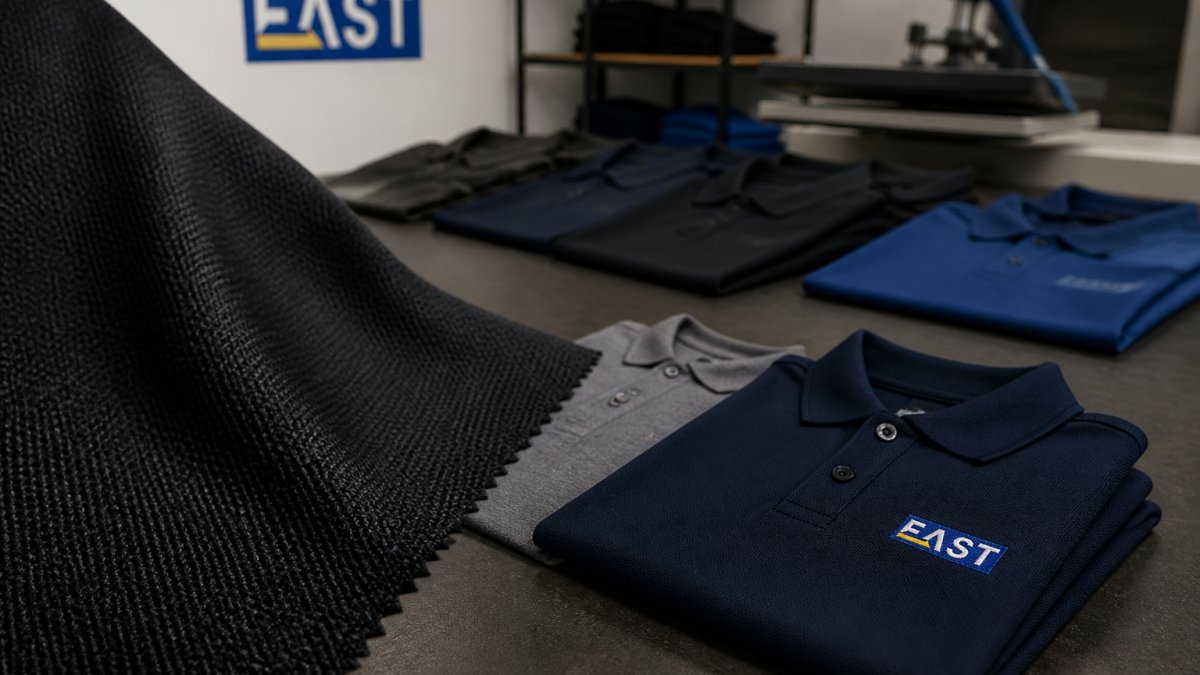
Poly-cotton blends (65% polyester, 35% cotton) resist shrinkage and maintain colour vibrancy better than pure cotton. Check fabric specifications when ordering. Workwear East sources garments that meet rigorous durability standards, and our Branded Polo shirts range has been selected specifically for demanding work environments.
How to Care for Printed Polo Shirts
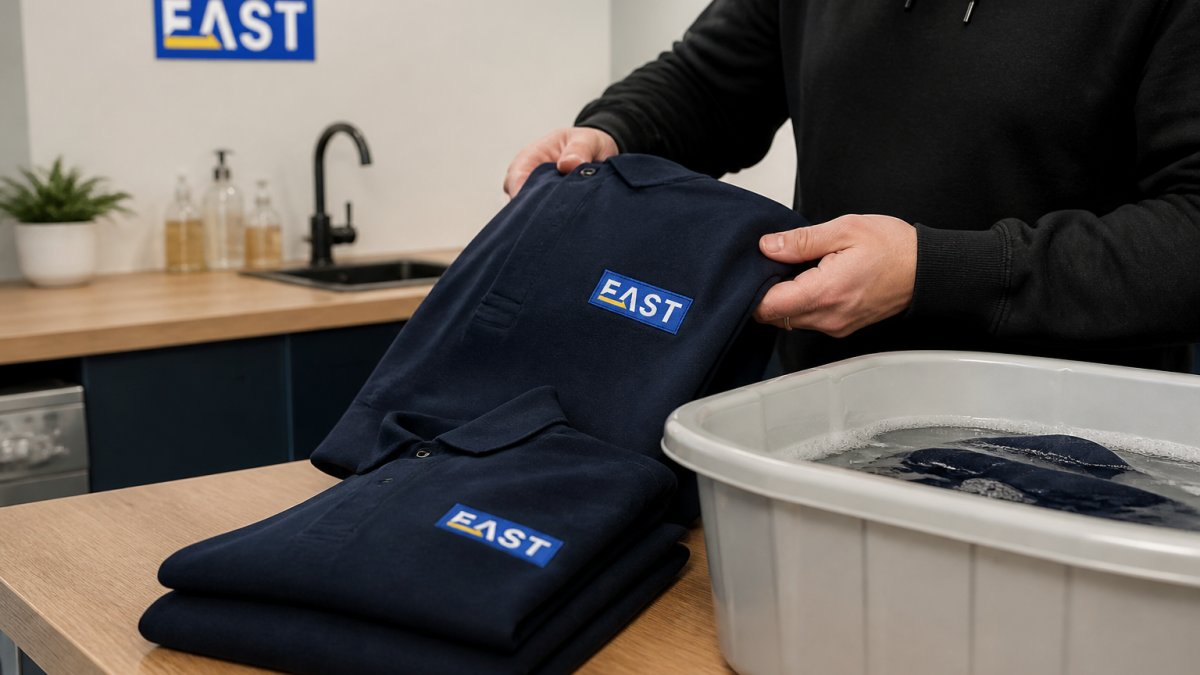
Turn printed polo shirts inside out before washing to protect the design. Use cold water; avoid bleach. Dry on low heat or air dry when possible. For embroidered polo shirts, the same principles apply.
Ordering Printed Polo Shirts: A Practical Guide
Ordering printed polo shirts involves more steps than buying off-the-shelf apparel, but the process becomes straightforward once you understand the key decisions and timelines. For businesses locally, ordering offers advantages in turnaround, communication, and the ability to inspect samples before committing to full production.
Step 1: Determine Your Quantity and Timeline
Start by determining your quantity and realistic timeline. Small orders typically have lead times that depend on production schedules. Larger orders often qualify for faster turnaround. Be realistic about when you need the shirts; rushing adds cost and increases the risk of errors.
For local ordering through Workwear East, lead times depend on the decoration method and current production schedule. If you have a tight deadline, discuss this upfront; some decoration methods can be expedited, but this may incur a rush fee.
Step 2: Choose Your Decoration Method
Next, choose your decoration method based on your design complexity and order size. A single-colour logo on 15 shirts? DTF printing is a versatile option. A two-colour logo on 200 shirts? Screen printing is a cost-effective choice for bulk. A premium corporate look for 30 shirts? Embroidery creates a professional impression.
Consider your team's work environment when choosing. Construction workers and outdoor staff benefit from embroidery's durability; retail or office staff may prefer the softer feel and photographic quality of DTF printing. If your design includes employee names or varies between shirts, DTF printing offers flexibility.
Step 3: Prepare and Submit Your Artwork
Prepare your artwork in the correct format before you contact your supplier. Request technical specifications from Workwear East before you design; different methods have different requirements, and submitting artwork in the wrong format delays your order.
For DTF printing, provide high-resolution raster files (JPEG, PNG, TIFF) or vector files (AI, EPS with fonts converted to outlines). For screen printing, vector files (AI, EPS) are essential, with colours specified as Pantone references. For embroidery, provide your design as a standard file (AI, PDF, or high-resolution PNG); your supplier will convert it to an embroidery file and confirm stitch count and thread colours before production.
Include a brief design brief with your artwork: intended placement (chest-left, full-back, sleeve), approximate size in centimetres, and any colour-matching requirements. This prevents misunderstandings and ensures your supplier interprets your design correctly.
Step 4: Request a Digital Proof
Before production begins, request a digital proof showing your design on a polo shirt mockup. This is a critical step that catches errors before any shirts are made. Confirm:
- Logo placement and size match your expectations
- Colours are accurate (especially important if brand matching is required)
- Text spelling and positioning are correct
- The design looks professional and balanced on the garment
For embroidery, the proof should show the stitch pattern. For DTF printing, the proof confirms colour saturation and edge sharpness. For screen printing, the proof shows colour separation.
Workwear East provides digital proofs for all orders at no additional cost. Approval of the proof is your final opportunity to request changes before production starts, so review carefully and ask questions if anything looks unclear.
Step 5: Select Your Sizes and Order a Sample
Select your sizes carefully. Request a size chart from your supplier and consider ordering a sample in your primary size before committing to full quantities. A sample investment helps prevent sizing errors.
When you order your sample, request it in the same fabric weight and colour as your full order, and have it decorated with your design. This confirms not only fit but also how your logo or text appears on the actual garment and fabric you've chosen.
Step 6: Confirm All Details in Writing
Finally, confirm all details in writing before production begins: exact colours (Pantone numbers for screen printing, RGB or hex for DTF), placement dimensions, text spelling, quantity, delivery address, and expected delivery date. Verbal agreements about "close enough" lead to disappointment and costly remakes.
A clear written specification protects both you and your supplier. It also serves as a reference if any issues arise during production or after delivery.
Local Delivery and Collection Options
For businesses locally, Workwear East offers flexible delivery and collection options. Standard delivery is available to most postcodes. For larger orders, collection from our location can be arranged, allowing you to inspect the finished shirts before taking them away and avoiding delivery delays.
If you need your printed polo shirts urgently, discuss collection options when you place your order. Local collection can sometimes be arranged depending on production capacity.
Frequently Asked Questions
What's the best printing method for polo shirts used in workwear?
DTF printing works well for detailed, full-colour logos and small orders, while screen printing suits bulk orders and offers excellent durability. Embroidery is ideal for premium finishes on branded workwear. The best choice depends on your design complexity, order quantity, and budget. Contact Workwear East at info@workweareast for a quote to discuss which method suits your needs.
How should printed polo shirts be washed to maintain quality?
Turn printed polo shirts inside out before washing in cool water on a gentle cycle. Avoid bleach, which can damage prints. Air dry rather than tumble drying to extend the life of both the garment and the printed design. Following these care guidelines helps preserve vibrant colours and prevents cracking or peeling.
Can you print a logo on a polo shirt, and what file format do I need?
Yes, logos can be printed using DTF, screen printing, or embroidery. For printing methods, provide vector files (EPS, PDF, or AI) or high-resolution raster images. Embroidery works with most file formats. Workwear East can advise on the best format for your specific design and printing method, email info@workweareast for guidance on preparing your artwork.
Are printed polo shirts suitable for work uniforms, and how durable are they?
Printed polo shirts are excellent for workwear uniforms, especially when made from heavyweight poly-cotton fabric and printed using quality methods like DTF or screen printing. Durability depends on fabric quality, printing technique, and care. Properly maintained printed polos typically withstand regular washing and daily wear for extended periods. For specific durability expectations for your industry, contact Workwear East at info@workweareast.