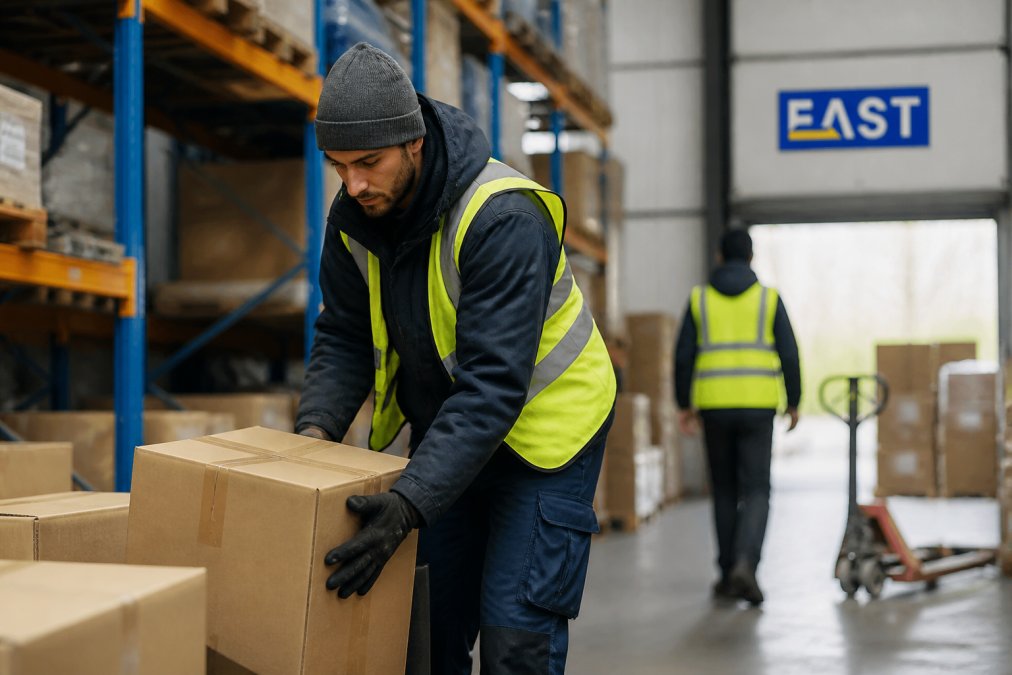
 ultimate-guide
Warehouse Workwear: The 2026 UK Buyer's Guide
Table of Contents
- Why Warehouse Workwear Affects Fatigue, Safety and Staff Retention
- Choosing Safety Footwear for Warehouse Staff
- Hi-Vis, Base Layers and Fabrics That Handle a Full Shift
- Custom Embroidered Workwear: Branding That Survives Industrial Laundry
- Workwear Maintenance Tips That Double Garment Lifespan
- What Warehouse Workwear Costs and How to Budget for It
- A Compliance Checklist for Warehouse Workwear
- Conclusion
- Frequently Asked Questions
Last Updated: September 24, 2026
Why Warehouse Workwear Affects Fatigue, Safety and Staff Retention
Warehouse workwear is the category of protective and functional clothing designed for distribution, storage and logistics environments, covering safety footwear, high-visibility garments, work trousers, base layers and branded uniform items. Get it wrong and the consequences compound: tired staff, avoidable injuries and a workforce that quietly votes with its feet.
This guide from Workwear East covers what actually matters when specifying clothing for warehouse teams, from safety footwear to industrial laundry. This guide from Workwear East covers what actually matters when specifying clothing for warehouse teams, from safety footwear to industrial laundry.
The common mistake is treating workwear as a one-off purchase rather than an operating decision. Clothing that restricts movement or traps heat makes every lift harder, and over a full shift that accumulates into genuine fatigue. Managers who track this tell us the same thing: comfortable teams take fewer unplanned absences and stay longer.
That's the argument running through this guide. Workwear is a retention tool as much as a safety requirement, and the sections below explain how to buy it that way.
Choosing Safety Footwear for Warehouse Staff
Safety footwear is the highest-risk line in the specification, because the wrong sole or fit causes problems that only surface weeks later, and because feet carry the cumulative load of every step across a ten-hour shift.
Start with the hazard, not the style. Warehouse floors vary enormously: polished concrete in a picking aisle, uneven loading bay surfaces, wet areas near goods-in. A slip-resistant sole rated for the specific floor conditions matters more than any aesthetic choice. If your site handles heavy pallets or falling stock, steel toe cap protection is the baseline, and many operations now specify composite toe caps instead because they are lighter and do not conduct cold in chilled areas. Where racking or powered equipment creates a crush risk, midsole penetration protection is worth specifying too.
The ergonomic case: footwear is a fatigue decision, not just a safety one
This is the angle most buying guides skip. Footwear is the single biggest ergonomic lever you have over warehouse fatigue, because it changes how the whole body absorbs load.
A shoe with poor cushioning forces the foot to absorb impact directly. Over a shift that means the calf and lower back work harder to stabilise each step, and the effect compounds: by hour eight, posture degrades, reaction time slows, and the risk of a handling error rises. A shoe with adequate underfoot cushioning and a supportive heel counter spreads that load, so the same number of steps costs the operative less.
The mechanism is straightforward. Cushioning absorbs impact at the heel strike. A supportive heel counter limits excess pronation, which reduces the rotational strain passed up through the ankle and knee. A slightly rockered sole helps the foot roll through the step rather than fighting the floor. None of these are luxuries in a warehouse, they are the difference between a team that finishes a shift fresh and one that finishes it sore.
Fit is where most buyers lose money.
Hi-Vis, Base Layers and Fabrics That Handle a Full Shift
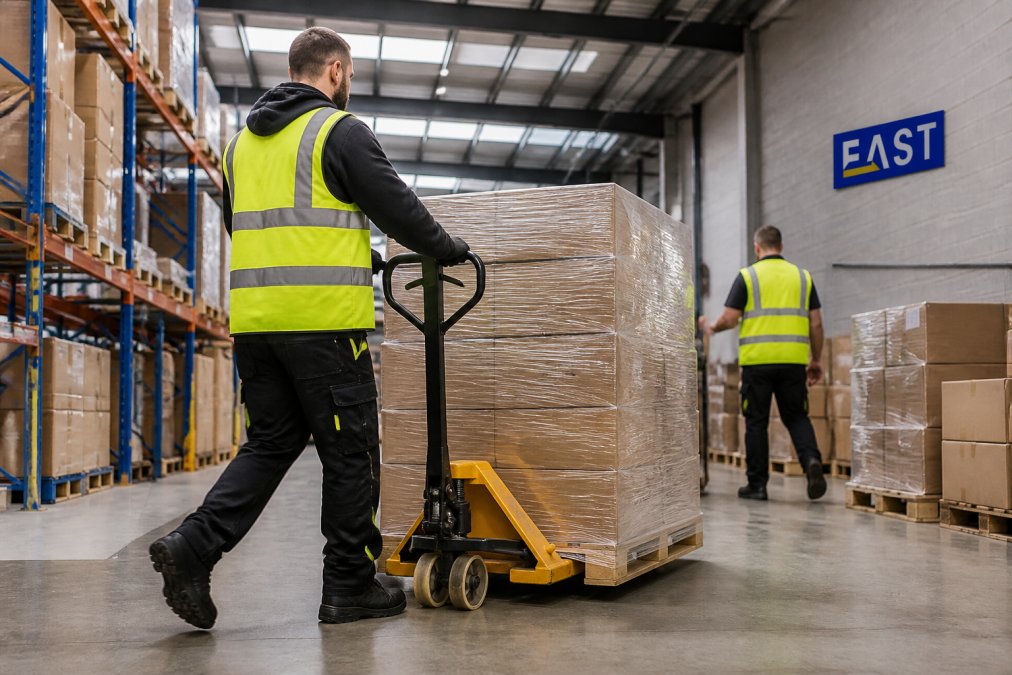
High-visibility clothing requirements depend on your site's risk assessment and lighting conditions, but the fabric underneath often matters just as much as the reflective strips on top.
Base Layers and Layering for Cold Stores and Loading Bays
Cold-chain and freezer logistics need a layering system, not a single heavy coat. A three-part approach works best: a moisture-wicking base layer against the skin, an insulating mid-layer, and a wind-resistant outer shell for loading bays where doors stay open.
Custom Embroidered Workwear: Branding That Survives Industrial Laundry
Custom embroidered workwear is the most durable branding option for warehouse teams because the logo is stitched into the fabric rather than printed onto it. Embroidery withstands repeated industrial laundry cycles far better than most surface-printed alternatives, which is why it suits garments that get washed commercially every week.
| Branding Method | Best For | Laundry Durability | Detail Level |
|---|---|---|---|
| Embroidery | Polos, fleeces, jackets | High, survives industrial cycles | Multi-colour, stitched |
| DTF printing | Event apparel, detailed logos | Moderate, cooler washes | Full-colour photographic |
| Screen printing | Large single-colour runs | Moderate | Simple, bold designs |
Workwear Maintenance Tips That Double Garment Lifespan
Maintenance is where most warehouse workwear budgets quietly leak. Garments washed at the temperature the manufacturer specifies, rather than the hottest setting available, keep their reflective strips and fabric integrity far longer. The three levers are wash temperature, prompt repair, and rotation, but the difference between a guide that lists them and one that works is the audit behind them.
The maintenance audit most guides skip
Run a simple monthly audit against these checks:
- Reflective strips inspected for cracking, peeling or dulling, not just for presence
- Wash temperature log reviewed against garment care labels
- Repair queue cleared or escalated within an agreed window
- Rotation confirmed: each operative has at least two sets in circulation
- Damaged garments removed from service, not returned to the rack
- Sizing records checked against current team list
Keep the completed audits. They are the evidence that demonstrates compliance when it is questioned, and they turn maintenance from a vague instruction into a documented process.
Repair, rotation and the economics of doing it properly
Repair beats replace every time. A torn seam or a missing button caught early costs minutes to fix; left alone, it becomes a replacement garment. Set up a simple repair station or a named person responsible for checking returns each week.
Managing sizing and replacements across a large team
- Hold a sizing session before the first order
- Record measurements per person, not per department
- Set a replacement threshold, such as two sets per operative
- Assign one person to weekly garment checks
- Review sizing annually or after any team change
For a managed programme that includes sizing records, replacement thresholds and audit support, email info@workweareast for a quote, or browse the range at Workwear East.
What Warehouse Workwear Costs and How to Budget for It
Warehouse workwear costs depend on fabric specification, branding method, order quantity and how you manage replacements, so pricing is best quoted against your actual requirement.
A Compliance Checklist for Warehouse Workwear
Compliance starts with the risk assessment, not the catalogue. The employer identifies the hazards, then specifies protective equipment that controls them, then trains staff on correct use. Clothing is only compliant if it fits the person wearing it and suits the task they're doing.
Work through this before you order:
- Risk assessment completed for each warehouse zone
- Safety footwear specified against actual floor hazards
- Hi-vis class matched to site lighting and vehicle movement
- Cold-store clothing specified as a layering system
- All garments correctly sized to the individual
- Branding method compatible with the planned wash cycle
- Replacement and inspection schedule documented
- Staff trained on correct wear and reporting faults
Conclusion
Specifying warehouse workwear that survives industrial laundry, fits every operative and still looks professional after a year is harder than it sounds, and it's where most first orders go wrong. Workwear East handles the whole process, from advanced embroidery machines that produce intricate multi-colour logos, to DTF printing for detailed full-colour designs and cost-effective screen printing for large runs, all backed by a local service based in Thetford.
Frequently Asked Questions
What are the essential features of warehouse workwear?
Prioritise safety footwear with toe protection and slip-resistant soles, high-visibility upper garments with reflective strips, and work trousers with reinforced knees and stretch panels. Breathable, moisture-wicking fabrics keep staff comfortable across a full shift, while cargo pockets and a layering system handle temperature swings between loading bays and cold stores. Durable stitching matters more than styling, because garments are worn daily and washed frequently.
Does warehouse workwear need to meet specific safety standards?
Yes, where a risk assessment identifies a hazard. High-visibility clothing is usually specified to BS EN ISO 20471, and safety footwear should carry a recognised toe protection rating. The Management of Health and Safety at Work Regulations 1999 require suitable risk assessment, and the Personal Protective Equipment at Work Regulations 1992 (as amended in 2022) place PPE duties on employers. This matters for warehouse workwear because compliance is judged against the actual task, not the job title.
Can embroidered workwear withstand industrial laundry?
Quality embroidery handles industrial laundry well when the backing and thread are specified for it. Ask for wash testing at the temperature your laundry contract uses, and check that stitching is dense enough to resist abrasion. Cheaper embroidered logos often fail because the backing breaks down first. If your kit goes through a commercial wash cycle, confirm the garment and the embroidery are both rated for repeated high-temperature washing before you commit to a large order.
How often should warehouse workwear be replaced?
Replace garments when reflective strips lose visibility, when fabric tears at stress points like knees and shoulders, or when footwear treads are worn smooth. Daily-wear polo shirts and trousers usually need replacing more often than outer layers. Build a rolling replacement schedule rather than a single annual order, and keep a small stock of spare sizes so a damaged item does not leave someone without compliant kit. A workwear portal makes tracking this far easier across a large team.