 ultimate-guide
Workwear Thetford: Custom Uniforms for Local Teams
Table of Contents
- Workwear Thetford: What Local Teams Need to Know
- Branded Corporate Apparel That Builds Trust
- Hi-Vis and PPE: Meeting Workplace Safety Standards
- Embroidered Workwear Norfolk: Durability That Lasts
- DTF Printing for Workwear: Vibrant, Wash-Resistant Logos
- Choosing Fabrics and Managing Bulk Orders
- Sizing, Turnaround and Looking After Your Kit
- Conclusion
- Frequently Asked Questions
Last Updated: September 27, 2026
Workwear Thetford: What Local Teams Need to Know
Workwear Thetford is the process of sourcing, branding and managing staff clothing that meets both your brand standards and the safety rules your site demands. At Workwear East, we supply embroidered and printed garments to businesses across the area, from two-person trade outfits to multi-department operations.
The core tension is simple. A uniform has to look sharp on day one and still hold up after a year of washes, site dust and daily abuse. Most suppliers can manage one of those. Fewer manage both.
Below, we cover what actually decides whether your kit survives, how branding methods differ, and how to run a bulk order without the sizing chaos that derails most first attempts.
Branded Corporate Apparel That Builds Trust
Branded corporate apparel is clothing carrying your company identity, and it changes how customers read your business before anyone speaks.
A driver in a plain fleece is anonymous. The same driver in a branded polo with a clean embroidered logo reads as a company with standards. That distinction matters most in trades and services, where customers judge competence in the first ten seconds.
The practical rule: keep the branding restrained. A left-chest logo on polos and a larger back print on hi-vis works because it identifies without shouting. guidance from the British Standards Institution on garment marking is worth checking if you supply into regulated sectors.
Hi-Vis and PPE: Meeting Workplace Safety Standards
Hi-vis and PPE must meet the standards that apply to the task, not just look the part. In the UK, most workplace clothing obligations sit with the employer under health and safety law, and the specific garment requirements come from the relevant British and European standards.
PPE (personal protective equipment) is the umbrella term covering everything from safety boots to flame resistant coveralls. Hi-vis is one category within it.
What matters when ordering:
- Confirm the standard the garment is certified to, and keep the certificate
- Match the class of hi-vis to the risk and the site rules
- Check that branding does not compromise the reflective tape
- Replace damaged garments rather than patching them
The Health and Safety Executive guidance on PPE at work sets out the employer's duties, including that equipment is suitable, maintained and provided free of charge.
Embroidered Workwear Norfolk: Durability That Lasts
Embroidered workwear Norfolk businesses rely on is the most durable branding option for anything washed repeatedly. Stitching outlasts every print method, which is why it dominates corporate clothing.
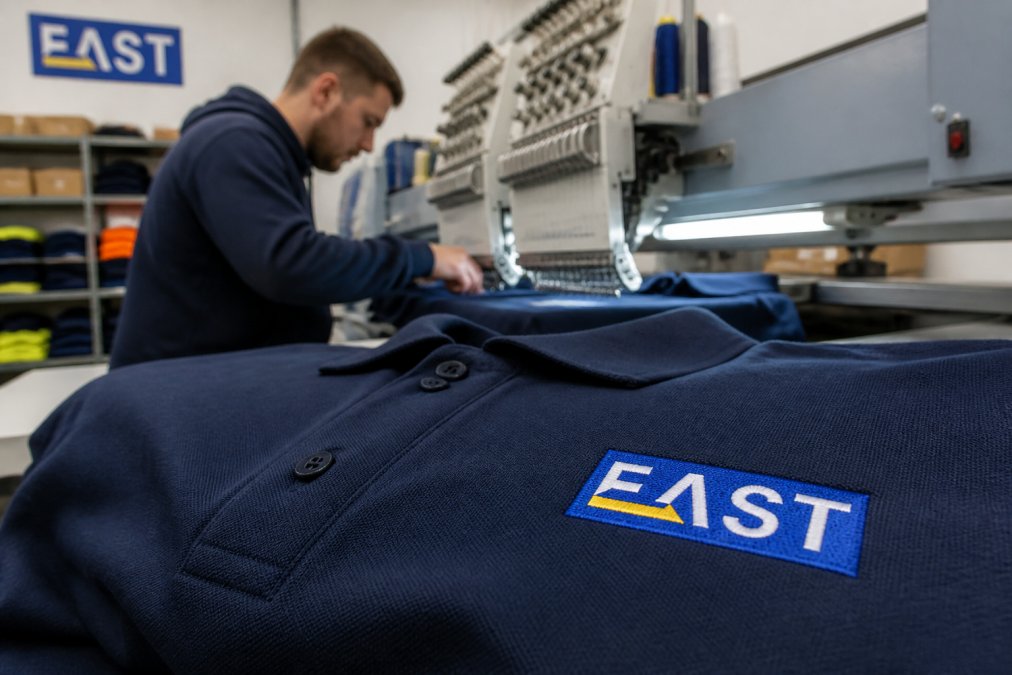
The trade-off is detail. Embroidery handles bold shapes, lettering and simple multi-colour logos well. It struggles with fine gradients and small text, which is where digitisation quality decides the result.
Good digitisation is not a file conversion. It is a decision about stitch direction, density and underlay, made by someone who knows how the logo will sit on a moving garment. Get it right and a chest logo still looks crisp after years of industrial washing.
Workwear East runs advanced embroidery machines, which matters for multi-colour logos where thread changes drive cost and lead time.
DTF Printing for Workwear: Vibrant, Wash-Resistant Logos
DTF printing for workwear produces full-colour, detailed logos that embroidery cannot match, and modern films hold up well to repeated washing when applied correctly.
DTF (direct to film) printing transfers a printed design onto the garment using a heat press. It handles gradients, photographs and fine text, and it works across cotton, poly-cotton blends and synthetics.
The cracking and peeling people complain about usually traces to application, not the method. Temperature, pressure and dwell time all have to be right, and the garment has to be clean and flat.
Where DTF wins:
- Complex, multi-colour artwork with fine detail
- Small runs where screen setup costs are hard to justify
- Mixed fabric orders where one method has to cover everything
Screen printing is cost-effective for large orders. If your order is big and simple, ask for screen printing instead.
Choosing Fabrics and Managing Bulk Orders
Fabric choice decides comfort, lifespan and how the branding behaves. The right answer depends on where the garment is worn, not on the price tag. Most competitors list fabrics without explaining the trade-offs, so here is what actually matters for different work environments.
| Fabric | Best For | Branding Notes | Wear Pattern |
|---|---|---|---|
| 100% cotton | Office and light trade | Excellent for embroidery and DTF | Soft, shrinks slightly |
| Poly-cotton blend | General workwear | Versatile, holds both methods | Low shrink, hard-wearing |
| 100% polyester | Hi-vis and sportswear | Good for sublimation and DTF | Wicks moisture, quick dry |
| Heavy canvas | Site and outdoor | Embroidery preferred | Very durable, stiff at first |
| Moisture-wicking polyester | Active roles and warm environments | Best for sublimation, can be DTF | Keeps wearer dry, quick dry |
| Recycled polyester blends | Eco-conscious operations | Embroidery and DTF both work | Similar to standard polyester |
Fabric selection guide: For construction and outdoor work, poly-cotton blends resist abrasion and hold shape. For office and light trade, cotton or poly-cotton offer comfort and a professional look.
Compliance note: Some sectors have specific fabric requirements, for example, flame-retardant clothing must meet specific standards, and hi-vis must meet the relevant British and European standards. Always confirm the garment's certification before ordering.
For bulk orders, the failure point is almost always sizing, not production. Collect sizes from staff before you order, add spares in the middle sizes, and keep a written record of who got what. That record is what makes reordering straightforward a year later. Workwear East offers Workwear Bundles and Branded Polo shirts as ready starting points, and larger operations can run everything through a Workwear Portal so staff order their own sizes against a controlled list.
Sizing, Turnaround and Looking After Your Kit
Sizing and turnaround are the two questions every buyer asks first, and both are manageable with a bit of planning. But the gap most competitors miss is care and maintenance, how to wash and maintain embroidered and printed logos so they last. Here is the full picture.
Sizing: ask for a fit sample in the sizes you use most. Men's and women's cuts vary between suppliers, and a medium in one range is a large in another. Get the sample before the bulk run, not after. For mixed teams, consider unisex styles with a size range that covers most staff, and offer a women's fit where needed. A common pattern is to order 10% extra in the middle sizes to cover new starters and replacements.
Turnaround: lead time depends on garment availability, branding method and quantity. Embroidery on stock items is typically quicker than a full custom print run. If you have a fixed event date, tell your supplier at the quote stage rather than after the order is placed. For urgent needs, ask about express options, but expect to pay more and have fewer garment choices.
Care and maintenance:
- Wash inside out at a moderate temperature (30-40°C is typical for most workwear).
- Avoid fabric softener on printed garments, it breaks down the adhesive.
- Never iron directly over a transfer or embroidery. If needed, iron on the reverse or use a pressing cloth.
- Air-dry where you can. Tumble drying on high heat shortens the life of both fabric and branding.
- For hi-vis, check reflective tape condition each time the garment is washed. Tape that has cracked or lifted needs replacing, not ignoring.
- For embroidery, trim any loose threads with scissors, do not pull them.
- For DTF prints, wait 24 hours after application before washing.
These habits add real life to any branded garment. A well-maintained embroidered polo can last years; a poorly maintained one can look tired in months.
Compliance reminder: if your workwear is PPE, you must maintain it in good condition and replace it when damaged.
Conclusion
Getting uniforms right takes planning, and most of the risk sits in sizing, fabric choice and lead time rather than in the branding itself. Workwear East handles embroidery, DTF and screen printing in-house, offers hi-vis and PPE alongside corporate clothing, and runs workwear portals for teams that need staff to manage their own orders. Email info@workweareast for a quote or visit workweareast.co.uk to see the full range.
Frequently Asked Questions
What are the benefits of embroidered workwear for local businesses?
Embroidery gives a durable, premium finish that holds up to repeated washing and daily wear, so logos stay sharp for the life of the garment. For local businesses, it reinforces a professional appearance and brand identity with customers and suppliers. Workwear East uses multi-colour embroidery machines for intricate designs on polos, hoodies and jackets, and can manage sizes across departments through a workwear portal. Email info@workweareast for a quote tailored to your team.
How do I choose the right fabric for industrial workwear?
Match the fabric to the job. Poly-cotton blends resist shrinking and hold colour well for everyday uniforms, while heavier cotton or canvas suits trade roles where abrasion is constant. Consider breathability for indoor work and water resistance for outdoor shifts. If you are unsure, tell Workwear East your working conditions and they will recommend suitable durable fabrics.
What is the difference between DTF printing and screen printing for uniforms?
DTF printing transfers full-colour, detailed images onto many fabric types, making it ideal for small runs and complex artwork. Screen printing applies ink through a mesh screen and is cost-effective for large orders with simple designs. Both produce vibrant, long-lasting results when applied correctly. Workwear East offers both methods, so you can choose based on design complexity, order size and garment type. Visit workweareast.co.uk to see examples.
How can branded workwear improve staff professionalism?
Uniforms signal that your team is organised, approachable and accountable. Staff in branded corporate apparel are easier for customers to identify, which builds trust during site visits and in public-facing roles. A consistent look also reinforces brand identity across departments and locations. Workwear East supplies embroidered and printed garments that withstand daily wear, helping small firms in Thetford and across Norfolk present a professional image without replacing kit every few months.