 How-to
Embroidery Suffolk: Your Complete Ordering Guide
Last Updated: October 22, 2026
Quick Summary
Embroidery Suffolk businesses order through Workwear East by emailing info@workweareast with their logo and garment list. We digitise your artwork, send a proof to approve, then confirm garments and sizes before production. Nothing is stitched until you have approved both the proof and the size breakdown.
- Embroidery stitches logos into the fabric, so it outlasts surface prints on daily-wear uniforms.
- Ask for a stitched sample of your logo before committing to a full run.
- Piqué cotton polos are the safest garment choice because the weave holds a crest cleanly.
- Wash embroidered workwear inside out on a cool cycle and never iron directly on the stitching.
- Unapproved artwork and missing size breakdowns cause most order delays, so sort both first.
Table of Contents
- Why Embroidered Workwear Works for Suffolk Businesses
- Embroidery vs Printing on Workwear: Which Suits Your Team?
- How to Prepare a Logo for Embroidery
- Choosing Garments for Embroidery Suffolk Teams Will Wear Daily
- How to Care for Embroidered Workwear
- The Step-by-Step Ordering Process
- Conclusion
- Frequently Asked Questions
Why Embroidered Workwear Works for Suffolk Businesses
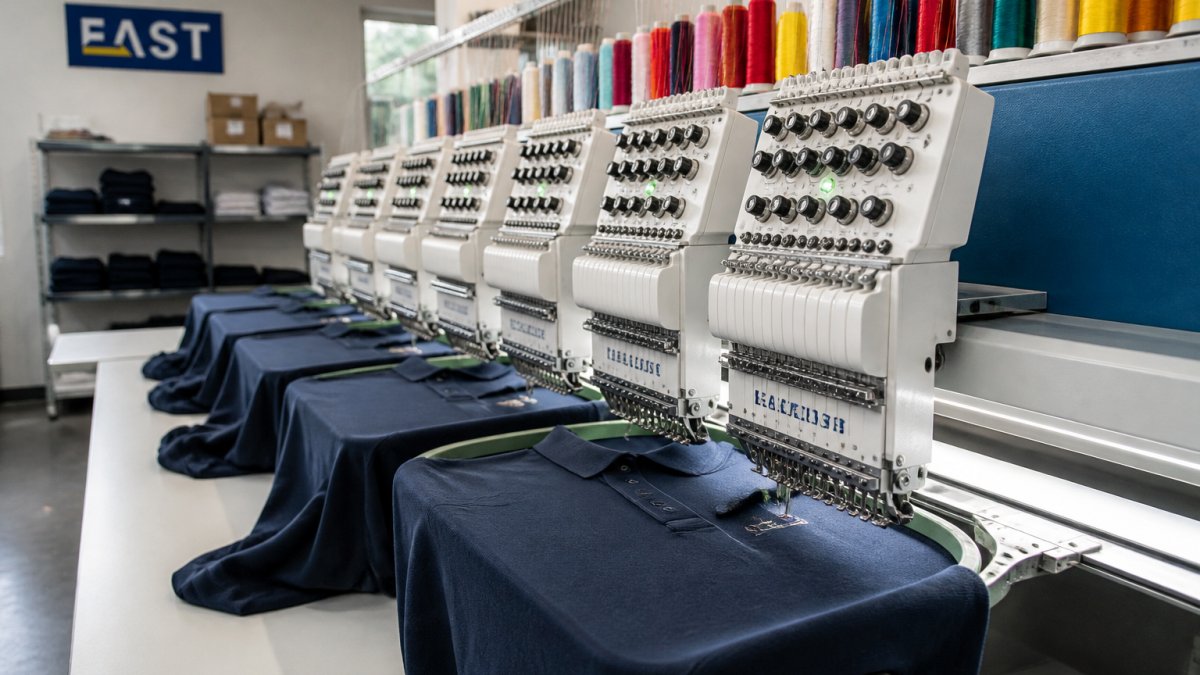
Embroidery does more than put a logo on a shirt. It turns a standard uniform into a walking advert, and it lasts. At Workwear East, we see the difference a clean, stitched crest makes to how a trade firm or shop front is judged on first contact.
A logo that survives a hundred washes beats a printed badge that peels by month three. That is the core argument of this guide.
Stitched branding sits in the fabric. It does not sit on top of it. That single fact drives everything else: how long it lasts, how it feels, and why so many businesses choose it for daily-wear uniforms.
Three things make it work for local firms:
- It holds colour and shape far longer than surface prints
- It looks sharp on polo shirts, sweatshirts, hoodies and jackets
- It suits team clothing that gets worn hard, week after week
Embroidery vs Printing on Workwear: Which Suits Your Team?
The right method depends on the design, the fabric and how often the garment gets worn. Embroidery stitches a logo into the cloth. Printing lays colour on the surface. Each has a clear job.
Embroidery is the better pick for logos, monograms and small crests that need to survive heavy use. Printing wins when the design has fine detail, gradients or lots of colours.
Here is how they compare in practice:
| Factor | Embroidery | Printing (DTF/Screen) |
|---|---|---|
| Best for | Logos, crests, monograms | Full-colour, detailed artwork |
| Durability | Very high, sits in the fabric | Good, depends on care |
| Feel | Textured, raised stitch | Smooth, flat finish |
| Great on | Polos, hoodies, jackets, hi-vis | T-shirts, aprons, merchandise |
| Colour range | Limited by thread stock | Near unlimited |
How to Prepare a Logo for Embroidery
A clean logo file is the difference between crisp stitching and a muddled result. Embroidery cannot render every fine line, so artwork needs preparing before it goes near a machine.
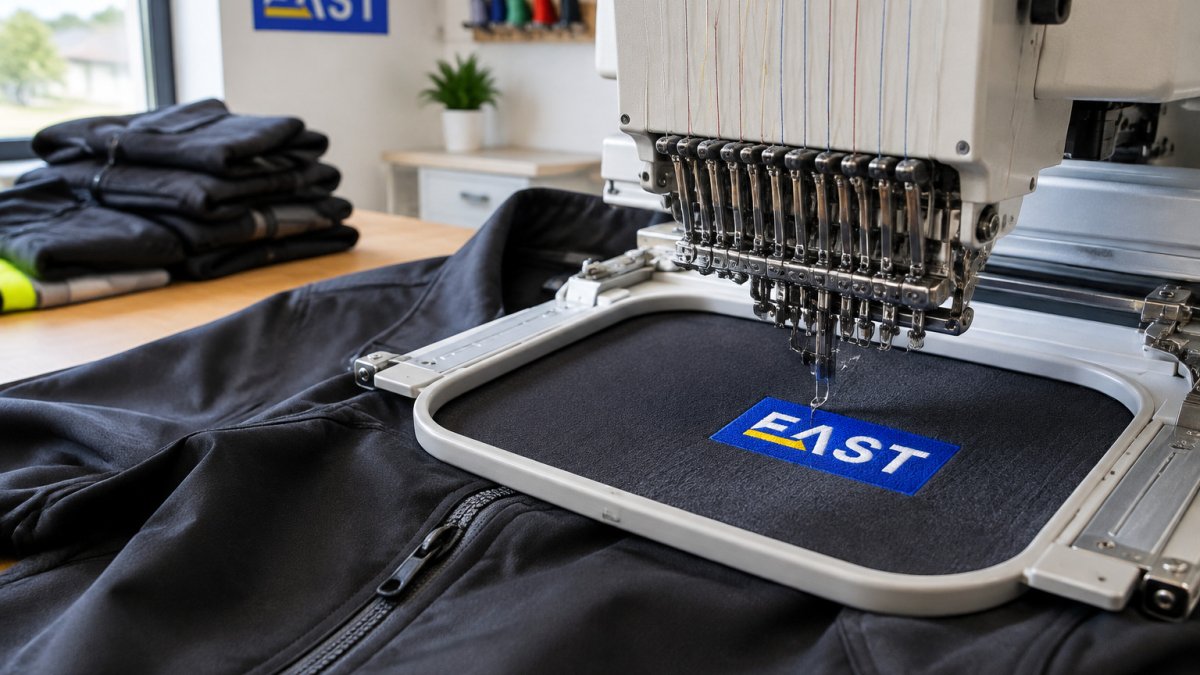
Digitising is the process of converting your logo into a stitch file the machine can follow. It sets the stitch count, the path the needle takes and the thread colours.
What we need from you:
- Vector files (AI, EPS, PDF) where possible
- A high-resolution PNG or JPG if vector is not available
- Clear colour references
- Any small text checked for legibility
Small text is the usual sticking point. Letters under a few millimetres tall lose detail in thread. We often simplify or enlarge text so it stays readable.
Choosing Garments for Embroidery Suffolk Teams Will Wear Daily
Garment choice decides whether staff actually wear the uniform or leave it in a locker. Fabric, fit and weight matter as much as the logo, and some fabrics simply do not take dense stitching well. This is the part most guides skip, so here is the plain-English version.
For daily wear, heavier fabrics hold embroidery better and keep their shape. Lightweight fabrics can pucker around dense stitching. We match the garment to the job:
- Polo shirts for office, retail and front-of-house teams
- Sweatshirts and hoodies for cooler months and site work
- Jackets for outdoor and trade roles
- Hi-vis clothing for construction and industrial crews
- Aprons and overalls for kitchens, workshops and warehouses
Fabric suitability: what stitches well and what does not
Embroidery pulls thread through the weave, so the cloth has to be able to carry the load. As a rule of thumb:
- Piqué cotton polos are the safest bet, the weave is stable and holds a crest cleanly.
- Heavy cotton and poly-cotton sweatshirts take dense logos well and keep their shape through repeated washing.
- Softshell and bonded jackets need a backing layer; stitching straight onto a bonded face can pucker or delaminate.
- Fine knits, lightweight viscose and thin performance tees are the usual problem fabrics. A dense logo can distort the drape or pull the knit out of shape.
- Waterproof and coated fabrics need specialist handling, every stitch is a potential leak point, so placement and backing matter more than stitch count.
When embroidery is the wrong choice
Stitching is not always the answer, and saying so saves everyone time:
- Very fine detail and small text. Letters under a few millimetres tall lose legibility in thread. If the logo relies on hairline strokes, a print method will reproduce it better.
- Gradients and photographic artwork. Thread is solid colour; blends and photos need printing.
- High-colour designs. Each thread colour adds a setup step, so a ten-colour logo is often better printed.
- Delicate or stretch fabrics. Lightweight tees and performance base layers can distort around dense stitching.
- Tight placement areas. Cuffs, narrow plackets and pocket edges leave no room for a clean stitch path.
Where embroidery is unsuitable, we will say so and suggest a print method instead. A mixed order, stitched crests on polos, printed detail on tees, is often the most practical answer.
Colour, sizing and fit
Colour options matter too. A dark navy or black hides marks well on site. Lighter shades suit corporate uniforms and look sharp with a contrasting thread. We keep a stock range that covers most team needs, and we can advise on fabric suitability for each role.
Sizing is where orders go wrong. For larger teams, our Workwear Portals let staff pick their own sizes within a set range, which removes most of the guesswork.
How to Care for Embroidered Workwear
Embroidered garments last for years when washed and stored with a little care. The stitching is tough, but heat and harsh chemicals shorten any garment's life.
Follow these habits:
- Wash inside out on a cool cycle
- Avoid bleach and fabric softener on stitched areas
- Tumble dry on low or air dry
- Iron on the reverse, never directly on the stitching
- Store folded rather than on a tight hanger
Caring for embroidered workwear this way keeps thread colours bright and stops the fabric around dense stitching from pulling. For hi-vis and industrial gear, check the garment's own care label first, since some fabrics have specific rules.
A small repair early beats replacing a whole garment. Loose threads can be trimmed and secured before they unravel.
The Step-by-Step Ordering Process
Ordering embroidery is straightforward when each step is clear. Here is how we run it from first enquiry to delivery, including the local logistics that decide whether your team is kitted out on time.
- Send your logo and brief. Email info@workweareast for a quote with your artwork and garment list. Tell us the roles, the quantities and your deadline, that shapes everything downstream.
- We digitise and proof. You get a design proof to approve before anything is stitched. The proof shows stitch count, thread colours and placement, so you can catch problems on screen rather than on 50 polo shirts.
- Choose garments and sizes. We confirm fabric, colour options and a size breakdown across your team. A fitting sample is worth arranging for larger orders.
- Approve and order. Once the proof and sizes are signed off, we move to production. Nothing is stitched until you have approved both.
- Production and quality check. Each garment is checked for stitch quality and placement before it is packed.
- Delivery or collection. We arrange delivery or collection to suit your schedule.
Coverage, collection and delivery
We work with businesses, from town-centre retailers and offices to trade firms, workshops and industrial sites. Whether your team is spread across one site or several, the practical questions are the same:
- Delivery to one address or several? Bulk orders can ship to a single hub, or we can split consignments across sites so each team gets its own sizes.
- Collection. If you would rather collect, say so when you enquire and we will confirm what is ready and when.
- Repeat orders. Once your artwork is digitised and your size breakdown is on file, reordering is much faster, the setup work is already done.
- Deadlines. Tell us your date early. Turnaround depends on quantity and stock, and rush orders are possible when the artwork and sizes are ready to go.
What slows an order down
Most delays come from two things: unapproved artwork and missing size breakdowns. A low-resolution logo has to be redrawn before digitising, and a vague size list means back-and-forth before production. Get both sorted at step one and the rest of the order runs smoothly.
For larger teams, our Workwear Portals make repeat ordering simple, letting staff pick their own sizes within a set range. You can also browse branded polo shirts and hi-vis to start building a bundle.
Conclusion
Getting branded uniforms right takes a little planning, but the payoff is a team that looks sharp and a logo that lasts. The challenge is avoiding the delays and sizing problems that trip up so many orders.
Workwear East handles the whole process, from logo digitising and design proofs to durable embroidery, DTF printing and screen printing on garments built for daily wear. We are focused on consistent, high-quality results.
Email info@workweareast for a quote, or visit workweareast.co.uk to get started and give your team workwear that holds up.
Frequently Asked Questions
What is the difference between embroidery and printed workwear?
Embroidery stitches thread directly into the fabric, creating a raised, textured finish that holds up well to repeated washing and heavy daily wear. Printing, including DTF and screen printing, lays colour onto the surface and suits detailed multi-colour graphics or large back prints. For small chest logos on polo shirts or sweatshirts, embroidery tends to last longer. For full-colour promotional designs, printing often gives more flexibility. Many teams combine both on the same garment.
How do I prepare a logo for embroidery?
Send the highest-resolution version you have, ideally a vector file such as EPS, AI or PDF, because these scale cleanly. If you only have a JPG or PNG, a clear high-resolution copy can usually be redigitised. Avoid screenshots or images pulled from a website. Small text and fine detail may need simplifying so the stitches stay legible. A design proof is normally supplied before production so you can approve colours and sizing first.
How should I care for embroidered workwear?
Wash embroidered garments inside out on a cool or moderate cycle and avoid fabric conditioner, which can soften the backing. Turn the garment inside out before ironing and never press a hot iron directly onto the stitching. Tumble drying on high heat can shrink backing and distort the design, so air drying is safer. Check the care label on each garment, since fabric type affects the right temperature. Following these steps keeps logos sharp for far longer.
Can small text and detailed logos be embroidered?
Very small text and fine lines are the hardest things to embroider well, because each letter needs a minimum number of stitches to stay readable. Tiny serif fonts and thin outlines often blur together. The usual fix is to simplify the artwork: increase the text size, switch to a cleaner sans-serif font, or remove very fine detail. A supplier can advise on what will work at your intended logo size before anything is stitched.