 ultimate-guide
Screen Printing for Apparel: Benefits for Bulk Orders
Table of Contents
- What Screen Printing Offers for Apparel
- How the Screen Printing Process Works
- Cost-Effectiveness and Economies of Scale in Screen Printing Bulk Orders
- Durability of Screen Printed Apparel Through Wash Cycles
- Screen Printing vs Embroidery for Workwear
- Vibrant Colour and Design Complexity in Screen Printing
- Design File Preparation and Print Registration
- Turnaround Time and Production Scheduling
- Pros and Cons of Screen Printing for Apparel
- Frequently Asked Questions
Screen Printing for Apparel: Benefits for Bulk Orders
Last Updated: August 4, 2026
Understanding the benefits of screen printing for apparel remains essential for businesses planning bulk uniform orders, promotional merchandise, or branded workwear. At Workwear East, we've worked with construction firms, event coordinators, and corporate teams across Norfolk who need durable, professional-looking apparel that survives months of daily wear. Screen printing delivers vibrant, long-lasting results at a cost per unit that becomes increasingly attractive as order quantities grow.
This guide covers everything you need to decide whether screen printing is right for your team, from the mechanics of the process to realistic durability expectations and how it compares to embroidery and digital alternatives.
What Screen Printing Offers for Apparel
Screen printing is a stencil-based printing method that forces ink through a fine mesh screen onto fabric. The process creates a direct, durable deposit of colour that bonds with the garment fibres rather than sitting on the surface. This is why screen-printed logos on workwear often outlast digital alternatives, the ink becomes part of the textile.
The method excels at producing vibrant, opaque prints with excellent colour saturation. Whether you're printing a single spot colour or complex multi-colour designs using halftone separation techniques, screen printing delivers consistent results across hundreds or thousands of units. The thick ink deposit resists fading even after repeated washing and industrial laundering.
Setup requires creating a stencil for each colour in your design. A five-colour logo requires five separate screens. The initial screen preparation is labour-intensive, which explains why screen printing makes economic sense only for bulk orders. For a 50-shirt run, the per-unit cost is significantly higher than for 500 shirts, where the setup cost spreads across many more units.
How the Screen Printing Process Works
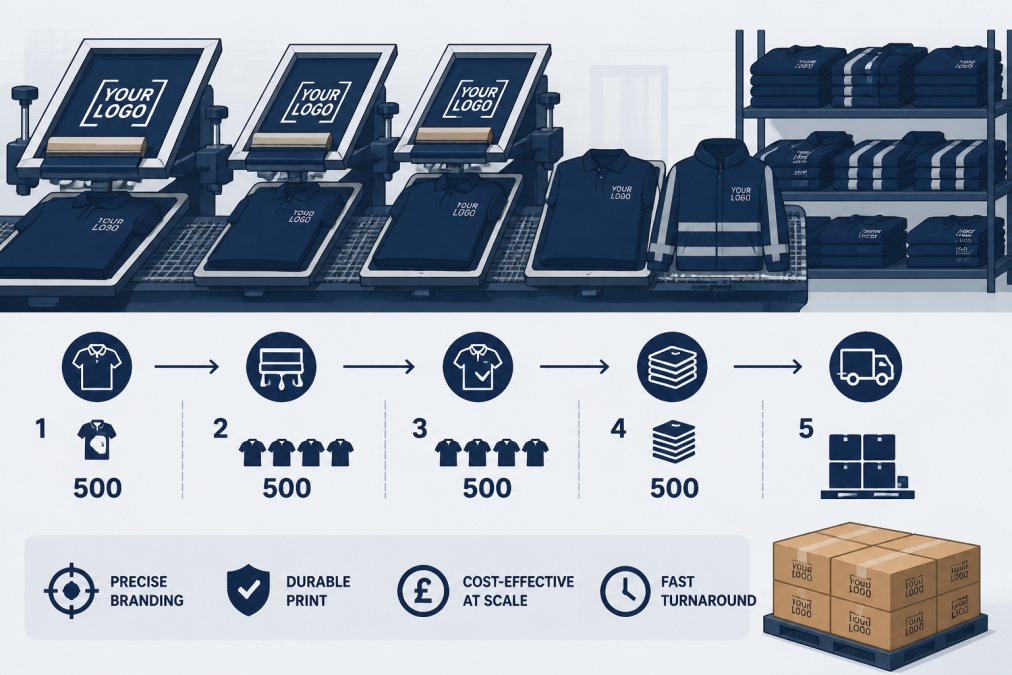
The screen printing process begins with design preparation. Your artwork must be converted into vector format with clean, scalable lines. Raster artwork (photographs, complex gradients) cannot be screen printed directly; it must first be converted through colour separation, a technique that breaks the image into individual spot colours or halftone dots.
Once your design is ready, the printer creates a separate mesh screen for each colour. The screen is coated with photosensitive emulsion, exposed to UV light using your design as a stencil, and washed to remove unexposed emulsion. This leaves open mesh where ink will pass through and blocked mesh where it won't.
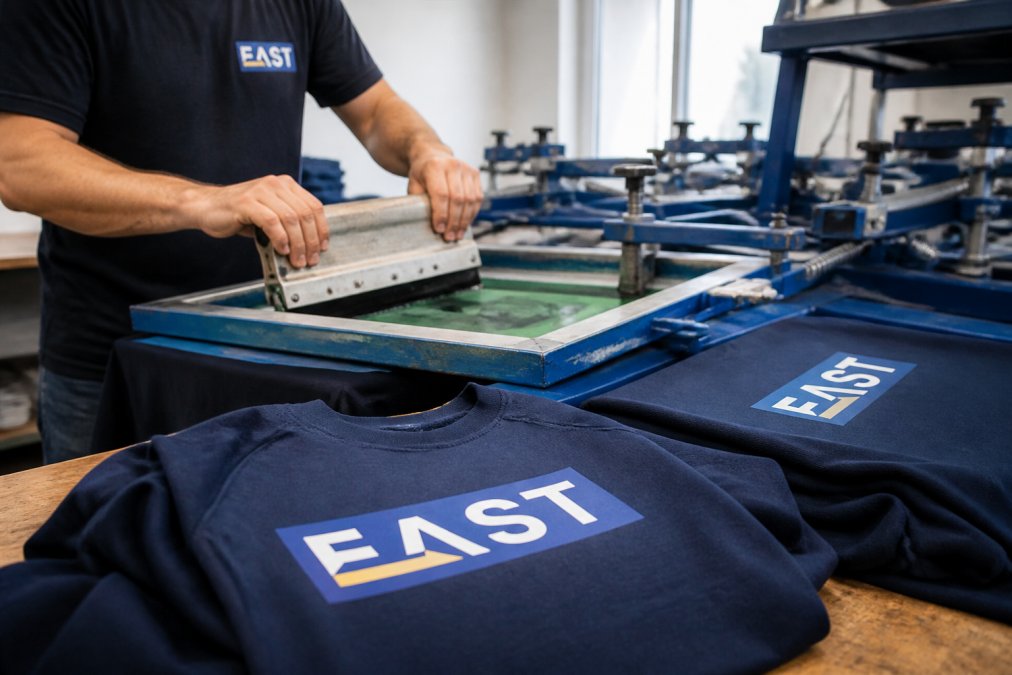
Printing itself is straightforward. The garment is positioned on a flat press, the screen is lowered onto the fabric, and a squeegee pushes ink through the open mesh. For multi-colour designs, registration (alignment of each colour layer) is critical; misalignment produces blurred or offset logos.
After printing, garments move to a heat source to cure the ink. Plastisol inks, the most common type, require temperatures around 160°C to fully cure and bond with the fabric. The curing step makes the print permanent; uncured ink will crack and peel within a few washes.
Cost-Effectiveness and Economies of Scale in Screen Printing Bulk Orders
Screen printing has high fixed costs (screen creation, setup, design preparation) and low variable costs (per-garment labour, ink, substrate). This creates a steep economies-of-scale curve: the first 50 shirts absorb most of the setup expense; the 500th shirt costs a fraction of the first.
Setup Costs Versus Per-Unit Pricing
Setup costs vary depending on screen size and supplier. These are one-time costs per design.
Once screens are made, per-unit costs drop dramatically. Adding one more shirt to a 100-unit run costs only the garment itself, negligible ink, and a few seconds of labour. Compare this to embroidery, where every unit requires needle time, or digital printing, where each shirt is a separate print job with setup overhead.
The crossover point where screen printing becomes cheaper than alternatives typically occurs around 50-100 units, depending on design complexity and garment cost.
When Bulk Orders Justify the Investment
Screen printing justifies itself when you're ordering at least 50 units of the same design. For 100+ units, the per-unit cost advantage becomes substantial. At 500 units, setup costs are nearly invisible on a per-shirt basis.
This is why workwear bundles and corporate uniform orders are ideal screen printing candidates. A construction firm ordering 40 polo shirts for staff, a retail chain needing 200 branded t-shirts for an event, or a manufacturing facility outfitting 150 employees with safety-compliant work apparel all benefit from screen printing's cost structure.
Small orders (under 50 units) should consider embroidery or digital printing instead. The lower setup costs and per-unit flexibility make those methods more economical for limited quantities.
Durability of Screen Printed Apparel Through Wash Cycles
Durability is where screen printing truly separates itself from cheaper alternatives. A well-executed screen print, proper ink deposit, correct curing, and appropriate fabric choice, will outlast the garment itself.
Wash Fastness and Ink Deposit Quality
Wash fastness refers to the print's resistance to fading and degradation through repeated laundering. Screen printing achieves excellent wash fastness because the ink penetrates the fabric fibres rather than sitting on the surface. Plastisol inks bond chemically during curing, while water-based inks achieve similar durability if properly cured.
The ink deposit, the thickness of ink laid down during printing, is measurable and controllable. A thicker deposit provides a more opaque, vibrant print that resists fading longer. Professional screen printers adjust squeegee pressure, ink viscosity, and mesh thread count to achieve the desired deposit thickness.
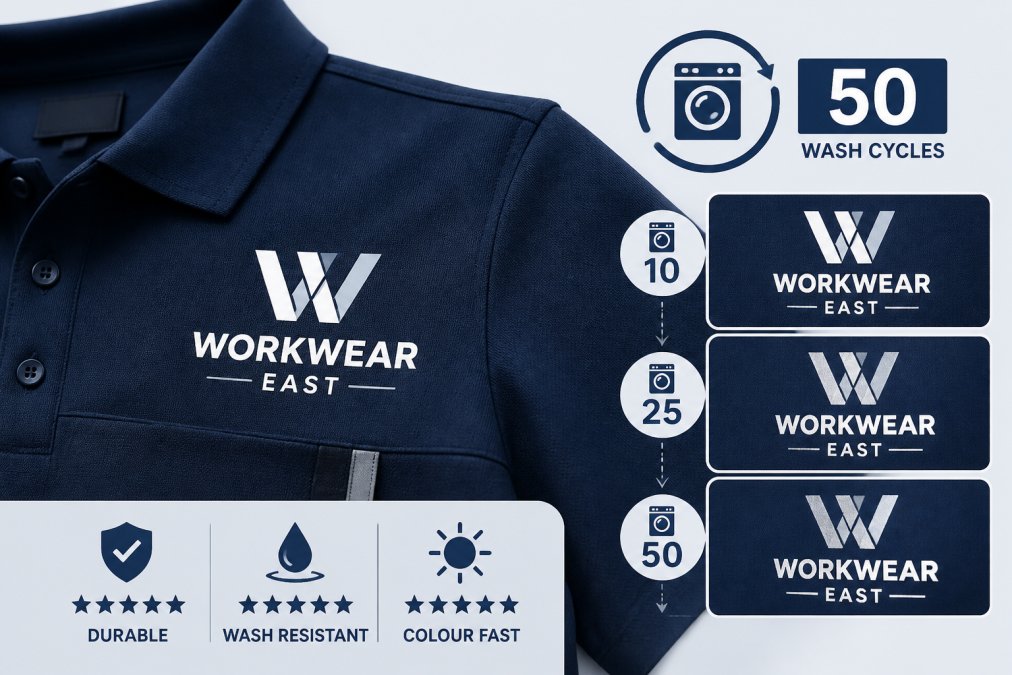
Proper curing is non-negotiable. Fully cured plastisol ink typically survives 50+ industrial wash cycles without significant fading. For workwear applications, where garments endure regular commercial laundering, this durability is essential.
Garment Longevity for Workwear Applications
Construction workers, warehouse staff, and manufacturing employees subject their workwear to harsh conditions: abrasion, sweat, industrial detergents, and heat. A screen-printed logo on a well-made work shirt will remain sharp and vibrant long after the garment's seams have weakened or fabric has thinned from use.
This durability translates directly to professional appearance and brand consistency. A team wearing faded, peeling logos looks unprofessional. A team in crisp, vibrant branded apparel projects competence and attention to detail. For client-facing roles, delivery drivers, and field technicians, this matters significantly.
Workwear East specialises in durable, professional workwear solutions designed for exactly these conditions. Our screen printing process ensures that logos remain sharp through months of daily wear, maintaining your brand's professional image across your workforce.
Screen Printing vs Embroidery for Workwear
Both screen printing and embroidery produce durable, professional results. The choice depends on design complexity, order quantity, and aesthetic preference.
Embroidery uses needle and thread to create a raised, textured logo. It's inherently durable and produces a premium appearance. Embroidery works exceptionally well for simple logos and monochromatic designs but cannot reproduce fine detail, complex gradients, or photographic images. Each unit requires needle time, making per-unit costs relatively constant regardless of order size.
Screen printing excels at multi-colour designs, fine detail, and large order quantities. It produces a smooth, flat finish and can reproduce complex artwork. The per-unit cost advantage grows with order size. Screen printing cannot reproduce the premium tactile quality of embroidery.
When to Choose Screen Printing Over Embroidery
Choose screen printing when:
- Your design includes multiple colours (more than two)
- You're ordering 50+ units of the same design
- Your logo includes fine detail or small text
- You want a flat, smooth finish
- Budget is a primary concern for large orders
Choose embroidery when:
- Your design is simple and monochromatic
- You're ordering fewer than 50 units
- You want a premium, high-end appearance
- You prefer raised texture and tactile quality
For most bulk workwear orders in the 50-500 unit range, screen printing offers better value and faster turnaround.
Vibrant Colour and Design Complexity in Screen Printing
One of the most visible benefits of screen printing for apparel is the vibrant, opaque colour reproduction it achieves. The thick ink deposit and direct contact with fabric create saturation that digital printing struggles to match.
Spot Colour Versus Halftone Reproduction
Spot colour printing uses solid, pre-mixed inks for each colour in your design. A navy blue logo is printed with navy blue ink, producing maximum vibrancy and requiring no colour separation beyond creating one screen per colour.
Halftone reproduction breaks a multi-colour or photographic image into tiny dots of individual colours. When viewed from a distance, the dots blend optically to create the appearance of continuous colour gradients. Halftone allows screen printing to reproduce photographs and complex artwork but requires precise registration and fine mesh screens.
Most corporate logos are spot colour designs, ideal for screen printing. Complex photographic designs are better suited to digital printing methods.
Opacity and Colour Separation Techniques
Opacity, the degree to which the print obscures the underlying fabric, is controlled through ink deposit thickness and colour choice. Dark inks on light fabrics achieve full opacity with a single pass. Light inks on dark fabrics require either a white underbase or acceptance of reduced opacity.
Colour separation is the process of breaking a multi-colour design into individual screens. Professional screen printers use digital colour separation to ensure consistent, accurate results across large production runs. This is why working with an experienced printer matters, amateur operations produce inferior prints.
Design File Preparation and Print Registration
Your design file must meet specific requirements for successful screen printing. Submitting artwork in the wrong format leads to delays, reprints, or poor quality.
Vector Artwork Requirements and Substrate Compatibility
Screen printing requires vector artwork, scalable, resolution-independent files created in Adobe Illustrator, CorelDRAW, or similar software. Raster artwork (photographs, Photoshop artwork) cannot be directly screen printed and must first be converted to vector format through tracing or colour separation.
Your design file should include:
- All text converted to outlines
- Colours specified as solid spot colours
- Artwork at actual print size or clearly marked with dimensions
- Separate layers for each colour
- No embedded images or linked files
Substrate compatibility refers to the fabric's suitability for screen printing. Cotton and cotton-blend fabrics are ideal. Synthetic fabrics require slightly different inks and curing temperatures. Very smooth, tightly woven fabrics can cause ink adhesion issues; rougher weaves accept ink more readily.
Print registration, the alignment of multiple colours, becomes critical with multi-colour designs. Misalignment by even 2-3 millimetres produces visible gaps or colour shifts. Professional equipment maintains registration within 1 millimetre across large print runs.
Turnaround Time and Production Scheduling
Screen printing turnaround times depend on design complexity, order size, and current workload.
Turnaround times vary based on design complexity, order size, and current workload. Rush orders are possible but may incur additional costs. Accelerating design approval, screen creation, and printing adds labour cost and reduces quality assurance time.
Workwear East can advise on realistic turnaround for your specific project. For accurate timelines and to discuss your order requirements, email info@workweareast for a quote.
Pros and Cons of Screen Printing for Apparel
Screen printing excels in certain applications and has clear limitations in others.
Pros of screen printing:
- Exceptional durability: prints survive 50+ industrial wash cycles without fading
- Vibrant colour reproduction, especially for spot colours
- Excellent value for bulk orders (100+ units)
- Versatile: works on cotton, blends, and some synthetics
- Simple designs print quickly once screens are made
- Opaque, professional appearance that stands out
- Ideal for promotional merchandise and corporate uniforms
Cons of screen printing:
- High setup costs make small orders (under 50 units) uneconomical
- Cannot reproduce photographic detail or fine gradients without halftone complexity
- Requires vector artwork; raster files need conversion
- Multi-colour designs require multiple screens and careful registration
- Not suitable for one-off or highly customised orders
- Requires proper curing equipment; undercured prints fail quickly
For bulk workwear, promotional apparel, and corporate uniforms, screen printing's durability and cost advantages far outweigh the limitations. For small orders, custom designs, or photographic artwork, digital printing or embroidery are better choices.
The real challenge isn't finding a printer who can screen print, it's finding one who understands your specific needs and delivers consistent quality across large production runs. Workwear East combines advanced screen printing capabilities with the local service and attention to detail that construction firms, event coordinators, and corporate teams across Norfolk depend on. Our team ensures that every logo is sharp, every colour is vibrant, and every garment meets your durability expectations.
Ready to discuss your screen printing project? Visit workweareast.co.uk or email info@workweareast for a quote tailored to your order size and specifications.
Frequently Asked Questions
Why is screen printing better than digital printing for apparel?
Screen printing excels at producing vibrant, durable prints on bulk orders because it deposits a thicker ink layer onto the fabric. This creates superior wash fastness and opacity compared to digital methods. For large production runs, screen printing also offers better economies of scale once setup costs are absorbed. Digital printing suits small runs and complex multi-colour designs, but screen printing dominates for branded workwear where durability and cost per unit matter most.
Is screen printing durable for workwear and industrial apparel?
Yes. Screen-printed apparel withstands repeated industrial washing and daily wear because plastisol and water-based inks bond effectively to fabric fibres. Proper curing during the screen printing process ensures the ink deposit remains flexible and resists cracking. For workwear that faces frequent washing and harsh conditions, screen printing typically outperforms other methods. Garment longevity depends on ink quality, curing temperature, and substrate choice, all factors Workwear East controls in production.
What are the main advantages of screen printing for large orders?
Bulk orders benefit from screen printing's cost-effectiveness because setup costs (mesh screen preparation, colour separation, stencil creation) are spread across many units. Per-unit pricing drops significantly at volumes of 50+ items. The process also ensures consistent print registration and colour reproduction across the entire run. For businesses ordering branded uniforms or promotional merchandise in quantity, screen printing delivers durability, vibrancy, and economies of scale that justify the initial investment.
How does screen printing affect the feel and weight of fabric?
Screen printing adds a noticeable texture and slight weight to the garment, especially with plastisol inks. The ink deposit creates a raised surface that some wearers prefer for its tactile quality and perceived durability. Water-based inks produce a softer hand-feel because they absorb into the fabric rather than sitting on top. The choice between ink types affects both comfort and longevity. Workwear East can advise on ink selection based on your garment type and end-use requirements.
This article was written using GrandRanker